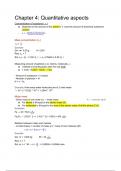
Chapter 4: Quantitative aspects
Concentration of solutions ( c )
■ Depends on the amount of the solvent ( V ) and the amount of dissolved substance
(solute)
𝑎𝑚𝑜𝑢𝑛𝑡 𝑜𝑓 𝑠𝑢𝑏𝑠𝑡𝑎𝑛𝑐𝑒 (𝑚)
- c= 𝑎𝑚𝑜𝑢𝑛𝑡 𝑜𝑓 𝑠𝑜𝑙𝑣𝑒𝑛𝑡 (𝑉)
Mass-concentration (cm)
𝑚
cm = 𝑉
Example
Giv: m= 5,00 g V= 2,00 l
Req: cm = ?
𝑚 𝑔 𝑔
Sol: cm= 𝑉
= 2,50 𝑙
( → cm of NaCl is 2,50 𝑙
)
Measuring amount of particles ( ex. Atoms, molecules,..)
■ Instead of counting each atom we use mole
■ 1 mole = 6,022 * 1023 ( → NA)
- Amount of substance = n (mole)
- Number of particles = N
N = n * NA
Example: How many water molecules are in 2 mole water
→ N = 2 * 6,022 * 1023 = 1,2044 * 1024
Molar mass
- Given mass of one mole (n) → molar mass Ar → periodic table
■ For atoms is M equal to the atomic mass (Ar)
■ For molecules is M equal to the sum of the atomic mass of all the atoms (Σ Ar)
Examples
𝑔
Fe → M = 55,8 𝑚𝑜𝑙𝑒
𝑔
Fe2O3 → ( 55,8 * 2 ) + ( 16,0 * 3) = 159,6 ≈ 160 𝑚𝑜𝑙𝑒
Relation between moles and masses
- m (total mass) = number of moles (n) * mass of one molecule (M)
𝑚
( m = n * N or n = 𝑀
)
Example
𝑔
Giv: m = 1,000 kg M = 18 𝑚𝑜𝑙𝑒
Req: n = ?
𝑚
Sol: m = n * M → n = 𝑀
= 0,05555 ≈ 0,0556 mole
Concentration of solutions ( c )
■ Depends on the amount of the solvent ( V ) and the amount of dissolved substance
(solute)
𝑎𝑚𝑜𝑢𝑛𝑡 𝑜𝑓 𝑠𝑢𝑏𝑠𝑡𝑎𝑛𝑐𝑒 (𝑚)
- c= 𝑎𝑚𝑜𝑢𝑛𝑡 𝑜𝑓 𝑠𝑜𝑙𝑣𝑒𝑛𝑡 (𝑉)
Mass-concentration (cm)
𝑚
cm = 𝑉
Example
Giv: m= 5,00 g V= 2,00 l
Req: cm = ?
𝑚 𝑔 𝑔
Sol: cm= 𝑉
= 2,50 𝑙
( → cm of NaCl is 2,50 𝑙
)
Measuring amount of particles ( ex. Atoms, molecules,..)
■ Instead of counting each atom we use mole
■ 1 mole = 6,022 * 1023 ( → NA)
- Amount of substance = n (mole)
- Number of particles = N
N = n * NA
Example: How many water molecules are in 2 mole water
→ N = 2 * 6,022 * 1023 = 1,2044 * 1024
Molar mass
- Given mass of one mole (n) → molar mass Ar → periodic table
■ For atoms is M equal to the atomic mass (Ar)
■ For molecules is M equal to the sum of the atomic mass of all the atoms (Σ Ar)
Examples
𝑔
Fe → M = 55,8 𝑚𝑜𝑙𝑒
𝑔
Fe2O3 → ( 55,8 * 2 ) + ( 16,0 * 3) = 159,6 ≈ 160 𝑚𝑜𝑙𝑒
Relation between moles and masses
- m (total mass) = number of moles (n) * mass of one molecule (M)
𝑚
( m = n * N or n = 𝑀
)
Example
𝑔
Giv: m = 1,000 kg M = 18 𝑚𝑜𝑙𝑒
Req: n = ?
𝑚
Sol: m = n * M → n = 𝑀
= 0,05555 ≈ 0,0556 mole