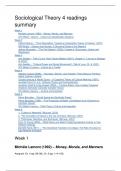
Sociological Theory 4 readings
summary
Week 1
Michèle Lamont (1992) – Money, Morals, and Manners
ST4 Week 1 lecture – Culture as Classification Systems
Week 2
Clifford Geertz – “Thick Description: Toward an Interpretive Theory of Culture” (1973)
Will Wright – Sixguns and Society: A Structural Study of the Western
Jeffrey Alexander – “The Civil Sphere” (2006), Chapter 4: Discourses: Liberty and
Repression
Week 3
Ann Swidler – Talk of Love: How Culture Matters (2001), Chapter 2: “Love as a Strategy
of Action”
Ann Swidler – “Cultural Power and Social Movements” (Talk of Love, Ch. 6, 2001)
ST4 Week 3 Lecture – Culture as a Toolkit
Week 4
Stephen Vaisey (2008) – “Socrates, Skinner, and Aristotle: Three Ways of Thinking
About Culture in Action”
Claudia Strauss & Naomi Quinn – A Cognitive Theory of Cultural Meaning (1997),
excerpts from Ch. 3–4: “Schema Theory and Connectionism”
Jonathan Haidt & Craig Joseph (2004) – “Intuitive Ethics: How Innately Prepared
Intuitions Generate Culturally Variable Virtues”
ST4 Week 4 lecture – Culture and Cognition
Week 5
Pierre Bourdieu – “Social Space and Symbolic Power”
Pierre Bourdieu (1980) – “The Production of Belief: Contribution to an Economy of
Symbolic Goods”
ST4 Week 5 lecture – Field Theory: Culture and Inequality
Week 6
1. “Culture in Networks” (McLean, 2016)
2. “The Circulation of Opera in the City of Dukes” (McLean, 2007)
3. “Patronage, Narrative, and Exchange” (McLean, 2001)
King-To Yeung (2005) – What Does Love Mean? Exploring Network Culture in Two
Network Settings
Danielle Kane (2011) – “The Gendered Transition to College: The Role of Culture in
Ego-Network Evolution”
Week 1
Michèle Lamont (1992) – Money, Morals, and Manners
Assigned: Ch. 4 (pp. 88–98), Ch. 5 (pp. 114–128)
, Central Question
How do upper-middle-class men in France and the United States draw symbolic
boundaries to distinguish themselves from others?
What criteria—moral, cultural, socioeconomic—matter most in this process?
Key Concepts
● Symbolic boundaries: conceptual distinctions used by individuals to classify people,
groups, and things.
● Social boundaries: actual social divisions, such as class or status group exclusion.
● Cultural capital: knowledge, tastes, and habits that signal belonging and distinction
(Bourdieu).
● Moral boundaries: judgments about others based on character, ethics,
responsibility.
● National repertoires: historical-cultural traditions shaping what forms of distinction
are legitimate.
🇺🇸 🇫🇷 Comparison: American vs. French Upper-Middle-Class Men
1. Moral vs. Cultural Boundaries
Americans French
Emphasize moral worth: authenticity, Emphasize cultural refinement: intellect, taste,
work ethic, integrity style
Judge others based on self-discipline, Judge others based on education, aesthetic
honesty, responsibility sensibility, intellectual ability
Are more likely to reject elitism and Are more likely to see intellectualism and
appreciate humility “distinction” as signs of worth
→ Americans draw socioeconomic and moral boundaries
→ French draw cultural boundaries
,2. Views on Wealth
● Both groups believe wealth alone is not sufficient for respect.
● However:
○ Americans are more ambivalent about the upper class; they criticize wealth
without morality.
○ French more often critique vulgarity and lack of taste rather than wealth
itself.
3. Cultural Elitism and Tolerance
● French men: more likely to be culturally exclusive—e.g., look down on popular or
mass culture.
● Americans: more culturally tolerant, but less tolerant of moral failings (e.g.,
arrogance, dishonesty).
Structural and Historical Influences
1. National Historic Repertoires
● 🇺🇸 U.S.: shaped by Protestant ethics, individualism, and populist anti-elitism
● 🇫🇷 France: influenced by aristocratic traditions, intellectualism, and centralised
culture
These cultural heritages shape which symbolic boundaries are seen as legitimate.
2. Educational and Media Systems
● French education: centralized, elitist, focused on cultural sophistication (especially
literature and philosophy)
● American education: more market-oriented, practical
● French media: public and intellectually oriented
, ● U.S. media: commercial, populist, entertainment-driven
These institutions disseminate class-specific cultural capital differently.
3. Cultural Institutions and Intellectuals
● France: strong tradition of public intellectuals; cultural legitimacy defined by elite
consensus
● U.S.: expertise more fragmented; legitimacy linked to success and productivity
Theoretical Contributions
1. Extends Bourdieu: Lamont agrees culture is used for distinction, but:
○ Emphasizes variation in how people draw boundaries.
○ Shows national culture modifies how cultural capital works.
2. Critique of Cultural Determinism: Not all elites value the same things. Cultural
practices are not entirely reducible to class position; they are mediated by national
context and personal values.
3. Moral Capital: Lamont introduces this concept as a counterpart to cultural capital—
status gained through displays of integrity, authenticity, and moral character,
especially in the U.S.
Summary for Exams
Theme France United States
Key Boundary Cultural refinement Moral worth
Elitism Accepted if based on intellect Rejected; humility and authenticity
and taste valued
Cultural Capital Classical, elite (arts, literature) Broader, but less central
summary
Week 1
Michèle Lamont (1992) – Money, Morals, and Manners
ST4 Week 1 lecture – Culture as Classification Systems
Week 2
Clifford Geertz – “Thick Description: Toward an Interpretive Theory of Culture” (1973)
Will Wright – Sixguns and Society: A Structural Study of the Western
Jeffrey Alexander – “The Civil Sphere” (2006), Chapter 4: Discourses: Liberty and
Repression
Week 3
Ann Swidler – Talk of Love: How Culture Matters (2001), Chapter 2: “Love as a Strategy
of Action”
Ann Swidler – “Cultural Power and Social Movements” (Talk of Love, Ch. 6, 2001)
ST4 Week 3 Lecture – Culture as a Toolkit
Week 4
Stephen Vaisey (2008) – “Socrates, Skinner, and Aristotle: Three Ways of Thinking
About Culture in Action”
Claudia Strauss & Naomi Quinn – A Cognitive Theory of Cultural Meaning (1997),
excerpts from Ch. 3–4: “Schema Theory and Connectionism”
Jonathan Haidt & Craig Joseph (2004) – “Intuitive Ethics: How Innately Prepared
Intuitions Generate Culturally Variable Virtues”
ST4 Week 4 lecture – Culture and Cognition
Week 5
Pierre Bourdieu – “Social Space and Symbolic Power”
Pierre Bourdieu (1980) – “The Production of Belief: Contribution to an Economy of
Symbolic Goods”
ST4 Week 5 lecture – Field Theory: Culture and Inequality
Week 6
1. “Culture in Networks” (McLean, 2016)
2. “The Circulation of Opera in the City of Dukes” (McLean, 2007)
3. “Patronage, Narrative, and Exchange” (McLean, 2001)
King-To Yeung (2005) – What Does Love Mean? Exploring Network Culture in Two
Network Settings
Danielle Kane (2011) – “The Gendered Transition to College: The Role of Culture in
Ego-Network Evolution”
Week 1
Michèle Lamont (1992) – Money, Morals, and Manners
Assigned: Ch. 4 (pp. 88–98), Ch. 5 (pp. 114–128)
, Central Question
How do upper-middle-class men in France and the United States draw symbolic
boundaries to distinguish themselves from others?
What criteria—moral, cultural, socioeconomic—matter most in this process?
Key Concepts
● Symbolic boundaries: conceptual distinctions used by individuals to classify people,
groups, and things.
● Social boundaries: actual social divisions, such as class or status group exclusion.
● Cultural capital: knowledge, tastes, and habits that signal belonging and distinction
(Bourdieu).
● Moral boundaries: judgments about others based on character, ethics,
responsibility.
● National repertoires: historical-cultural traditions shaping what forms of distinction
are legitimate.
🇺🇸 🇫🇷 Comparison: American vs. French Upper-Middle-Class Men
1. Moral vs. Cultural Boundaries
Americans French
Emphasize moral worth: authenticity, Emphasize cultural refinement: intellect, taste,
work ethic, integrity style
Judge others based on self-discipline, Judge others based on education, aesthetic
honesty, responsibility sensibility, intellectual ability
Are more likely to reject elitism and Are more likely to see intellectualism and
appreciate humility “distinction” as signs of worth
→ Americans draw socioeconomic and moral boundaries
→ French draw cultural boundaries
,2. Views on Wealth
● Both groups believe wealth alone is not sufficient for respect.
● However:
○ Americans are more ambivalent about the upper class; they criticize wealth
without morality.
○ French more often critique vulgarity and lack of taste rather than wealth
itself.
3. Cultural Elitism and Tolerance
● French men: more likely to be culturally exclusive—e.g., look down on popular or
mass culture.
● Americans: more culturally tolerant, but less tolerant of moral failings (e.g.,
arrogance, dishonesty).
Structural and Historical Influences
1. National Historic Repertoires
● 🇺🇸 U.S.: shaped by Protestant ethics, individualism, and populist anti-elitism
● 🇫🇷 France: influenced by aristocratic traditions, intellectualism, and centralised
culture
These cultural heritages shape which symbolic boundaries are seen as legitimate.
2. Educational and Media Systems
● French education: centralized, elitist, focused on cultural sophistication (especially
literature and philosophy)
● American education: more market-oriented, practical
● French media: public and intellectually oriented
, ● U.S. media: commercial, populist, entertainment-driven
These institutions disseminate class-specific cultural capital differently.
3. Cultural Institutions and Intellectuals
● France: strong tradition of public intellectuals; cultural legitimacy defined by elite
consensus
● U.S.: expertise more fragmented; legitimacy linked to success and productivity
Theoretical Contributions
1. Extends Bourdieu: Lamont agrees culture is used for distinction, but:
○ Emphasizes variation in how people draw boundaries.
○ Shows national culture modifies how cultural capital works.
2. Critique of Cultural Determinism: Not all elites value the same things. Cultural
practices are not entirely reducible to class position; they are mediated by national
context and personal values.
3. Moral Capital: Lamont introduces this concept as a counterpart to cultural capital—
status gained through displays of integrity, authenticity, and moral character,
especially in the U.S.
Summary for Exams
Theme France United States
Key Boundary Cultural refinement Moral worth
Elitism Accepted if based on intellect Rejected; humility and authenticity
and taste valued
Cultural Capital Classical, elite (arts, literature) Broader, but less central