Marketing 214
Chapter 1: An overview of marketing
What is marketing?
Marketing is the philosophy of customer satisfaction with a set of activities to implement this philosophy.
Customer satisfaction
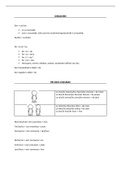
Disconfirmation paradigm:
Compare performance (p) with expectations (e)
Compare
p>e p=e p<e
Positive Negative
Confirmation
confirmation confirmation
Satisfaction Satisfaction Dissatisfaction
, The concept of exchange
Customer satisfaction /dissatisfaction Five conditions must be satisfied
Two factor model At least two parties
Hygiene factors Each party must have something of value
Basic expectation. Communicate and deliver goods
Contribute to consumer dissatisfaction.
Free to accept or reject
Satisfiers
Must want to deal
Contribute to consumer satisfaction (exceed
minimum expectation).
Needs cannot be created, only desires.
Benefits of customer satisfaction and loyalty
Lower acquisition cost
Base profit
Revenue growth
Cost savings
Referrals
Price premium
Marketing management philosophies
Orientation Focus Example
Production Internal production or manufacturing “If we build it they’ll come”
capabilities
Product Product features and quality Henry Ford: “Any colour as long as it is
black.” Unique product.
Sales Aggressive sales technique to push sales
Consumer (marketing) Thorough understanding of consumer
needs
Social marketing Satisfy consumer needs, while preserving Green marketing. Woolworths “farming
or enhancing society’s long-term interest for the future”
Relationship marketing Long-term relationships with customers, by
consistently offering value and satisfaction.
Differences between sales and marketing orientations
Focus Business Goal Tools used Directed at
Sales Inward (firm’s Selling goods and Profit through Intensive Everybody
needs) services maximum sales advertising and
volume promotion
Consumer Outward (consumer Satisfying Profit through Co-ordinated Specific groups
(marketing) needs) consumer needs customer marketing
and wants satisfaction activities
The importance of new opportunities
Steps in evaluating new opportunities
What business are we in?
Does this opportunity fall within the scope of our business?
If we pursue this opportunity will we have a sustainable competitive advantage?
The firm’s business
Generic Product market
More opportunities What?
More competitors To meet what?
Greater focus on consumer needs For whom?
Innovation and creativity Where?
Aware of changes in customer desires and preference
,Marketing myopia: Managements failure to recognise the scope of its business.
E.g.: Ster-Kinekor not just in the movie business, but in the entertainment business
The importance of a competitive advantage
Simply something a firm or product has that competing firms or products do not have.
Competitive advantages:
Service quality
Customer value
o The ratio of benefits to the sacrifice necessary to obtain those benefits.
Customer satisfaction
Customer orientated employees
Well-trained employees
Empowered employees
o Advantages:
o Quicker response to customer needs
o Employees gaining a higher sense of job satisfaction.
o Source of information about customer needs
o Improved customer satisfaction
Team work
More advantages:
o Cost
o Quality
o Flexibility
o Location
o Safety
o Image
o Product
o Design
o Distribution
Marketing process
Understand the firm’s business Critics of marketing
Set marketing objective Intermediaries
Collect, analyse and interpret information Misleading advertisements
Develop a marketing strategy
Implement the strategy Advantages of marketing (overcome discrepancies
Design performance measures and separations)
Evaluate and make changes if needed Marketing creates utility
Discrepancy of quantity
Marketing strategy: Objective, four P’s Discrepancy of assortment
Marketing plan: Strategy + allocation of resources and Spatial separation
responsibilities. A written document Separation in time
Marketing program: several marketing plans. Separation of information
Separation in ownership
Separation in value
The position and role of marketing in the firm
Marketing must be managed through: Why study marketing?
Planning (Objectives) Marketing plays an important role in society
Organising Marketing is important for business
Leading Marketing offer outstanding career opportunities
Control (Assessment) Marketing influences your everyday life
,Chapter 2: Analysing the marketing environment
Marketing’s influence in the marketing environment
Internal environment (Micro) External environment
Marketing environment Business environment Market Environment Macro environment
Marketing goals and Business mission, Suppliers Factors:
objectives objectives and activities Intermediaries Social
Planning and execution Management: Consumers Demographic
of marketing process Operations Quantitive and Economic
Marketing mix – 4P’s Financial qualitative aspects Technological
Purchasing Competitors Political
Human resources Consumerism Legal
Information
Public relations
Power of disposal over
factors of production
Direct Control High influence Limited influence No influence
Macro environment
Social factors Economic factors
Consumer values Inflation and recession
Role of families and working women Interest rate
New social trend or fad
Generation Strategies to survive recession:
o Pre-teens Improve existing products and introduce new ones
o Teenagers Maintain and expand customer services
o Generation Y Emphasise product value
o Generation X Use special offers to stimulate demand
o Baby Boomers Target new market segments
o Older consumers
Black Diamonds Technological factors
The Internet
Demographic factors
Universal Living Standards Measure (LSM)
LSM 1 lowest income (R1 269) to LSM 10 high with
highest income (R28 467)
Focus on:
Monthly income
Shopping Patterns
Consumer needs
Education an literacy
Language
,Political factors Legal factors
The right: Laws promoting competition
to basic needs Laws limiting competition
to safety Laws protecting consumer rights
to be informed
to choose Examples:
to be heard Tabaco Products control act
to redress Electronic Communications and Transactions Act
to consumer education WTO
to a healthy environment South African Customs-union (SACU)
South African development community (SADC)
Self-regulatory agencies
ASA – Advertising Standards Authority of SA Competitive factors
Advantages Constant awareness of competitive situation:
Faster international, national, within industries and across
More flexible industries.
Cheaper
Physical factors
Thank government legislation.
Climate change
Basic principles Pollution
Stay within the law Scarce resources
Claim only what you can prove Recycling of packaging
Don’t mislead Environmentally friendly ingredients
Do not disparage
Compete fairly
Act with responsibility
Do not offend
Do not steal
Do not exploit the vulnerable
Consider your neighbour.
, Chapter 3: Understanding consumer decision-making
Model of consumer behaviour
Individual factors Social factors The purchase situation
The process by which we choose Gives order to society. Why a consumer buys
stimuli, organize and interpret tar to Cultural values in advertising: something has an effect.
form a coherent picture of the Wisdom, Practicality, Family, Eg. Watch for running or as a
Purchase reason
world. Health, Sexiness
gift?
Perception
- Selective exposure Subculture:
Culture
- Selective distortion Homogeneous group of people
- Selective retention with elements of the overall
culture as well as unique
Just noticeable difference elements.
Eg. Religious subcultures,
lifestyle (eg Harley-Davidson),
etc.
What motivates consumers? Influence buying behaviour of How much time does the
Maslow's hierarchy: an individual. consumer have to buy
Self- Bases of power. something?
actual. - Information, legitimate,
Reference group
Purchase time
referent, expert
Motivation
Esteem
needs A valentine’s Day dinner is
Direct (face to face)
- Primary (Family and Friends) different from a quick meal
Social needs before a rugby match.
- Secondary (Large formal)
Indirect (non-membership)
Safety
- Aspirational (desires to be
Physiological: member)
hunger, first, shelter, sex - Non-aspirational (avoids being
identified with group)
Experiential Learning - First to use new product Surroundings may encourage
Conceptual learning - Typically influential or discourage buying.
Opinion leaders
Stimulus generalization - Often informal and personal
surroundings
- Senses
Same name for another product, - Difficult to create
Learning
automatic association with original Physical - Privacy
product. Celebrity endorsements
Stimulus discrimination Watch out for Tiger Woods,
Want to create differences. Coca Lance Armstrong, Oscar
Cola, Powerade, Bonaqua Pistorius endorsements
Product differentiation
Attitude: learned tendency to Family life cycle
respond consistently. lengthy and People have different needs in
Values, beliefs,
complex different stages of life.
attitudes
Belief: I do not believe it is a good
Family
movie
Values: guide your behavior
- Change beliefs about attributes
- Change the importance of beliefs
- Add new beliefs
Personality Nearly equal in status or
self-concept,
Personality,
+ community esteem.
Social class
lifestyle
Self-concept E.g. in America we have:
= - Upper class
Lifestyle - Middle class
“psychographics” - Working class
- Lower class
Consumer decision-making process:
1.Problem recognition Difference between desired and actual state
2. Information search Internally and externally
Eg. Car: price, fuel consumption. Select properties, and remove products
3. Evaluation of alternatives
without that feature. Use cut-off points.
4. Purchase
Cognitive dissonance. Typical after purchase behavior:
5. Post-purchase dissonance Seek new information to confirm decision and avoid contradictory
information.
Chapter 1: An overview of marketing
What is marketing?
Marketing is the philosophy of customer satisfaction with a set of activities to implement this philosophy.
Customer satisfaction
Disconfirmation paradigm:
Compare performance (p) with expectations (e)
Compare
p>e p=e p<e
Positive Negative
Confirmation
confirmation confirmation
Satisfaction Satisfaction Dissatisfaction
, The concept of exchange
Customer satisfaction /dissatisfaction Five conditions must be satisfied
Two factor model At least two parties
Hygiene factors Each party must have something of value
Basic expectation. Communicate and deliver goods
Contribute to consumer dissatisfaction.
Free to accept or reject
Satisfiers
Must want to deal
Contribute to consumer satisfaction (exceed
minimum expectation).
Needs cannot be created, only desires.
Benefits of customer satisfaction and loyalty
Lower acquisition cost
Base profit
Revenue growth
Cost savings
Referrals
Price premium
Marketing management philosophies
Orientation Focus Example
Production Internal production or manufacturing “If we build it they’ll come”
capabilities
Product Product features and quality Henry Ford: “Any colour as long as it is
black.” Unique product.
Sales Aggressive sales technique to push sales
Consumer (marketing) Thorough understanding of consumer
needs
Social marketing Satisfy consumer needs, while preserving Green marketing. Woolworths “farming
or enhancing society’s long-term interest for the future”
Relationship marketing Long-term relationships with customers, by
consistently offering value and satisfaction.
Differences between sales and marketing orientations
Focus Business Goal Tools used Directed at
Sales Inward (firm’s Selling goods and Profit through Intensive Everybody
needs) services maximum sales advertising and
volume promotion
Consumer Outward (consumer Satisfying Profit through Co-ordinated Specific groups
(marketing) needs) consumer needs customer marketing
and wants satisfaction activities
The importance of new opportunities
Steps in evaluating new opportunities
What business are we in?
Does this opportunity fall within the scope of our business?
If we pursue this opportunity will we have a sustainable competitive advantage?
The firm’s business
Generic Product market
More opportunities What?
More competitors To meet what?
Greater focus on consumer needs For whom?
Innovation and creativity Where?
Aware of changes in customer desires and preference
,Marketing myopia: Managements failure to recognise the scope of its business.
E.g.: Ster-Kinekor not just in the movie business, but in the entertainment business
The importance of a competitive advantage
Simply something a firm or product has that competing firms or products do not have.
Competitive advantages:
Service quality
Customer value
o The ratio of benefits to the sacrifice necessary to obtain those benefits.
Customer satisfaction
Customer orientated employees
Well-trained employees
Empowered employees
o Advantages:
o Quicker response to customer needs
o Employees gaining a higher sense of job satisfaction.
o Source of information about customer needs
o Improved customer satisfaction
Team work
More advantages:
o Cost
o Quality
o Flexibility
o Location
o Safety
o Image
o Product
o Design
o Distribution
Marketing process
Understand the firm’s business Critics of marketing
Set marketing objective Intermediaries
Collect, analyse and interpret information Misleading advertisements
Develop a marketing strategy
Implement the strategy Advantages of marketing (overcome discrepancies
Design performance measures and separations)
Evaluate and make changes if needed Marketing creates utility
Discrepancy of quantity
Marketing strategy: Objective, four P’s Discrepancy of assortment
Marketing plan: Strategy + allocation of resources and Spatial separation
responsibilities. A written document Separation in time
Marketing program: several marketing plans. Separation of information
Separation in ownership
Separation in value
The position and role of marketing in the firm
Marketing must be managed through: Why study marketing?
Planning (Objectives) Marketing plays an important role in society
Organising Marketing is important for business
Leading Marketing offer outstanding career opportunities
Control (Assessment) Marketing influences your everyday life
,Chapter 2: Analysing the marketing environment
Marketing’s influence in the marketing environment
Internal environment (Micro) External environment
Marketing environment Business environment Market Environment Macro environment
Marketing goals and Business mission, Suppliers Factors:
objectives objectives and activities Intermediaries Social
Planning and execution Management: Consumers Demographic
of marketing process Operations Quantitive and Economic
Marketing mix – 4P’s Financial qualitative aspects Technological
Purchasing Competitors Political
Human resources Consumerism Legal
Information
Public relations
Power of disposal over
factors of production
Direct Control High influence Limited influence No influence
Macro environment
Social factors Economic factors
Consumer values Inflation and recession
Role of families and working women Interest rate
New social trend or fad
Generation Strategies to survive recession:
o Pre-teens Improve existing products and introduce new ones
o Teenagers Maintain and expand customer services
o Generation Y Emphasise product value
o Generation X Use special offers to stimulate demand
o Baby Boomers Target new market segments
o Older consumers
Black Diamonds Technological factors
The Internet
Demographic factors
Universal Living Standards Measure (LSM)
LSM 1 lowest income (R1 269) to LSM 10 high with
highest income (R28 467)
Focus on:
Monthly income
Shopping Patterns
Consumer needs
Education an literacy
Language
,Political factors Legal factors
The right: Laws promoting competition
to basic needs Laws limiting competition
to safety Laws protecting consumer rights
to be informed
to choose Examples:
to be heard Tabaco Products control act
to redress Electronic Communications and Transactions Act
to consumer education WTO
to a healthy environment South African Customs-union (SACU)
South African development community (SADC)
Self-regulatory agencies
ASA – Advertising Standards Authority of SA Competitive factors
Advantages Constant awareness of competitive situation:
Faster international, national, within industries and across
More flexible industries.
Cheaper
Physical factors
Thank government legislation.
Climate change
Basic principles Pollution
Stay within the law Scarce resources
Claim only what you can prove Recycling of packaging
Don’t mislead Environmentally friendly ingredients
Do not disparage
Compete fairly
Act with responsibility
Do not offend
Do not steal
Do not exploit the vulnerable
Consider your neighbour.
, Chapter 3: Understanding consumer decision-making
Model of consumer behaviour
Individual factors Social factors The purchase situation
The process by which we choose Gives order to society. Why a consumer buys
stimuli, organize and interpret tar to Cultural values in advertising: something has an effect.
form a coherent picture of the Wisdom, Practicality, Family, Eg. Watch for running or as a
Purchase reason
world. Health, Sexiness
gift?
Perception
- Selective exposure Subculture:
Culture
- Selective distortion Homogeneous group of people
- Selective retention with elements of the overall
culture as well as unique
Just noticeable difference elements.
Eg. Religious subcultures,
lifestyle (eg Harley-Davidson),
etc.
What motivates consumers? Influence buying behaviour of How much time does the
Maslow's hierarchy: an individual. consumer have to buy
Self- Bases of power. something?
actual. - Information, legitimate,
Reference group
Purchase time
referent, expert
Motivation
Esteem
needs A valentine’s Day dinner is
Direct (face to face)
- Primary (Family and Friends) different from a quick meal
Social needs before a rugby match.
- Secondary (Large formal)
Indirect (non-membership)
Safety
- Aspirational (desires to be
Physiological: member)
hunger, first, shelter, sex - Non-aspirational (avoids being
identified with group)
Experiential Learning - First to use new product Surroundings may encourage
Conceptual learning - Typically influential or discourage buying.
Opinion leaders
Stimulus generalization - Often informal and personal
surroundings
- Senses
Same name for another product, - Difficult to create
Learning
automatic association with original Physical - Privacy
product. Celebrity endorsements
Stimulus discrimination Watch out for Tiger Woods,
Want to create differences. Coca Lance Armstrong, Oscar
Cola, Powerade, Bonaqua Pistorius endorsements
Product differentiation
Attitude: learned tendency to Family life cycle
respond consistently. lengthy and People have different needs in
Values, beliefs,
complex different stages of life.
attitudes
Belief: I do not believe it is a good
Family
movie
Values: guide your behavior
- Change beliefs about attributes
- Change the importance of beliefs
- Add new beliefs
Personality Nearly equal in status or
self-concept,
Personality,
+ community esteem.
Social class
lifestyle
Self-concept E.g. in America we have:
= - Upper class
Lifestyle - Middle class
“psychographics” - Working class
- Lower class
Consumer decision-making process:
1.Problem recognition Difference between desired and actual state
2. Information search Internally and externally
Eg. Car: price, fuel consumption. Select properties, and remove products
3. Evaluation of alternatives
without that feature. Use cut-off points.
4. Purchase
Cognitive dissonance. Typical after purchase behavior:
5. Post-purchase dissonance Seek new information to confirm decision and avoid contradictory
information.