HC 1 prenatal development
WEIRD science; western, educational, industrialized, rich, democratic. This is a selective part
of human kind, be careful with generalizing.
Development is a specific type of change, that change is;
1. Qualitative (type of cell that change)
2. Sequential
3. Cumulative (stage’s build up)
4. Directional, progressive or regressive (build up or broken down)
5. Multifactorial (multiple factors are involved)
6. Individual (change per human being)
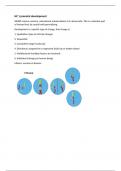
Mitosis; normal cel division
,Meiosis; special cell division
23 chromosomes of mom and 23 of dad
Meiosis; crossing over genetic information, meiosis is the basis for genetic variation and
individual differences
Monozygote twins; share the same genetics
4 developmental processes ;
1. Mitosis (ordinary cell division)
2. Cell migration
3. Cell differentiation
4. Apoptosis (programmed cell death)
Stimulations from the outside;
10w sense of pressure (muscles, skin)
13w detection movement (of mom)
20w detection of light
26w detection of sound
26-28w detection of smell and taste what mom eats
---------------------------> this all leads to preference mom’s voice and diet
Fetal movement;
5-6w bending head and spine
, 8-9wstartle like movements (hiccups, burping)
10w variety limb movements
10-11w head movements, breathing movements
10-12w yawn, suck, swallow amnionic fluid
14w non random movements (touches own bodyparts)
20w movements with all parts of face (wenkbrauwen optrekken)
25w opening and closing eyes
Swallowing is important for lungs digestive system
Body movement is important for developing muscles, bones, skins
Teratogens; potential prenatal harm development (drugs, nicotine) most vulnerable during
early development.
HC 2 braindevelopment
The brain is made up of 100 billion neurons
Cell body; most important processes
Axon; sending part
Myeling sheath; keep neuron healthy, speed up signal connexion
Axon terminals; how is information send to other cells
How do neurons communicate?’;
(723) NEURON ACTION POTENTIAL (MADE EASY) - YouTube
Resting potential; negative potential, na+ are outside, inside are A- and K+. the distribution is
held stable in resting potential.
Threshold; -55 mv than is action potential N+ rushes into neuron. This is depolarization in the
neuron it is +40mv
WEIRD science; western, educational, industrialized, rich, democratic. This is a selective part
of human kind, be careful with generalizing.
Development is a specific type of change, that change is;
1. Qualitative (type of cell that change)
2. Sequential
3. Cumulative (stage’s build up)
4. Directional, progressive or regressive (build up or broken down)
5. Multifactorial (multiple factors are involved)
6. Individual (change per human being)
Mitosis; normal cel division
,Meiosis; special cell division
23 chromosomes of mom and 23 of dad
Meiosis; crossing over genetic information, meiosis is the basis for genetic variation and
individual differences
Monozygote twins; share the same genetics
4 developmental processes ;
1. Mitosis (ordinary cell division)
2. Cell migration
3. Cell differentiation
4. Apoptosis (programmed cell death)
Stimulations from the outside;
10w sense of pressure (muscles, skin)
13w detection movement (of mom)
20w detection of light
26w detection of sound
26-28w detection of smell and taste what mom eats
---------------------------> this all leads to preference mom’s voice and diet
Fetal movement;
5-6w bending head and spine
, 8-9wstartle like movements (hiccups, burping)
10w variety limb movements
10-11w head movements, breathing movements
10-12w yawn, suck, swallow amnionic fluid
14w non random movements (touches own bodyparts)
20w movements with all parts of face (wenkbrauwen optrekken)
25w opening and closing eyes
Swallowing is important for lungs digestive system
Body movement is important for developing muscles, bones, skins
Teratogens; potential prenatal harm development (drugs, nicotine) most vulnerable during
early development.
HC 2 braindevelopment
The brain is made up of 100 billion neurons
Cell body; most important processes
Axon; sending part
Myeling sheath; keep neuron healthy, speed up signal connexion
Axon terminals; how is information send to other cells
How do neurons communicate?’;
(723) NEURON ACTION POTENTIAL (MADE EASY) - YouTube
Resting potential; negative potential, na+ are outside, inside are A- and K+. the distribution is
held stable in resting potential.
Threshold; -55 mv than is action potential N+ rushes into neuron. This is depolarization in the
neuron it is +40mv