Chapter 10: The Political Economy of Trade Policy
The Case for Free Trade
Few countries have anything approaching completely free trade. Nonetheless, since the time of
Adam Smith, economists have advocated free trade as an ideal toward which trade policy should
strive. The reasons for this advocacy are not quite as simple as the idea itself. At one level,
theoretical models suggest that free trade will avoid the efficiency losses associated with protection.
Many economists believe free trade produces additional gains beyond the elimination of production
and consumption distortions. Finally, even among economists who believe free trade is a less-than-
perfect policy, many believe free trade is usually better than any other policy a government is likely
to follow.
Free Trade and Efficiency
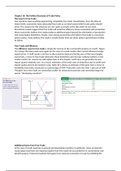
The efficiency case for free trade is simply the reverse of the cost-benefit analysis of a tariff. Figure
10-1 shows the basic point once again for the case of a small country that cannot influence foreign
export prices. A tariff causes a net loss to the economy measured by the area of the two triangles.
Conversely, a move to free trade eliminates these distortions and increase national welfare. In the
modern world, for reasons we will explain later in this chapter, tariff rates are generally low and
import quotas relatively rare. As a result, estimates of the total costs of distortions due to tariffs and
import quotas tend to be modest in size. Table 10-1 shows an estimate of the gains from a move to
worldwide free trade, measured as a percentage of GDP. Protection costs less than 1 percent of GDP.
The gains from free trade are somewhat smaller for advanced economies and somewhat larger for
poorer “developing countries”.
Additional Gains from Free Trade
In the case of small countries in general and developing countries in particular, many economists
would argue that there are important gains from free trade not accounted for in conventional cost-
benefit analysis. Protected markets limit gains from external economies of scale by inhibiting the
, concentration of industries; when the economies of scale are internal, they not only fragment
production internationally, but by reducing competition and raising profits, they also lead too many
firms to enter the protected industry. With a proliferation of firms in narrow domestic markets, the
scale of production of each firm becomes inefficient. Another argument for free trade is that by
providing entrepreneurs with an incentive to seek new ways to export or compete with imports, free
trade offers more opportunities for learning and innovation than are provided by a system of
“managed” trade, where the government largely dictates the pattern of imports and exports. A
related form of gains from free trade involves the tendency for more productive firms to engage in
exports while less productive firms stay with the domestic market. This suggests that a move to free
trade makes the economy as a whole more efficient by shifting the industrial mix toward firms with
higher productivity.
Rent Seeking
When imports are restricted with a quota rather than a tariff, the cost is sometimes magnified by a
process known as rent seeking. Recall from Chapter 9 that to enforce an import quota, a government
has to issue import licenses and economic rents accrue to whoever receives these licenses. In some
cases, individuals and companies incur substantial costs – in effect, wasting some of the economy’s
productive resources – in an effort to get import licenses.
Political Argument for Free Trade
A political argument for free trade reflects the fact that a political commitment to free trade may be
a good idea in practice even though there may be better policies in principle. Economists often argue
that trade policies in practice are dominated by special-interest politics rather than by consideration
of national costs and benefits. Economists can sometimes show that in theory, a selective set of
tariffs and export subsidies could increase national welfare, but that in reality, any government
agency attempting to pursue a sophisticated program of intervention in trade would probably be
captured by interest groups and converted into a device for redistributing income to politically
influential sectors. If this argument is correct, it may be better to advocate free trade without
exceptions even though on purely economic grounds, free trade may not always be the best
conceivable policy.
The three arguments outlined in the previous section probably represent the standard view of most
international economists, at least those in the United States:
1. The conventionally measured costs of deviating from free trade are large.
2. There are other benefits from free trade that add to the costs of protectionist policies.
3. Any attempt to pursue sophisticated deviation from free trade will be subverted by the
political process.
National Welfare Arguments against Free Trade
Most tariffs import quotas, and other trade policy measures are undertaken primarily to protect the
income of particular interest groups. Politicians often claim, however, that the policies are being
undertaken in the interest of the nation as a whole, and sometimes they are even telling the truth.
Although economists frequently argue that deviations from free trade reduce national welfare, there
are some theoretical grounds for believing that activist trade policies can sometimes increase the
welfare of the nation as a whole.
The Terms of Trade Argument for a Tariff
One argument for deviating from free trade comes directly out of cost-benefit analysis: For a large
country that is able to affect the prices of foreign exporters, a tariff lowers the price of imports and
thus generates a terms of trade benefit. This benefit must be set against the costs of the tariff, which
arise because the tariff distorts production and consumption incentives. It is possible, however, that
in some cases the terms of trade benefits of a tariff outweigh its costs, so there is a terms of trade
The Case for Free Trade
Few countries have anything approaching completely free trade. Nonetheless, since the time of
Adam Smith, economists have advocated free trade as an ideal toward which trade policy should
strive. The reasons for this advocacy are not quite as simple as the idea itself. At one level,
theoretical models suggest that free trade will avoid the efficiency losses associated with protection.
Many economists believe free trade produces additional gains beyond the elimination of production
and consumption distortions. Finally, even among economists who believe free trade is a less-than-
perfect policy, many believe free trade is usually better than any other policy a government is likely
to follow.
Free Trade and Efficiency
The efficiency case for free trade is simply the reverse of the cost-benefit analysis of a tariff. Figure
10-1 shows the basic point once again for the case of a small country that cannot influence foreign
export prices. A tariff causes a net loss to the economy measured by the area of the two triangles.
Conversely, a move to free trade eliminates these distortions and increase national welfare. In the
modern world, for reasons we will explain later in this chapter, tariff rates are generally low and
import quotas relatively rare. As a result, estimates of the total costs of distortions due to tariffs and
import quotas tend to be modest in size. Table 10-1 shows an estimate of the gains from a move to
worldwide free trade, measured as a percentage of GDP. Protection costs less than 1 percent of GDP.
The gains from free trade are somewhat smaller for advanced economies and somewhat larger for
poorer “developing countries”.
Additional Gains from Free Trade
In the case of small countries in general and developing countries in particular, many economists
would argue that there are important gains from free trade not accounted for in conventional cost-
benefit analysis. Protected markets limit gains from external economies of scale by inhibiting the
, concentration of industries; when the economies of scale are internal, they not only fragment
production internationally, but by reducing competition and raising profits, they also lead too many
firms to enter the protected industry. With a proliferation of firms in narrow domestic markets, the
scale of production of each firm becomes inefficient. Another argument for free trade is that by
providing entrepreneurs with an incentive to seek new ways to export or compete with imports, free
trade offers more opportunities for learning and innovation than are provided by a system of
“managed” trade, where the government largely dictates the pattern of imports and exports. A
related form of gains from free trade involves the tendency for more productive firms to engage in
exports while less productive firms stay with the domestic market. This suggests that a move to free
trade makes the economy as a whole more efficient by shifting the industrial mix toward firms with
higher productivity.
Rent Seeking
When imports are restricted with a quota rather than a tariff, the cost is sometimes magnified by a
process known as rent seeking. Recall from Chapter 9 that to enforce an import quota, a government
has to issue import licenses and economic rents accrue to whoever receives these licenses. In some
cases, individuals and companies incur substantial costs – in effect, wasting some of the economy’s
productive resources – in an effort to get import licenses.
Political Argument for Free Trade
A political argument for free trade reflects the fact that a political commitment to free trade may be
a good idea in practice even though there may be better policies in principle. Economists often argue
that trade policies in practice are dominated by special-interest politics rather than by consideration
of national costs and benefits. Economists can sometimes show that in theory, a selective set of
tariffs and export subsidies could increase national welfare, but that in reality, any government
agency attempting to pursue a sophisticated program of intervention in trade would probably be
captured by interest groups and converted into a device for redistributing income to politically
influential sectors. If this argument is correct, it may be better to advocate free trade without
exceptions even though on purely economic grounds, free trade may not always be the best
conceivable policy.
The three arguments outlined in the previous section probably represent the standard view of most
international economists, at least those in the United States:
1. The conventionally measured costs of deviating from free trade are large.
2. There are other benefits from free trade that add to the costs of protectionist policies.
3. Any attempt to pursue sophisticated deviation from free trade will be subverted by the
political process.
National Welfare Arguments against Free Trade
Most tariffs import quotas, and other trade policy measures are undertaken primarily to protect the
income of particular interest groups. Politicians often claim, however, that the policies are being
undertaken in the interest of the nation as a whole, and sometimes they are even telling the truth.
Although economists frequently argue that deviations from free trade reduce national welfare, there
are some theoretical grounds for believing that activist trade policies can sometimes increase the
welfare of the nation as a whole.
The Terms of Trade Argument for a Tariff
One argument for deviating from free trade comes directly out of cost-benefit analysis: For a large
country that is able to affect the prices of foreign exporters, a tariff lowers the price of imports and
thus generates a terms of trade benefit. This benefit must be set against the costs of the tariff, which
arise because the tariff distorts production and consumption incentives. It is possible, however, that
in some cases the terms of trade benefits of a tariff outweigh its costs, so there is a terms of trade