Summary Immunopharmacology
1 College 1, Chapter 1: Introduction to the immune system
Biologics = proteins from the immune system, can be used as medicine. The majority of all medicine.
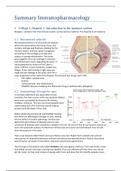
1.1 Rheumatoid arthritis
Rheumatoid arthritis is an auto immune disease
where the joints (where the bones move, and
contains cartilage and fluid) are attacked by the
immune system. Immune system recognizes
something of the cartilage as foreign and
attacks it causing inflammation. The bones
grind together since the cartilage is removed
and inflammation starts degrading the bone. In
starts gradually (no notice at first): pain in
joints, stiffness, muscle weakness, weight loss,
fatigue. If you start treating it right away you
might prevent damage to the joints since RA is
most progressive at the start of the disease. Hit hard and fast. Drugs used in RA:
- Pain killers: paracetemol
- NSAIDs
- Corticosteroids: anti-inflammatory
- DMARDs (disease modifying Anti Rheumatic Drugs): methotrexate, biologicals
1.2 Immunology through the ages
In the early 1800 there was about 40% of child
mortality. The main course of this was because children
were more susceptible for diseases like cholera,
smallpox, influenza. This was normal and people never
really looked up to this until they started making
pictures with the death of the child.
Robert Hooke discovered cells and Rudolph Virchow
that there are pathological changes to cells, making
him the father of modern pathology. Virchow was
against the germ theory of diseases since he was
convinced all diseases were caused by a change in the cell. He was the first to use forensic analysis of
haris and systematic autopsy. Furthermore Virchow was anti-racism and anti-Darwin since all cells
from every person is the same.
Then a war between Robert Koch and Louis Pasteur occurred. Robert Koch isolated and cultured
many germs, he improved laboratory methods and discovered mycobacterium. Pasteur discovered
pasteurization, principle of vaccination, disproves spontaneous genorarions.
The first type of vaccination was called virolation, this was against small pox. Two main forms, minor
(not lethal) version and major one that was deathly. If you are effected with the minor you cannot
get the major. So they took scrapes of people with minor and blow that into healthy peoples noses.
,Picked up by Lady Montague and brought to Europe, tested on prisoners and children. The theories
they invented behind this method were:
- Excess moisture driven from the blood through the pox
- Contaminant of menstrual blood (when born, this blood feeds the bux)
- Pocks distend pores in the skin
- Everybody is born with seeds of diseases, when you use it up you cannot get it again
Emil von Behring (discovered diphtheria toxin and serum therapy) and Paul Ehrlich (first suggested
existence of antibodies, he developed the side chain theory, humoral immunity = adaptive immunity)
from Germany and in France Elie Metchnikoff (discovered phagocytes and suggested the importance
of the microbiome, cellular immunity = innate immunity). They both won the nobel prize and the
comity reconciled by sharing the Nobel price between them.
But antibodies could not explain everything. Until 1997, discovery of lymphocytes, clonal selection,
MHC, co-stimulation etc. Then the discovery of TLR and their role in immunity by
Medzhitov/Janeway/Hoffmann and a renewed interest in innate immunity.
1.3 The immune systems
The immune system tries to restore a balance, homeostasis. When the balance is disturbed it needs
to be restored, fast. The invaders can be:
- Bacteria
- Virus
- Fungi
- Parasites
- Objects
But it also needs to remove things that shouldn’t be there:
- Death cells
- Tumors
- Artificial objects
- Damaged molecules
The cell has cellular alarm systems to warn that something is wrong and signal that the cell needs to
be protected.
EC barriers: building of a wall against invaders with protectors on that wall: tissue resident immune
cells (like a neighborhood watch). Protect the tissue. If those cannot handle it they call in the help
from the bone marrow which provides new cells. Cells from bone marrow and tissue that help defeat
the infection and clean up. If those cannot handle there are special cells, lymphocytes:
• T helper cells: investigate, tell other cells what need to do
• Cytotoxic T cell: kills other cells themselves
• B cells: produce ab and also help
Immune cells are all made in the bone marrow, except macrophages that can also be born from ECs
1.3.1 Innate vs Adaptive
The Immune system consists of:
• Innate immunity: born with, protects you
from day 1
o Fast (sec-hours)
o Not specific
o Limited recognition
o Limited memory
o Limited recognition of self
o Not flexible
, o Present at birth
• Adaptive immunity: develop while you age
o Slow (days-weeks)
o Specific
o Recognizes millions of antigens
o Memory
o Distinguishes self/non-self
o Fast expansion/contraction
o Develops after birth
Requirements for effective immunity:
- Barrier for prevention
- Recognition: detection and identification of the
foreign substance
- Communication/organization: coordination to
mount the most optimal immune response
- Effector mechanisms: to destruct or suppress
the invading pathogen
1.3.2 Organ
The immune system can be seen as a diffuse, body-spanning organs. It also consists of lymphoid
tissues that are everywhere in the body like veins. It consist of:
- Primary lymphoid tissues: for development and maturation of cells:
o Bone marrow: generation of all immune cells
o Thymus: maturation of T cells, selection of non-self-reactive T cells
o Generative lymphoid organs
- Secondary/peripheral lymphoid tissues: meeting place of immune cells and antigens:
o Spleen
o Site where immune responses are initiated
Fight the terror:
- APC patrol tissues and present antigens
- Lymphocytes patrol the body for antigens they recognize
- They find each other in lymphoid structures and communicate there.
1.3.2.1 T cells
Progenitors from bone marrow, migrate to thymus to develop into a naïve T cell, these develop into
effector T cells after recognition of antigens.
, 1.3.2.2 B cells
Progenitors from the bone marrow stay in bone marrow to develop into naïve B cells, that recognize
antigens and develop into antibody-producing plasma cells.
1.3.2.3 APC
The innate and adaptive immune systems are connected by APCs: DC and macrophages. These are
phagocytic cells that are strategically located where the danger from outside is the biggest: lung, gut,
skin. They constantly sample for antigens and break these in little pieces and when considered
dangerous they move to the lymph nodes and present to
T cells.
1.4 Lymph nodes
Are part of the lymphatic circulation that drains all tissues
and collects microbial antigens and delivers these to the
lymph nodes. Immune cells in the lymph node sense and
intercept pathogens preventing their spread throughout
the body by initiating an immune response. The cortex
(outside) consists of B cells and the para cortex (inside) of
T cells. When the lymphatics get clogged it means that
they can’t get rid of the fluid.
1.5 Spleen
Is a highly vascularized organ. It monitors and filters the
blood for rubbish including pathogens but also aged red
blood cells. It consists of:
- Red pulp: macrophages to remove damaged cells
(RBC) and invaders/reservoir of monocytes.
- White pulp: B and T cells, for adaptive response against
blood-born antigens.
Tissue connected to the outside world have their own lymphoid
structure for a faster response against threads:
- BALT: bronchus associated lymphoid tissue
- GALT: gut associated lymphoid tissue
MALT: mucosa associated lymphoid tissue
When the lymph nodes are at work, they get
swollen and visible on the skin as a hump.
1 College 1, Chapter 1: Introduction to the immune system
Biologics = proteins from the immune system, can be used as medicine. The majority of all medicine.
1.1 Rheumatoid arthritis
Rheumatoid arthritis is an auto immune disease
where the joints (where the bones move, and
contains cartilage and fluid) are attacked by the
immune system. Immune system recognizes
something of the cartilage as foreign and
attacks it causing inflammation. The bones
grind together since the cartilage is removed
and inflammation starts degrading the bone. In
starts gradually (no notice at first): pain in
joints, stiffness, muscle weakness, weight loss,
fatigue. If you start treating it right away you
might prevent damage to the joints since RA is
most progressive at the start of the disease. Hit hard and fast. Drugs used in RA:
- Pain killers: paracetemol
- NSAIDs
- Corticosteroids: anti-inflammatory
- DMARDs (disease modifying Anti Rheumatic Drugs): methotrexate, biologicals
1.2 Immunology through the ages
In the early 1800 there was about 40% of child
mortality. The main course of this was because children
were more susceptible for diseases like cholera,
smallpox, influenza. This was normal and people never
really looked up to this until they started making
pictures with the death of the child.
Robert Hooke discovered cells and Rudolph Virchow
that there are pathological changes to cells, making
him the father of modern pathology. Virchow was
against the germ theory of diseases since he was
convinced all diseases were caused by a change in the cell. He was the first to use forensic analysis of
haris and systematic autopsy. Furthermore Virchow was anti-racism and anti-Darwin since all cells
from every person is the same.
Then a war between Robert Koch and Louis Pasteur occurred. Robert Koch isolated and cultured
many germs, he improved laboratory methods and discovered mycobacterium. Pasteur discovered
pasteurization, principle of vaccination, disproves spontaneous genorarions.
The first type of vaccination was called virolation, this was against small pox. Two main forms, minor
(not lethal) version and major one that was deathly. If you are effected with the minor you cannot
get the major. So they took scrapes of people with minor and blow that into healthy peoples noses.
,Picked up by Lady Montague and brought to Europe, tested on prisoners and children. The theories
they invented behind this method were:
- Excess moisture driven from the blood through the pox
- Contaminant of menstrual blood (when born, this blood feeds the bux)
- Pocks distend pores in the skin
- Everybody is born with seeds of diseases, when you use it up you cannot get it again
Emil von Behring (discovered diphtheria toxin and serum therapy) and Paul Ehrlich (first suggested
existence of antibodies, he developed the side chain theory, humoral immunity = adaptive immunity)
from Germany and in France Elie Metchnikoff (discovered phagocytes and suggested the importance
of the microbiome, cellular immunity = innate immunity). They both won the nobel prize and the
comity reconciled by sharing the Nobel price between them.
But antibodies could not explain everything. Until 1997, discovery of lymphocytes, clonal selection,
MHC, co-stimulation etc. Then the discovery of TLR and their role in immunity by
Medzhitov/Janeway/Hoffmann and a renewed interest in innate immunity.
1.3 The immune systems
The immune system tries to restore a balance, homeostasis. When the balance is disturbed it needs
to be restored, fast. The invaders can be:
- Bacteria
- Virus
- Fungi
- Parasites
- Objects
But it also needs to remove things that shouldn’t be there:
- Death cells
- Tumors
- Artificial objects
- Damaged molecules
The cell has cellular alarm systems to warn that something is wrong and signal that the cell needs to
be protected.
EC barriers: building of a wall against invaders with protectors on that wall: tissue resident immune
cells (like a neighborhood watch). Protect the tissue. If those cannot handle it they call in the help
from the bone marrow which provides new cells. Cells from bone marrow and tissue that help defeat
the infection and clean up. If those cannot handle there are special cells, lymphocytes:
• T helper cells: investigate, tell other cells what need to do
• Cytotoxic T cell: kills other cells themselves
• B cells: produce ab and also help
Immune cells are all made in the bone marrow, except macrophages that can also be born from ECs
1.3.1 Innate vs Adaptive
The Immune system consists of:
• Innate immunity: born with, protects you
from day 1
o Fast (sec-hours)
o Not specific
o Limited recognition
o Limited memory
o Limited recognition of self
o Not flexible
, o Present at birth
• Adaptive immunity: develop while you age
o Slow (days-weeks)
o Specific
o Recognizes millions of antigens
o Memory
o Distinguishes self/non-self
o Fast expansion/contraction
o Develops after birth
Requirements for effective immunity:
- Barrier for prevention
- Recognition: detection and identification of the
foreign substance
- Communication/organization: coordination to
mount the most optimal immune response
- Effector mechanisms: to destruct or suppress
the invading pathogen
1.3.2 Organ
The immune system can be seen as a diffuse, body-spanning organs. It also consists of lymphoid
tissues that are everywhere in the body like veins. It consist of:
- Primary lymphoid tissues: for development and maturation of cells:
o Bone marrow: generation of all immune cells
o Thymus: maturation of T cells, selection of non-self-reactive T cells
o Generative lymphoid organs
- Secondary/peripheral lymphoid tissues: meeting place of immune cells and antigens:
o Spleen
o Site where immune responses are initiated
Fight the terror:
- APC patrol tissues and present antigens
- Lymphocytes patrol the body for antigens they recognize
- They find each other in lymphoid structures and communicate there.
1.3.2.1 T cells
Progenitors from bone marrow, migrate to thymus to develop into a naïve T cell, these develop into
effector T cells after recognition of antigens.
, 1.3.2.2 B cells
Progenitors from the bone marrow stay in bone marrow to develop into naïve B cells, that recognize
antigens and develop into antibody-producing plasma cells.
1.3.2.3 APC
The innate and adaptive immune systems are connected by APCs: DC and macrophages. These are
phagocytic cells that are strategically located where the danger from outside is the biggest: lung, gut,
skin. They constantly sample for antigens and break these in little pieces and when considered
dangerous they move to the lymph nodes and present to
T cells.
1.4 Lymph nodes
Are part of the lymphatic circulation that drains all tissues
and collects microbial antigens and delivers these to the
lymph nodes. Immune cells in the lymph node sense and
intercept pathogens preventing their spread throughout
the body by initiating an immune response. The cortex
(outside) consists of B cells and the para cortex (inside) of
T cells. When the lymphatics get clogged it means that
they can’t get rid of the fluid.
1.5 Spleen
Is a highly vascularized organ. It monitors and filters the
blood for rubbish including pathogens but also aged red
blood cells. It consists of:
- Red pulp: macrophages to remove damaged cells
(RBC) and invaders/reservoir of monocytes.
- White pulp: B and T cells, for adaptive response against
blood-born antigens.
Tissue connected to the outside world have their own lymphoid
structure for a faster response against threads:
- BALT: bronchus associated lymphoid tissue
- GALT: gut associated lymphoid tissue
MALT: mucosa associated lymphoid tissue
When the lymph nodes are at work, they get
swollen and visible on the skin as a hump.