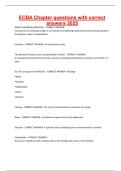
Swimming pool operator certification| 103 QUESTIONS| WITH COMPLETE SOLUTIONS
Swimming pool operator certification| 103 QUESTIONS| WITH COMPLETE SOLUTIONS First step of fecal accident procedure Direct all bathers to leave the pool. All affected waters must be closed to swimming until proper procedures for contamination have been completed Second step of fecal accident procedure Manually remove as much of the material as possible using a net or scoop and dispose of it in a sanitary manner. Clean and disinfect the scoop or net. After cleaning leave the net or scoop immersed in the pool during this infection. Vacuuming the stool is not allowed. Establish a fecal accident log documenting....? (1) the date and time of the event (2) if the accident is a result of a form stools or diarrhea (3) The free available chlorine concentration at the time or observation of the event and before opening the public pool (4) The pH (5) The procedures followed to respond to the fecal accident including the process used to increase free chlorine residual if necessary (6) The contact time Procedures for form stool that is solid and not liquid Raise the free available chlorine level to 2 ppm and ensure that the pH is between 7.2 and 7.5 Maintain the chlorine concentration for at least 25 minutes. Ensure this concentration is found throughout all waters by sampling at least three widely spaced locations away from return outlets Procedures for diarrhea liquid or non-form stools Raise the free available chlorine level two 20 ppm and ensure that the pH is between 7.2 and 7.5 Maintain the chlorine concentration and pH for eight hours while ensuring that the filtration system is operating. Backwash the filter thoroughly discharging the effluent directly to waste. Where appropriate replace the filter media Bathers may be allowed into pool after chlorine concentration has been returned to normal operating ranges Acid demand The amount of acid required to reduce pH and alkalinity to the correct range Algae Microscopic plant like organisms that grow in water do to warm temperatures and in adequate sanitizer. Algae can be green blue green black or yellow green (mustard). Alkalinity A measure of the ability of pool water to resist changes in pH. Buffering capacity of water. Balanced water The correct ratio of hardness, alkalinity, temperature, dissolved solids, and pH that prevent pool water from being either corrosive or scale forming Bromine A chemical element that exists as a liquid in its elemental form or as part of a chemical compound that is an oxidant and a biocidal agent used to disinfect pool, spa and hot tub water. Bromamine Bromine-ammonia compounds formed when the bromine in the water combines with ammonia, nitrogen or swimmer or bather waste. Unlike Chloramines they do not smell or irritate the body. They are active sanitizers. Calcium hardness The amount of dissolved calcium in the pool. High levels promote scale and cloudy water. Low levels promote corrosion of the pool or spa equipment. Cavitation Formation of partial vacuums when the pump exceeds the water supply Chlorine A chemical element that exists as a gas in its elemental form or as a part of a chemical compound that is an oxidant and a biocidal agent used in pool, spa, and hot tub disinfection Chlorine demand The amount of chlorine necessary to destroy the germs, algae, and other impurities in the water. Demand refers to the amount required before chlorine can be made available to continue sanitizing the pool, spa, or hot tub water. Chloramines A compound formed when chlorine combines with ammonia, nitrogen, or swimmer or bather wastes. They cause eye and skin irritation, and they have a strong objectionable odor. Chlorine residual The amount of measurable chlorine remaining after treating water with chlorine to disinfect and oxidize contaminants. It may also be explained as the amount of chlorine left after satisfying the chlorine demand. Free available chlorine (FAC) The portion of total chlorine remaining in chlorinated water that is not combined with ammonia or nitrogen compounds and will react chemically with undesirable or disease causing organisms Conditioner Also called cyanuric acid, stabilizer, Isocyanuric acid and Triazinetrione-A chemical that helps reduce the excessive loss of chlorine in water due to ultraviolet rays of the sun. Copper Metallic element that forms compounds causing green or blue green water, green or blue green stains in pool or spa surfaces and green hair or blue fingernails on swimmers and bathers. Cross connection An unprotected connection between a domestic water supply and the pool. Protective devices must be used to eliminate possible contamination. DPD

Geschreven voor
- Instelling
- Swimming pool operator certification| 103
- Vak
- Swimming pool operator certification| 103
Documentinformatie
- Geüpload op
- 5 juni 2024
- Aantal pagina's
- 8
- Geschreven in
- 2023/2024
- Type
- Tentamen (uitwerkingen)
- Bevat
- Vragen en antwoorden
Onderwerpen
-
swimming pool operator certification 103 question