
Lecture 1 – Visual System 1
Retinal Circuitry:
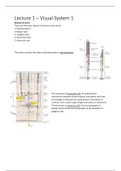
There are five basic classes of neurons in the retina:
1. Photoreceptors
2. Bipolar cells
3. Ganglion cells
4. Horizontal cells
5. Amacrine cells.
The retina contains two types of photoreceptors: rods and cones.
The processes of horizontal cells → enable lateral
interactions between photoreceptors and bipolar cells that
are thought to maintain the visual system's sensitivity to
contrast, over a wide range of light intensities, or luminance.
The processes of amacrine cells → are postsynaptic to
bipolar cell terminals and presynaptic to the dendrites of
ganglion cells.
,Retinal Pigment Epithelium:
The cells that make up the retinal pigment epithelium have long
processes that extend into the photoreceptor layer, surrounding
the tips of the outer segments of each photoreceptor.
The pigment epithelium plays 2 roles:
1. The membranous disk in the outer
segment have a relatively limited life
span of about 12 days. New outer
segment disks are continuously being
formed near the base of the outer
segment, while the oldest disks are
removed, or "shed," at the tip of the
outer segment. During their life span,
disks move progressively from the base
of the outer segment to the tip, where
the pigment epithelium plays an
essential role in removing the
expended receptor disks.
2. To regenerate photopigment
molecules after they have been
exposed to light.
These considerations, along with the
fact that the capillaries in the choroid
underlying the pigment epithelium are
the primary source of nourishment for
retinal photoreceptors, presumably
explain why rods and cones are found
in the outermost rather than the
innermost layer of the retina.
,Phototransduction:
In the retina, however, photoreceptors do not
exhibit action potentials; rather, light activation
causes a graded change in membrane potential
and a corresponding change in the rate of
transmitter release onto postsynaptic neurons.
Indeed, much of the processing within the retina
is mediated by graded potentials.
Perhaps even more surprising is that shining light
on a photoreceptor, either a rod or a cone, leads
to membrane hyperpolarization rather than
depolarization.
In the dark, when photoreceptors are
relatively depolarized, the number of open
Ca2+ channels in the synaptic terminal is
high, and the rate of transmitter release is
correspondingly great in the light, when
receptors are hyperpolarized, the number
of open Ca2+ channels is reduced, and the
rate of transmitter release is also reduced.
In the dark, cations (both Na+ and Ca2+) flow
into the outer segment through membrane
channels that are gated by the nucleotide
cyclic guanosine monophosphate (cGMP).
Thus, the depolarized state of the
photoreceptor in the dark reflects the net
contribution of Na+ and Ca2+ influx, which
acts to depolarize the cell and K+ efflux,
which acts to hyperpolarize the cell.
The series of biochemical changes that ultimately leads to a
reduction in cGMP levels begins when a photon is absorbed by the
photopigment in the receptor disks. The photopigment contains
the light-absorbing chromophore retinal (an aldehyde of vitamin A)
coupled to one of several possible proteins called opsins. The
different opsins tune the molecule's absorption of light to a
particular region of the spectrum.
When retinal absorbs a photon of light, one of the double bonds
between the carbon atoms in the retinal molecule breaks, and its
configuration changes from the 11-cis isomer to all-trans retinal,
this change triggers a series of alterations in the opsin component
of the molecule. The changes in opsin leads in turn, to the
activation of an intracellular messenger called transducin, which
activates a phosphodiesterase that hydrolyzes cGMP.
→ function: signal amplification!
, Activated rhodopsin is rapidly
phosphorylated by rhodopsin kinase, which
permits the protein arrestin to bind to
rhodopsin.
The restoration of retinal to a form capable
of signaling photon capture is a complex
process known as the retinoid cycle. The all-
trans retinal dissociates from opsin and
diffuses into the cytosol of the outer
segment; there it is converted to all-trans
retinal and transported into the pigment
epithelium via a chaperone protein,
interphotoreceptor retinoid binding protein,
where appropriate enzymes ultimately
convert it to 11-cis retinal. After being
transported back into the outer segment via
IRBP, 11-cis retinal recombines with opsin in
the receptor disks.
Feedback system:
The decrease in Ca2+ increases the activity of
guanylate cyclase, the cGMP synthesizing
enzyme, leading to increased cGMP levels.
The decrease in Ca2+ also increases the
activity of rhodopsin kinase, permitting more
arrestin to bind to rhodopsin. Finally, the
decrease in Ca2+ increases the affinity of the
cGMP-gated channels for cGMP, reducing
the impact of the light-induced reduction of
cGMP levels.
Functional Specialization of the Rod and Cone Systems:
Rod system →
- very low spatial resolution
- Extremely sensitive to light
It is therefore specialized for sensitivity at the expense of resolution.
Cone system→
- very high spatial resolution
- Relatively insensitive to light
It is specialized for acuity at the expense of sensitivity.
Retinal Circuitry:
There are five basic classes of neurons in the retina:
1. Photoreceptors
2. Bipolar cells
3. Ganglion cells
4. Horizontal cells
5. Amacrine cells.
The retina contains two types of photoreceptors: rods and cones.
The processes of horizontal cells → enable lateral
interactions between photoreceptors and bipolar cells that
are thought to maintain the visual system's sensitivity to
contrast, over a wide range of light intensities, or luminance.
The processes of amacrine cells → are postsynaptic to
bipolar cell terminals and presynaptic to the dendrites of
ganglion cells.
,Retinal Pigment Epithelium:
The cells that make up the retinal pigment epithelium have long
processes that extend into the photoreceptor layer, surrounding
the tips of the outer segments of each photoreceptor.
The pigment epithelium plays 2 roles:
1. The membranous disk in the outer
segment have a relatively limited life
span of about 12 days. New outer
segment disks are continuously being
formed near the base of the outer
segment, while the oldest disks are
removed, or "shed," at the tip of the
outer segment. During their life span,
disks move progressively from the base
of the outer segment to the tip, where
the pigment epithelium plays an
essential role in removing the
expended receptor disks.
2. To regenerate photopigment
molecules after they have been
exposed to light.
These considerations, along with the
fact that the capillaries in the choroid
underlying the pigment epithelium are
the primary source of nourishment for
retinal photoreceptors, presumably
explain why rods and cones are found
in the outermost rather than the
innermost layer of the retina.
,Phototransduction:
In the retina, however, photoreceptors do not
exhibit action potentials; rather, light activation
causes a graded change in membrane potential
and a corresponding change in the rate of
transmitter release onto postsynaptic neurons.
Indeed, much of the processing within the retina
is mediated by graded potentials.
Perhaps even more surprising is that shining light
on a photoreceptor, either a rod or a cone, leads
to membrane hyperpolarization rather than
depolarization.
In the dark, when photoreceptors are
relatively depolarized, the number of open
Ca2+ channels in the synaptic terminal is
high, and the rate of transmitter release is
correspondingly great in the light, when
receptors are hyperpolarized, the number
of open Ca2+ channels is reduced, and the
rate of transmitter release is also reduced.
In the dark, cations (both Na+ and Ca2+) flow
into the outer segment through membrane
channels that are gated by the nucleotide
cyclic guanosine monophosphate (cGMP).
Thus, the depolarized state of the
photoreceptor in the dark reflects the net
contribution of Na+ and Ca2+ influx, which
acts to depolarize the cell and K+ efflux,
which acts to hyperpolarize the cell.
The series of biochemical changes that ultimately leads to a
reduction in cGMP levels begins when a photon is absorbed by the
photopigment in the receptor disks. The photopigment contains
the light-absorbing chromophore retinal (an aldehyde of vitamin A)
coupled to one of several possible proteins called opsins. The
different opsins tune the molecule's absorption of light to a
particular region of the spectrum.
When retinal absorbs a photon of light, one of the double bonds
between the carbon atoms in the retinal molecule breaks, and its
configuration changes from the 11-cis isomer to all-trans retinal,
this change triggers a series of alterations in the opsin component
of the molecule. The changes in opsin leads in turn, to the
activation of an intracellular messenger called transducin, which
activates a phosphodiesterase that hydrolyzes cGMP.
→ function: signal amplification!
, Activated rhodopsin is rapidly
phosphorylated by rhodopsin kinase, which
permits the protein arrestin to bind to
rhodopsin.
The restoration of retinal to a form capable
of signaling photon capture is a complex
process known as the retinoid cycle. The all-
trans retinal dissociates from opsin and
diffuses into the cytosol of the outer
segment; there it is converted to all-trans
retinal and transported into the pigment
epithelium via a chaperone protein,
interphotoreceptor retinoid binding protein,
where appropriate enzymes ultimately
convert it to 11-cis retinal. After being
transported back into the outer segment via
IRBP, 11-cis retinal recombines with opsin in
the receptor disks.
Feedback system:
The decrease in Ca2+ increases the activity of
guanylate cyclase, the cGMP synthesizing
enzyme, leading to increased cGMP levels.
The decrease in Ca2+ also increases the
activity of rhodopsin kinase, permitting more
arrestin to bind to rhodopsin. Finally, the
decrease in Ca2+ increases the affinity of the
cGMP-gated channels for cGMP, reducing
the impact of the light-induced reduction of
cGMP levels.
Functional Specialization of the Rod and Cone Systems:
Rod system →
- very low spatial resolution
- Extremely sensitive to light
It is therefore specialized for sensitivity at the expense of resolution.
Cone system→
- very high spatial resolution
- Relatively insensitive to light
It is specialized for acuity at the expense of sensitivity.




