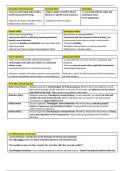
Normative ethical theories Practical ethics Metaethics
-Seeks to understand and provide a -Seeks to apply normative ethical -Is concerned with the origin and
moral framework for living. theories to specific moral scenarios. meaning of moral
terms/judgements.
-Natural Law Theory, Situation ethics, -Euthanasia, Business ethics
Utilitarianism, Kantian ethics.
Deontic ethics Teleological ethics
-Also known as deontology -Also known as consequentialism
-Concerned with the underlying reasoning/intention -Concerned with the outcome of moral actions (the
behind a moral decision. consequences determine an action’s moral worth).
-Tend to be absolute and legalistic (we must follow strict, -Tend to be flexible.
rigid moral rules). -Morality is determined on a case-by-case basis
-Natural Law Theory, Kantian (Deontological) ethics. -Utilitarianism, Situation ethics
Moral relativism Ethical absolutism
-There are no universally valid moral principles. -A command that is true for all time, in all places and
-All principles and values are relative to a particular situations.
culture or age. -There are eternal moral values applicable everywhere.
-No objective basis for us to discover the truth. -Deontological approach.
-However, it implies that there cannot be real evaluation However, it does not take into account the circumstances
or criticism of practices such as slavery or the Holocaust. of each situation.
Normative ethical theories
Natural Law Theory Religious approach. Deontological. St Thomas Aquinas. Believes that moral rightness can be
determined through careful reflection on the facts of the world and adherence to the natural
laws (laid out by God). ‘Right reason in accordance with nature’.
Situation ethics Religious approach. Teleological. Joseph Fletcher. In each situation, we should do what will
produce the most loving outcome. Always following rules can lead to cruel and unloving
consequences. Agape (selfless love).
Utilitarianism Secular approach. Teleological. Jeremy Bentham. We should always seek the greatest
balance of good over evil (principle of utility). ‘Greatest good for the greatest number’.
Utility=pleasure/happiness.
Kantian ethics Secular approach. Deontological. Immanuel Kant. NEVER lie. Emphasises the primacy of doing
one’s duty regardless of the consequences. Argues that the good=good will. Morality is
absolute.
Act Utilitarianism (hedonistic)
-Jeremy Bentham: Introduction to the Principles of Morals and Legislation.
-The right action is the one which maximises pleasure and minimises pain.
“The question is not, Can they reason? Nor, Can they talk? But, Can they suffer?”
-Psychological hedonism: we are driven by pleasure and the absence of pain: “Nature has placed mankind under the
,governance of two sovereign masters, pain and pleasure”
-Bentham makes the normative claim that: we should choose the course of action that maximises pleasure (utility)
and minimises pain, for the greatest number (Principle of Utility).
-However, happiness is comparative, there could always be something better that we don’t know about.
Hedonistic calculus/ Felicific calculus
-A quantitative analysis of actions to determine whether they should be pursued or not.
-Seven factors to consider:
1.) The extent (how many people are affected)
2.) Fecundity (how many more pleasures this will result in)
3.) Duration (how long the pleasure/pain will last for)
4.) Purity (will the pleasures remain pleasurable, or go on to cause pain)
5.) Propinquity (how long will it take for the effects of the pleasure to kick in)
6.) Certainty (how sure you are that the pleasure or reduction of pain will take place)
7.) Intensity (how intense the pain or pleasure will be)
Problem: We must make many assumptions to use the calculus, and therefore nothing will be certain. This makes it
impossible to use.
Rule Utilitarianism (hedonistic)
-John Stuart Mill
- The right action is the one which conforms to the rules which lead to the maximisation of pleasure and
minimisation of pain.
-Follow the rules laid out by society.
-Disagrees with Bentham’s hedonic calculus, as you could pursue any action (e.g. murder) if it brought about the
greatest good, which Mill called “philosophy of the swine”.
-Also argues that it is not practical (“[happiness is] much too complex and indefinite”), and that society has already
created rules with which to judge actions by, which are called secondary principles.
Mill: a.) Intellectual pleasures b.) bestial pleasures. Argues that if our base pleasures are met, then we will always
pursue higher pleasures.
Problems: Elitist (assumes that everyone is in the position to experience both types of pleasure). Idealistic (assumes
that we will choose the higher pleasures if our base needs are met).
Rule Utilitarianism over Act Utilitarianism
Strengths: Weaknesses:
-Hypothetically, Act Utilitarianism would allow murder -When you impose a legalistic framework, rules often
(“tyranny of the majority”), which Rule Utilitarianism conflict. (Mill’s response: follow the rule that produces
would not. the greatest happiness for the greatest number)
-People are happier and attain more pleasure. -Collapses into act utilitarianism under the problem and
-More practical and faster to use solution above (J.J.C. Smart)
-Happiness is the aggregate of society, and rule protects -Does not solve as many problems as it seems to
and promotes this -Could lead to rule worship (strictly following rules but
not comprehending what the rule is for) (J.J.C. Smart
“superstitious rule worship”)
-You could argue that not everything we do is to pursue
happiness (Nozick)
-Too idealistic and elitist
, -Robert Nozick and J.J.C Smart
Robert Nozick
-‘Experience machine’ (thought experiment)
-Reveals that we seek more than happiness, although Nozick does not state what this is.
-A machine would give you a life of contentment, which would be indistinguishable from reality, however you would
be unable to unplug from the machine once you had plugged in.
-The vast majority of people would not plug into this machine.
-Nozick would argue that a life of contentment is not the same as happiness and pleasure.
J.J.C Smart
-Extreme and Restricted Utilitarianism
-‘Electrode operator’ (thought experiment)
-Reflected on the different types of Utilitarianism
-’Electrode Operator’: Similar to Nozick’s thought experiment
-Someone is hooked up to electrodes which will give dopamine at the push of a button.
-Would we constantly push that button?
-Named Act Utilitarianism is “extreme utilitarianism”
-Named Rule Utilitarianism is “restricted utilitarianism”
Preference Utilitarianism (non-hedonistic)
-Peter Singer
-The right action is the one which maximises preferences of all the parties involved.
-Considers animal rights more than classical arguments do.
-Argues that the minimisation of suffering is the more important aspect.
-It is wrong and grossly immoral to value humans over animals (speciesism)
-Doesn’t accept animal rights.
Cora Diamond
-Disagrees with Singer.
-Argues that the notion of speciesism produced by Singer conflicts with human ideas, as we do inherently recognise
speciesism (we won’t eat our pets but will eat other kinds of animals)
Problems with Utilitarianism
-It does not rule out any action as immoral, as any action, even an evil one, could bring the greatest happiness to the
greatest number.
-It is too idealistic, as it expects us to give priority to those in need over those we know and love.
-The number of beings we would have to include in calculation (in Act Utilitarianism especially) intensifies the
complexity and problem of calculation.
-Justice becomes irrelevant, as it does not help the minority.
-It (Act Utilitarianism) suggests that we should spend less time and money on those we love, and more on those who
need help. Is it morally permissible to be partial, or is impartiality always required of us?
-It requires us to take a value that bestows meaning onto our lives and treat it as simply a preference.
-We are not completely selfless beings, yet in utilitarianism our interests do not count more than anyone else’s.
-(Act) does not recognise the moral value of our intentions in acting as we do.
-Seeks to understand and provide a -Seeks to apply normative ethical -Is concerned with the origin and
moral framework for living. theories to specific moral scenarios. meaning of moral
terms/judgements.
-Natural Law Theory, Situation ethics, -Euthanasia, Business ethics
Utilitarianism, Kantian ethics.
Deontic ethics Teleological ethics
-Also known as deontology -Also known as consequentialism
-Concerned with the underlying reasoning/intention -Concerned with the outcome of moral actions (the
behind a moral decision. consequences determine an action’s moral worth).
-Tend to be absolute and legalistic (we must follow strict, -Tend to be flexible.
rigid moral rules). -Morality is determined on a case-by-case basis
-Natural Law Theory, Kantian (Deontological) ethics. -Utilitarianism, Situation ethics
Moral relativism Ethical absolutism
-There are no universally valid moral principles. -A command that is true for all time, in all places and
-All principles and values are relative to a particular situations.
culture or age. -There are eternal moral values applicable everywhere.
-No objective basis for us to discover the truth. -Deontological approach.
-However, it implies that there cannot be real evaluation However, it does not take into account the circumstances
or criticism of practices such as slavery or the Holocaust. of each situation.
Normative ethical theories
Natural Law Theory Religious approach. Deontological. St Thomas Aquinas. Believes that moral rightness can be
determined through careful reflection on the facts of the world and adherence to the natural
laws (laid out by God). ‘Right reason in accordance with nature’.
Situation ethics Religious approach. Teleological. Joseph Fletcher. In each situation, we should do what will
produce the most loving outcome. Always following rules can lead to cruel and unloving
consequences. Agape (selfless love).
Utilitarianism Secular approach. Teleological. Jeremy Bentham. We should always seek the greatest
balance of good over evil (principle of utility). ‘Greatest good for the greatest number’.
Utility=pleasure/happiness.
Kantian ethics Secular approach. Deontological. Immanuel Kant. NEVER lie. Emphasises the primacy of doing
one’s duty regardless of the consequences. Argues that the good=good will. Morality is
absolute.
Act Utilitarianism (hedonistic)
-Jeremy Bentham: Introduction to the Principles of Morals and Legislation.
-The right action is the one which maximises pleasure and minimises pain.
“The question is not, Can they reason? Nor, Can they talk? But, Can they suffer?”
-Psychological hedonism: we are driven by pleasure and the absence of pain: “Nature has placed mankind under the
,governance of two sovereign masters, pain and pleasure”
-Bentham makes the normative claim that: we should choose the course of action that maximises pleasure (utility)
and minimises pain, for the greatest number (Principle of Utility).
-However, happiness is comparative, there could always be something better that we don’t know about.
Hedonistic calculus/ Felicific calculus
-A quantitative analysis of actions to determine whether they should be pursued or not.
-Seven factors to consider:
1.) The extent (how many people are affected)
2.) Fecundity (how many more pleasures this will result in)
3.) Duration (how long the pleasure/pain will last for)
4.) Purity (will the pleasures remain pleasurable, or go on to cause pain)
5.) Propinquity (how long will it take for the effects of the pleasure to kick in)
6.) Certainty (how sure you are that the pleasure or reduction of pain will take place)
7.) Intensity (how intense the pain or pleasure will be)
Problem: We must make many assumptions to use the calculus, and therefore nothing will be certain. This makes it
impossible to use.
Rule Utilitarianism (hedonistic)
-John Stuart Mill
- The right action is the one which conforms to the rules which lead to the maximisation of pleasure and
minimisation of pain.
-Follow the rules laid out by society.
-Disagrees with Bentham’s hedonic calculus, as you could pursue any action (e.g. murder) if it brought about the
greatest good, which Mill called “philosophy of the swine”.
-Also argues that it is not practical (“[happiness is] much too complex and indefinite”), and that society has already
created rules with which to judge actions by, which are called secondary principles.
Mill: a.) Intellectual pleasures b.) bestial pleasures. Argues that if our base pleasures are met, then we will always
pursue higher pleasures.
Problems: Elitist (assumes that everyone is in the position to experience both types of pleasure). Idealistic (assumes
that we will choose the higher pleasures if our base needs are met).
Rule Utilitarianism over Act Utilitarianism
Strengths: Weaknesses:
-Hypothetically, Act Utilitarianism would allow murder -When you impose a legalistic framework, rules often
(“tyranny of the majority”), which Rule Utilitarianism conflict. (Mill’s response: follow the rule that produces
would not. the greatest happiness for the greatest number)
-People are happier and attain more pleasure. -Collapses into act utilitarianism under the problem and
-More practical and faster to use solution above (J.J.C. Smart)
-Happiness is the aggregate of society, and rule protects -Does not solve as many problems as it seems to
and promotes this -Could lead to rule worship (strictly following rules but
not comprehending what the rule is for) (J.J.C. Smart
“superstitious rule worship”)
-You could argue that not everything we do is to pursue
happiness (Nozick)
-Too idealistic and elitist
, -Robert Nozick and J.J.C Smart
Robert Nozick
-‘Experience machine’ (thought experiment)
-Reveals that we seek more than happiness, although Nozick does not state what this is.
-A machine would give you a life of contentment, which would be indistinguishable from reality, however you would
be unable to unplug from the machine once you had plugged in.
-The vast majority of people would not plug into this machine.
-Nozick would argue that a life of contentment is not the same as happiness and pleasure.
J.J.C Smart
-Extreme and Restricted Utilitarianism
-‘Electrode operator’ (thought experiment)
-Reflected on the different types of Utilitarianism
-’Electrode Operator’: Similar to Nozick’s thought experiment
-Someone is hooked up to electrodes which will give dopamine at the push of a button.
-Would we constantly push that button?
-Named Act Utilitarianism is “extreme utilitarianism”
-Named Rule Utilitarianism is “restricted utilitarianism”
Preference Utilitarianism (non-hedonistic)
-Peter Singer
-The right action is the one which maximises preferences of all the parties involved.
-Considers animal rights more than classical arguments do.
-Argues that the minimisation of suffering is the more important aspect.
-It is wrong and grossly immoral to value humans over animals (speciesism)
-Doesn’t accept animal rights.
Cora Diamond
-Disagrees with Singer.
-Argues that the notion of speciesism produced by Singer conflicts with human ideas, as we do inherently recognise
speciesism (we won’t eat our pets but will eat other kinds of animals)
Problems with Utilitarianism
-It does not rule out any action as immoral, as any action, even an evil one, could bring the greatest happiness to the
greatest number.
-It is too idealistic, as it expects us to give priority to those in need over those we know and love.
-The number of beings we would have to include in calculation (in Act Utilitarianism especially) intensifies the
complexity and problem of calculation.
-Justice becomes irrelevant, as it does not help the minority.
-It (Act Utilitarianism) suggests that we should spend less time and money on those we love, and more on those who
need help. Is it morally permissible to be partial, or is impartiality always required of us?
-It requires us to take a value that bestows meaning onto our lives and treat it as simply a preference.
-We are not completely selfless beings, yet in utilitarianism our interests do not count more than anyone else’s.
-(Act) does not recognise the moral value of our intentions in acting as we do.