Managament of Sustainable Innovation - Notes
MSc DBI
Recommended Notes template:
- What is the main thesis of the article, in a nutshell?
- What are some of the arguments made in this article? [statement about the way something
should be, a critical remark on existing approaches/perspectives in support of the main
thesis]
- Which arguments do you agree with, why?
- Which arguments do you disagree with, why?
- How would you apply this article to further understand/explain the phenomenon in real life?
- How would you compare this article to the other assigned articles on this topic?
Week 1 - Introduction to Sustainable Innovation for Shared Value Creation
● Adams, Jeanrenaud, Bessant, Denyer, & Overy (2016)
Professors tips:
- know these three approaches and how they are different from one another.
- You can skip the section "Stage 2: Systematic review of SOI" [except the bullet
points above "descriptive summary" on p. 187].
- We will use the model in figure 3 to classify and make sense of the sustainable
innovations we discuss in this class.
● Sustainability-oriented Innovation (a systematic review)
- Proposed model of Sustainability-Oriented Innovation (SOI)
- Begins with incremental changes at firm level to readical changes at large-scale
systems level (this progression requires a shift in values/behaviour → reflected in
firms innov activities)
3 key dimensions of SOI: (SIT - ISP)
- Standalone vs integrated
- The SOI should not be only in a standalone department, but integrated into the DNA
of the org and each of its departments
- Insular vs Systemic
- Firm should view itself as part of a ecosystem, not just an insulated body
- Technology vs human
- The sustainable innovation should focus on how it affects behaviour and ppl, not
just focused on the tech itself
Categorization of SOI activities:
1. Strategy → aligning org and management processes to facilitate delivery of sust goals
2. Innovation Process → organisation of innov process to ensure dev of sust prod/services
and effective capturing of value from these
, 3. Learning → recognition of value from new knowledge, its assimilate within the org and its
application to sust efforts
4. Linkages → int/ext linkages (collabs/partnerships) are important for learning and influencing
5. Innovative Organization → creating a helpful workplace to enable effective training,
leadershiship, development programs for SOI
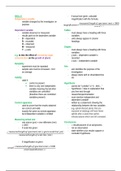
● SOI Framework (categorization of SOI activities in 3 stages)
→ framework examines activities SOI, provides structure for bringing together findings on
innovation activities from a diverse literature
- Each stage is an approach to incorporating sustainability practices within orgs
1. Operational Optimization
- Internal and incremental improvements/changes to reduce harm
→ “doing same things better”
- Targets resource use, waste management, pollution control, product design
modification
- Knowledge management + linkages aim to comply with regulations/adopting
efficient practices within the firm
2. Organizational Transformation
, -Shift in mindset toward shared value creation and societal benefits
-Strategic integration of sustainability into firms culture → leading to sust
products, market expansion and strong focus on social dimension of sust
- Involves adoption of new platforms, backcasting, stakeholder engagement,
enabling development of more radical/transformative innovations
- Learning + knowledge management from customer feedback and internal
stakeholder collaboration
3. Systems Building
- Collaborative creation of sustainability value at global level
- Establishing networks/partnerships in a web of stakeholders aiming to
transform entire systems
- Involves reframing purpose of business in society, extensive collaborations,
initiating systemic changes
- Orgs want to reframe the role of business through ‘benefit corporations’,
‘conscious capitalism’ and ‘circular economy’
Summarized below:
→ this SOI model represents a sustainability as a journey and its characteristic activities
- Managers need to be equipped with innovative tools to address sustainability, thus
theis framework can help
● Porter & Kramer (2011) - Creating Shared Value
MSc DBI
Recommended Notes template:
- What is the main thesis of the article, in a nutshell?
- What are some of the arguments made in this article? [statement about the way something
should be, a critical remark on existing approaches/perspectives in support of the main
thesis]
- Which arguments do you agree with, why?
- Which arguments do you disagree with, why?
- How would you apply this article to further understand/explain the phenomenon in real life?
- How would you compare this article to the other assigned articles on this topic?
Week 1 - Introduction to Sustainable Innovation for Shared Value Creation
● Adams, Jeanrenaud, Bessant, Denyer, & Overy (2016)
Professors tips:
- know these three approaches and how they are different from one another.
- You can skip the section "Stage 2: Systematic review of SOI" [except the bullet
points above "descriptive summary" on p. 187].
- We will use the model in figure 3 to classify and make sense of the sustainable
innovations we discuss in this class.
● Sustainability-oriented Innovation (a systematic review)
- Proposed model of Sustainability-Oriented Innovation (SOI)
- Begins with incremental changes at firm level to readical changes at large-scale
systems level (this progression requires a shift in values/behaviour → reflected in
firms innov activities)
3 key dimensions of SOI: (SIT - ISP)
- Standalone vs integrated
- The SOI should not be only in a standalone department, but integrated into the DNA
of the org and each of its departments
- Insular vs Systemic
- Firm should view itself as part of a ecosystem, not just an insulated body
- Technology vs human
- The sustainable innovation should focus on how it affects behaviour and ppl, not
just focused on the tech itself
Categorization of SOI activities:
1. Strategy → aligning org and management processes to facilitate delivery of sust goals
2. Innovation Process → organisation of innov process to ensure dev of sust prod/services
and effective capturing of value from these
, 3. Learning → recognition of value from new knowledge, its assimilate within the org and its
application to sust efforts
4. Linkages → int/ext linkages (collabs/partnerships) are important for learning and influencing
5. Innovative Organization → creating a helpful workplace to enable effective training,
leadershiship, development programs for SOI
● SOI Framework (categorization of SOI activities in 3 stages)
→ framework examines activities SOI, provides structure for bringing together findings on
innovation activities from a diverse literature
- Each stage is an approach to incorporating sustainability practices within orgs
1. Operational Optimization
- Internal and incremental improvements/changes to reduce harm
→ “doing same things better”
- Targets resource use, waste management, pollution control, product design
modification
- Knowledge management + linkages aim to comply with regulations/adopting
efficient practices within the firm
2. Organizational Transformation
, -Shift in mindset toward shared value creation and societal benefits
-Strategic integration of sustainability into firms culture → leading to sust
products, market expansion and strong focus on social dimension of sust
- Involves adoption of new platforms, backcasting, stakeholder engagement,
enabling development of more radical/transformative innovations
- Learning + knowledge management from customer feedback and internal
stakeholder collaboration
3. Systems Building
- Collaborative creation of sustainability value at global level
- Establishing networks/partnerships in a web of stakeholders aiming to
transform entire systems
- Involves reframing purpose of business in society, extensive collaborations,
initiating systemic changes
- Orgs want to reframe the role of business through ‘benefit corporations’,
‘conscious capitalism’ and ‘circular economy’
Summarized below:
→ this SOI model represents a sustainability as a journey and its characteristic activities
- Managers need to be equipped with innovative tools to address sustainability, thus
theis framework can help
● Porter & Kramer (2011) - Creating Shared Value