Finance
Chapter 12 - Estimating the Cost of Capital
12.1 The Equity Cost of Capital
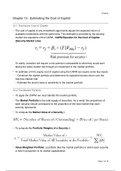
- The cost of capital of any investment opportunity equals the expected return of
available investments with the same beta. This estimate is provided by the security
market line equations of the CAPM - CAPM Equation for the Cost of Capital
(Security Market Line):
To clarify, investors will require a risk premium comparable to what they would earn
taking the same market risk through an investment in the market portfolio.
- To estimate a firm's equity cost of capital using the CAPM we require some key inputs:
○ Construct the market portfolio and determine its expected excess return over the
risk-free interest rate
○ Estimate the stock's beta or sensitivity to the market portfolio
12.2 The Market Portfolio
- To apply the CAPM, we must identify the market portfolio.
- The Market Portfolio is the total supply of securities. As a result, the proportions of
each security should correspond to the proportion of the total market that each
security represents.
- To compute the Market Value of a Security i:
- To compute the Portfolio Weights of a Security i:
- Value-Weighted Portfolio: a portfolio (like the market portfolio) in which each security
is held in proportion to its market capitalisation.
Page 1 of 16
, Finance
- Equal-Ownership Portfolio: we hold an equal fraction of the total number of shares
outstanding of each security in the portfolio. Thus, even when market price change we
do not need to trade to maintain a value-weight portfolio - unless, the number of
shares outstanding of some security changes.
- A value-weighted portfolio is an equal-ownership portfolio.
- Passive Portfolio: when very little trade is required to maintain a portfolio.
- A value-weighted portfolio is a passive portfolio.
- With respect to U.S. stocks, we can use market indexes rather than constructing the
market portfolio. These market indexes represent the performance of the U.S. stock
market.
- A Market Index reports the value of a particular portfolio of securities. An example of
a market index is the S&P 500. This is an index that represents a value-weighted
portfolio of 500 of the largest U.S. stocks.
- Price-Weighted Portfolio: a portfolio that hold an equal number of shares of each
stock, independent of their size. An example is the Dow Jones Industrial Average - a
U.S. stock index - which consists of a portfolio of 30 large industrial stocks.
- Index Funds are funds that companies offer to invest in a portfolio (a market index).
- An Exchange-Traded Fund (ETF) is a security that trades directly on an exchange,
like a stock, but represents ownership in a portfolio of stocks.
- Exchange-traded funds represent the index funds of market indices.
- Despite that practitioners commonly use the S&P 500 as the market portfolio in the
CAPM, no one does so because of a belief that this index is actually the market
portfolio. Instead they view the index as a market proxy.
- Market Proxy: a portfolio whose return closely tracks the true market portfolio.
- The risk-free interest rate in the CAPM model corresponds to the risk-free rate at
which investors can both borrow and save. Practitioners generally choose the riks-ree
rate from the yield curve based on the investment horizon.
- Given an assessment of firms' future cash flows, we can estimate the expected return
of the market by solving for the discount rate that is consistent with the current level of
the index. Therefore, to estimate the Market Risk Premium:
Page 2 of 16
, Finance
12.3 Beta Estimation
- After identifying a market proxy, we must determine a security's beta. Recall, that this
must all be computed in order to implement the CAPM successfully.
- A Beta measures the sensitivity of a security's return to those of the market. To clarify,
beta is the expected change (in %) in the return of a security given a 1% change in
the return of the market portfolio.
- Historical returns are often used to estimate beta. Here, beta corresponds to the slope
of the best-fitting line in the plot of a security's excess returns versus the market's
excess returns.
- The best-fitting line through a set of points is identified using Linear Regression. This
corresponds to writing the excess return of a security as the sum of three
components:
To clarify the formula:
• ai is the intercept of the regression line
• Bi (Rmkr - rf) represents the sensitivity of the stock to market risk
• Ei is the Residual Term and represents the deviation from the best-fitting line and is
zero on average (or else we could improve it)
- To illustrate:
Page 3 of 16
Chapter 12 - Estimating the Cost of Capital
12.1 The Equity Cost of Capital
- The cost of capital of any investment opportunity equals the expected return of
available investments with the same beta. This estimate is provided by the security
market line equations of the CAPM - CAPM Equation for the Cost of Capital
(Security Market Line):
To clarify, investors will require a risk premium comparable to what they would earn
taking the same market risk through an investment in the market portfolio.
- To estimate a firm's equity cost of capital using the CAPM we require some key inputs:
○ Construct the market portfolio and determine its expected excess return over the
risk-free interest rate
○ Estimate the stock's beta or sensitivity to the market portfolio
12.2 The Market Portfolio
- To apply the CAPM, we must identify the market portfolio.
- The Market Portfolio is the total supply of securities. As a result, the proportions of
each security should correspond to the proportion of the total market that each
security represents.
- To compute the Market Value of a Security i:
- To compute the Portfolio Weights of a Security i:
- Value-Weighted Portfolio: a portfolio (like the market portfolio) in which each security
is held in proportion to its market capitalisation.
Page 1 of 16
, Finance
- Equal-Ownership Portfolio: we hold an equal fraction of the total number of shares
outstanding of each security in the portfolio. Thus, even when market price change we
do not need to trade to maintain a value-weight portfolio - unless, the number of
shares outstanding of some security changes.
- A value-weighted portfolio is an equal-ownership portfolio.
- Passive Portfolio: when very little trade is required to maintain a portfolio.
- A value-weighted portfolio is a passive portfolio.
- With respect to U.S. stocks, we can use market indexes rather than constructing the
market portfolio. These market indexes represent the performance of the U.S. stock
market.
- A Market Index reports the value of a particular portfolio of securities. An example of
a market index is the S&P 500. This is an index that represents a value-weighted
portfolio of 500 of the largest U.S. stocks.
- Price-Weighted Portfolio: a portfolio that hold an equal number of shares of each
stock, independent of their size. An example is the Dow Jones Industrial Average - a
U.S. stock index - which consists of a portfolio of 30 large industrial stocks.
- Index Funds are funds that companies offer to invest in a portfolio (a market index).
- An Exchange-Traded Fund (ETF) is a security that trades directly on an exchange,
like a stock, but represents ownership in a portfolio of stocks.
- Exchange-traded funds represent the index funds of market indices.
- Despite that practitioners commonly use the S&P 500 as the market portfolio in the
CAPM, no one does so because of a belief that this index is actually the market
portfolio. Instead they view the index as a market proxy.
- Market Proxy: a portfolio whose return closely tracks the true market portfolio.
- The risk-free interest rate in the CAPM model corresponds to the risk-free rate at
which investors can both borrow and save. Practitioners generally choose the riks-ree
rate from the yield curve based on the investment horizon.
- Given an assessment of firms' future cash flows, we can estimate the expected return
of the market by solving for the discount rate that is consistent with the current level of
the index. Therefore, to estimate the Market Risk Premium:
Page 2 of 16
, Finance
12.3 Beta Estimation
- After identifying a market proxy, we must determine a security's beta. Recall, that this
must all be computed in order to implement the CAPM successfully.
- A Beta measures the sensitivity of a security's return to those of the market. To clarify,
beta is the expected change (in %) in the return of a security given a 1% change in
the return of the market portfolio.
- Historical returns are often used to estimate beta. Here, beta corresponds to the slope
of the best-fitting line in the plot of a security's excess returns versus the market's
excess returns.
- The best-fitting line through a set of points is identified using Linear Regression. This
corresponds to writing the excess return of a security as the sum of three
components:
To clarify the formula:
• ai is the intercept of the regression line
• Bi (Rmkr - rf) represents the sensitivity of the stock to market risk
• Ei is the Residual Term and represents the deviation from the best-fitting line and is
zero on average (or else we could improve it)
- To illustrate:
Page 3 of 16