Theoretical Foundations
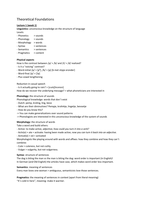
Lecture 1 (week 1)
Linguistics: unconscious knowledge on the structure of language
Levels:
- Phonetics > sounds
- Phonology > sounds
- Morphology > words
- Syntax > sentences
- Semantics > sentences
- Pragmatics > content
Physical aspects
How is the contrast between /p/ + /b/ and /t/ + /d/ realized?
- Is it a “voicing” contrast?
- Word-initial /p/ > [ph], /b/ > [p] [b met stipje eronder]
- Word-final /p/ > [ʔp]
- Plus vowel lengthening
Reduction in casual speech
- Is it actually going to rain? > [zɾækʃlɪnəreɪn]
How do we recover the underlying message? > what phoneticians are interested in
Phonology: the structure of sounds
Phonological knowledge: words that don’t exist
- Dutch: pemp, kroling, ling, bevo
- What are their diminutives? Pempje, krolinkje, lingetje, bevootje
- How do you know this?
-> You can make generalizations over sound patterns
-> Phonologists are interested in this unconscious knowledge of the system of sounds
Morphology: the structure of words
Take a word and build others:
- Active: to make active, adjective; how could you turn it into a verb?
- Activ(e) + ate = activate: having been made active; now you can turn it back into an adjective.
- Activat(e) + ed = activated
Morphologists like playing around with words and affixes: how they combine and how they can’t
combine:
- Cute > cuteness, but not cutity.
- Vulgar > vulgarity, but not vulgarness.
Syntax: structure of sentences
The dog is biting the man vs the man is biting the dog: word order is important (in English)!
In German (and Old English) the articles have case, which makes word order less important.
Semantics: meaning of sentences
Every man loves one woman > ambiguous, semanticists love those sentences.
Pragmatics: the meaning of sentences in context (apart from literal meaning)
“It’s cold in here”, meaning: make it warmer.
Lecture 1 (week 1)
Linguistics: unconscious knowledge on the structure of language
Levels:
- Phonetics > sounds
- Phonology > sounds
- Morphology > words
- Syntax > sentences
- Semantics > sentences
- Pragmatics > content
Physical aspects
How is the contrast between /p/ + /b/ and /t/ + /d/ realized?
- Is it a “voicing” contrast?
- Word-initial /p/ > [ph], /b/ > [p] [b met stipje eronder]
- Word-final /p/ > [ʔp]
- Plus vowel lengthening
Reduction in casual speech
- Is it actually going to rain? > [zɾækʃlɪnəreɪn]
How do we recover the underlying message? > what phoneticians are interested in
Phonology: the structure of sounds
Phonological knowledge: words that don’t exist
- Dutch: pemp, kroling, ling, bevo
- What are their diminutives? Pempje, krolinkje, lingetje, bevootje
- How do you know this?
-> You can make generalizations over sound patterns
-> Phonologists are interested in this unconscious knowledge of the system of sounds
Morphology: the structure of words
Take a word and build others:
- Active: to make active, adjective; how could you turn it into a verb?
- Activ(e) + ate = activate: having been made active; now you can turn it back into an adjective.
- Activat(e) + ed = activated
Morphologists like playing around with words and affixes: how they combine and how they can’t
combine:
- Cute > cuteness, but not cutity.
- Vulgar > vulgarity, but not vulgarness.
Syntax: structure of sentences
The dog is biting the man vs the man is biting the dog: word order is important (in English)!
In German (and Old English) the articles have case, which makes word order less important.
Semantics: meaning of sentences
Every man loves one woman > ambiguous, semanticists love those sentences.
Pragmatics: the meaning of sentences in context (apart from literal meaning)
“It’s cold in here”, meaning: make it warmer.