3.2 - Sources of Energy at the Coast
Factors that affect wave energy:
1. Wind strength – determined by pressure gradient
2. Duration of wind – the longer the wind blows, the more powerful waves become
3. Fetch – the distance of open water over which the wind blows
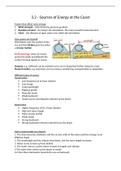
How waves are formed:
Wind blows over the surface of the
sea and that friction gives the water
a circular motion
Frictional drag= when air moves
across the water and disturbs the
surface forming ripples or waves
Outputs: e.g. sediment can be washed out to sea or deposited further along the coast.
Flows/transfers: e.g. processes such as erosion, weathering, transportation or deposition.
Different types of waves:
Constructive
Low frequency (6 to 8 per minute)
Low trough
Long wavelength
Elliptical profile
Powerful swash
Weak backwash
Swash carries and deposits materiel up the beach
Destructive
Higher frequency (10 to 14 per minute)
High and steep trough
More circular profile
Weak swash
Strong backwash
Strong backwash removes materiel from the beach
How a wave breaks on a beach:
1. The wave becomes shallower and the circular orbit of the water particles change to an
elliptical shape.
2. The wavelength and the velocity slow down, and the wave height increases.
3. Water starts to back up from behind
4. The water rises to a point where it starts to topple over (break)
5.The water then rushes up the beach as swash
6.It then flows backwards towards the sea as backwash.
Factors that affect wave energy:
1. Wind strength – determined by pressure gradient
2. Duration of wind – the longer the wind blows, the more powerful waves become
3. Fetch – the distance of open water over which the wind blows
How waves are formed:
Wind blows over the surface of the
sea and that friction gives the water
a circular motion
Frictional drag= when air moves
across the water and disturbs the
surface forming ripples or waves
Outputs: e.g. sediment can be washed out to sea or deposited further along the coast.
Flows/transfers: e.g. processes such as erosion, weathering, transportation or deposition.
Different types of waves:
Constructive
Low frequency (6 to 8 per minute)
Low trough
Long wavelength
Elliptical profile
Powerful swash
Weak backwash
Swash carries and deposits materiel up the beach
Destructive
Higher frequency (10 to 14 per minute)
High and steep trough
More circular profile
Weak swash
Strong backwash
Strong backwash removes materiel from the beach
How a wave breaks on a beach:
1. The wave becomes shallower and the circular orbit of the water particles change to an
elliptical shape.
2. The wavelength and the velocity slow down, and the wave height increases.
3. Water starts to back up from behind
4. The water rises to a point where it starts to topple over (break)
5.The water then rushes up the beach as swash
6.It then flows backwards towards the sea as backwash.