3.5 – Marine Processes
Erosional processes:
1. Hydraulic action: when air in cracks in cliffs is compressed when waves crash in,
pressure breaks off rock pieces.
2. Wave quarrying: when the energy of a wave as it breaks against a cliff is enough to
detach bits of rock.
3. Corrasion: when bits of rock and sediment is transported by waves and smash against
the cliff, breaking bits off.
Abrasion: “sandpapering effect as sediment is dragged up and down across the
shoreline
4. Solution (corrosion): when soluble rocks (limestone, chalk) get gradually dissolved by
the seawater
5. Cavitation: when the waves recede, the compressed air expands violently, again
exerting pressure on the rock and causing pieces to break off.
6. Attrition: when bits of rock in the water smash against each other and break into smaller
and more rounded pieces.
Factors affecting coastal erosion:
Waves – most erosion happens during winter when waves are destructive
Rock type – resistant consolidated rock (granite) erode slower than weak rock (clay)
Geological structure – cracks, joints, bedding planes and faults create weakness
Beach – beaches absorb wave energy and reduce impact of wave on cliff
Subaerial processes – weathering and mass movement create debris easily eroded
Coastal management – groynes and sea walls impact on sediment transfer and patterns
of wave energy
Transportation processes:
1. Traction: the rolling of coarse sediment along the seabed that is too heavy to be carried
2. Solution: when dissolved substances are carried in the water (e.g. limestone)
3. Suspension: smaller sediment picked up and carried within the flow of the water
4. Saltation: sediment bounced along the seabed (light enough to be picked up, too heavy
to remain within the flow of the water)
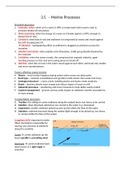
Longshore drift: important transfer
(flow) mechanism responsible for
moving vast amounts of sediment
along the coastline.
Swash carries sediment up the
beach parallel to prevailing wind
Backwash carries sediment back
down beach at a right angle to
shoreline
Erosional processes:
1. Hydraulic action: when air in cracks in cliffs is compressed when waves crash in,
pressure breaks off rock pieces.
2. Wave quarrying: when the energy of a wave as it breaks against a cliff is enough to
detach bits of rock.
3. Corrasion: when bits of rock and sediment is transported by waves and smash against
the cliff, breaking bits off.
Abrasion: “sandpapering effect as sediment is dragged up and down across the
shoreline
4. Solution (corrosion): when soluble rocks (limestone, chalk) get gradually dissolved by
the seawater
5. Cavitation: when the waves recede, the compressed air expands violently, again
exerting pressure on the rock and causing pieces to break off.
6. Attrition: when bits of rock in the water smash against each other and break into smaller
and more rounded pieces.
Factors affecting coastal erosion:
Waves – most erosion happens during winter when waves are destructive
Rock type – resistant consolidated rock (granite) erode slower than weak rock (clay)
Geological structure – cracks, joints, bedding planes and faults create weakness
Beach – beaches absorb wave energy and reduce impact of wave on cliff
Subaerial processes – weathering and mass movement create debris easily eroded
Coastal management – groynes and sea walls impact on sediment transfer and patterns
of wave energy
Transportation processes:
1. Traction: the rolling of coarse sediment along the seabed that is too heavy to be carried
2. Solution: when dissolved substances are carried in the water (e.g. limestone)
3. Suspension: smaller sediment picked up and carried within the flow of the water
4. Saltation: sediment bounced along the seabed (light enough to be picked up, too heavy
to remain within the flow of the water)
Longshore drift: important transfer
(flow) mechanism responsible for
moving vast amounts of sediment
along the coastline.
Swash carries sediment up the
beach parallel to prevailing wind
Backwash carries sediment back
down beach at a right angle to
shoreline