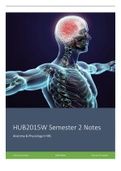
HUB2015W Semester 1 Notes
Anatomy & Physiology II HRS
Tammy van Druten VDRTAM002 3rd year OT student
, Table of Contents
Respiratory Anatomy Pg. 2
Respiratory Physiology
Pg. 26
Note: only up to lecture 4
CVS Anatomy Pg. 62
Head & Neck Pg. 111
Central Nervous System Pg. 189
Motor Function & Sensation
Pg. 255
Physiology
Neuro-embryology Pg. 295
Abdominal Wall, Pelvis, & Lower Back Pg. 327
Tammy van Druten HUB2015W
Semester 1 Notes 1
, HUB2015W
ANATOMY & PHYSIOLOGY II HRS
Topic 1
Respiratory Anatomy
LEARNING OBJECTIVES
1. Understand the components of the respiratory system
2. Understand and describe the functions of the respiratory system
3. Understand the functional and structural divisions of the respiratory system
4. Describe the components and organisation of the respiratory system
a) Nasal cavity
b) Paranasal sinuses
c) Pharynx
Why study the Respiratory System?
Physiotherapy Occupational Therapy
Patients • Increasing awareness, education,
• Obstructive and restrictive pulmonary training, advice on lifestyle and daily
diseases occupations
• Neuromuscular disorders
• Major surgery • Improve the independence of patients
• Critical illness in intensive care with respiratory disease in their
Chest Physiotherapy activities of daily living
• Mobilisation and removal of
secretions, and breathing exercises • Energy conservation and work
• Maintain or improve exercise simplification techniques for the
tolerance people with respiratory disease
• Improve functional abilities; carrying
out daily tasks • Promote strength, endurance, and
• Maintain and improve physical activity mobility
Improving Healthy Behaviour
• Reduce breathlessness and decreases
the work involved in breathing
• Improve the efficiency of ventilation
• Support weaning from mechanical
ventilation
• Reduce (thoracic pain)
Tammy van Druten HUB2015W
Semester 1 Notes 2
, Overview of the Respiratory System
• Comprised of:
→ Respiratory tract = the pathway via which air gets to the lungs
→ Lungs = contains structures for gaseous exchange (alveoli)
TERMINOLOGY
• VENTILATION
→ Movement of air into and out of lungs
→ Breathing
• RESPIRATION
→ Exchange of O2 and CO2 across membranes
→ External Respiration: Gaseous exchange between the lungs and the blood
→ Internal Respiration: Gaseous exchange between the blood and the tissues of the body
• TRANSPORT
→ Movement of O2 and CO2 in the blood by haemoglobin
Tammy van Druten HUB2015W
Semester 1 Notes 3
Anatomy & Physiology II HRS
Tammy van Druten VDRTAM002 3rd year OT student
, Table of Contents
Respiratory Anatomy Pg. 2
Respiratory Physiology
Pg. 26
Note: only up to lecture 4
CVS Anatomy Pg. 62
Head & Neck Pg. 111
Central Nervous System Pg. 189
Motor Function & Sensation
Pg. 255
Physiology
Neuro-embryology Pg. 295
Abdominal Wall, Pelvis, & Lower Back Pg. 327
Tammy van Druten HUB2015W
Semester 1 Notes 1
, HUB2015W
ANATOMY & PHYSIOLOGY II HRS
Topic 1
Respiratory Anatomy
LEARNING OBJECTIVES
1. Understand the components of the respiratory system
2. Understand and describe the functions of the respiratory system
3. Understand the functional and structural divisions of the respiratory system
4. Describe the components and organisation of the respiratory system
a) Nasal cavity
b) Paranasal sinuses
c) Pharynx
Why study the Respiratory System?
Physiotherapy Occupational Therapy
Patients • Increasing awareness, education,
• Obstructive and restrictive pulmonary training, advice on lifestyle and daily
diseases occupations
• Neuromuscular disorders
• Major surgery • Improve the independence of patients
• Critical illness in intensive care with respiratory disease in their
Chest Physiotherapy activities of daily living
• Mobilisation and removal of
secretions, and breathing exercises • Energy conservation and work
• Maintain or improve exercise simplification techniques for the
tolerance people with respiratory disease
• Improve functional abilities; carrying
out daily tasks • Promote strength, endurance, and
• Maintain and improve physical activity mobility
Improving Healthy Behaviour
• Reduce breathlessness and decreases
the work involved in breathing
• Improve the efficiency of ventilation
• Support weaning from mechanical
ventilation
• Reduce (thoracic pain)
Tammy van Druten HUB2015W
Semester 1 Notes 2
, Overview of the Respiratory System
• Comprised of:
→ Respiratory tract = the pathway via which air gets to the lungs
→ Lungs = contains structures for gaseous exchange (alveoli)
TERMINOLOGY
• VENTILATION
→ Movement of air into and out of lungs
→ Breathing
• RESPIRATION
→ Exchange of O2 and CO2 across membranes
→ External Respiration: Gaseous exchange between the lungs and the blood
→ Internal Respiration: Gaseous exchange between the blood and the tissues of the body
• TRANSPORT
→ Movement of O2 and CO2 in the blood by haemoglobin
Tammy van Druten HUB2015W
Semester 1 Notes 3