Intermediate financial accounting – college 1
What is accounting?
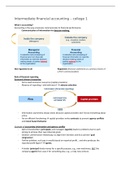
Accounting is the way a business communicates its financial performance.
Communication of information for decision-making.
Not regulated at all Regulated (financial statements as a primary means of
a firm’s communication).
Role of financial reporting
Economic (theory) reasoning
- Firms need economic resources (capital providers)
- Absence of reporting = wild wild west!! adverse selection
- Information asymmetry always exists because capital providers don’t know everything about
a firm.
- For an efficient functioning capital providers write contracts to prevent agency conflicts
and moral hazard behavior.
Example of accounting information and agency conflict
- Split of shareholders (principals) and managers (agents) leads to problems due to each
aiming to achieve their own (diverse) goals.
- Solution: performance-related pay, to align their interests and thus achieve ‘goal
congruence’.
- Further problem: such pay is usually based on reported profit… and who produces the
reported profit figure? agents.
- A lender (principal) lends money for a specific purpose, e.g., new machinery, BUT the
company (agent) then uses it for something else, e.g., a risky new venture.
, different goals, need for an aligning contract (here the loan covenant includes ratios such as
gearing/leverage to limit the agent’s ability to “misuse” the funds).
- Ratios are based on accounting numbers, produced by ….?
The objective of financial reporting is to provide financial information about the reporting entity that
is useful to present and potential equity investors, lenders and other creditors in making decisions
about providing resources to the entity.
In addition to decision-usefulness, financial reporting has also a stewardship purpose.
- If owners assign stewardship of their company to management, they wish to have the ability
to oversee management behavior to ensure that:
o It is aligned to the owners’ objectives
o Management are devising strategies aimed at making the best use of company assets
o No misappropriation of the company assets takes place.
Our focus in this course
- Annual report (consolidated) financial statements
Annual report vs. financial statements
Annual report
- General non-standard summary of company activities
- It includes financial statements, but many other things (e.g., CEO letter, employee and
gender issues, operation improvements, new technological developments)
- Distributed through media, firm websites, etc.
Financial statements (F/S) regulated by Generally Accepted Accounting Principles (GAAP)
- Must be deposited into national registers. For example:
o Kamer van Koophandel (KvK)
- Must comply with accounting standards (e.g., German GAAP)
- Usually include all financial statements and notes
o Depending on firm characteristics
Financial statements
- Statement of financial position – SOFP (aka Balance Sheet – BS)
- (Comprehensive) income statement – IS (aka Profit & Loss – P&L)
- Statement of cash flows
- Statement of changes in shareholders’ equity
Accompanying notes to the above F/S are also mandatory.
,Financial reporting standards
To satisfy the need for financial reporting, governments establish a set of rules Generally Accepted
Accounting Principles (GAAP)
A lot of developed countries have their own accounting standards:
- US GAAP
- UK GAAP
- Plan Comptable Général (France)
- Plan Genaral Contrable (Spain)
- Dutch GAAP
BUT a need for an international set of accounting standards was obvious.
Single set of rules (established by a single standard-setting body) that is:
- High-quality
- Understandable
- Enforceable
- Globally accepted
- Comparable
To ensure that relevant and faithful information is disclosed International Financial Reporting
Standards (IFRS).
Development of IFRS
1. International Accounting Standard Committee (IASC) – founded 1973 2001
2. International Accounting Standard Board (IASB) – Since 2001
1. IAS 1 to 41 (International Accounting Standards)
2. IFRS 1 to 17 (International Financial Reporting Standards) (at Sep. 2020)
From 1997 to 2002: SIC (Standard Interpretations Committee)
Since 2002: IFRIC (International Financial Reporting Interpretations Committee)
IFRS standard-setting structure
, IASB due process – “approval of a standard”
Standard setting through an open due process
1. The IASB establishes an Advisory Council to give advice on issues arising from a project.
2. Continuous consultation between IASB and the IFRS Advisory. Council throughout the
process.
3. Discussion documents are prepared for public consultation.
4. Comments are received and reviewed. IASB prepares and publishes an ‘exposure draft’ for
public comment (approval by 9 IASB members required).
5. Comments are received and reviewed. IASB issues a ‘final draft’.
6. Standards are published with basis for conclusions to assist users in their application.
IASB pronouncements
The IASB issues three major types of pronouncements:
1. International Financial Reporting Standards (IFRS)
2. Conceptual Framework of Financial Reporting
3. International Financial Reporting Standards Interpretations (IFRSI).
Hierarchy of IFRS
- The IASB is a private organization and has no regulatory mandate nor enforcement
mechanism.
- The IASB relies on other regulators to enforce the use of its standards
o E.g., The European Union requires publicly traded member country companies to use
IFRS.
- In order to determine what recognition, valuation, and disclosure requirements should be
used, companies follow a hierarchy:
1. International Financial Reporting Standards (IFRS), IAS and IFRS interpretations
2. Conceptual Framework for Financial reporting
3. Pronouncements of other standard-setting bodies that use a similar conceptual framework
(e.g., US GAAP).
What is accounting?
Accounting is the way a business communicates its financial performance.
Communication of information for decision-making.
Not regulated at all Regulated (financial statements as a primary means of
a firm’s communication).
Role of financial reporting
Economic (theory) reasoning
- Firms need economic resources (capital providers)
- Absence of reporting = wild wild west!! adverse selection
- Information asymmetry always exists because capital providers don’t know everything about
a firm.
- For an efficient functioning capital providers write contracts to prevent agency conflicts
and moral hazard behavior.
Example of accounting information and agency conflict
- Split of shareholders (principals) and managers (agents) leads to problems due to each
aiming to achieve their own (diverse) goals.
- Solution: performance-related pay, to align their interests and thus achieve ‘goal
congruence’.
- Further problem: such pay is usually based on reported profit… and who produces the
reported profit figure? agents.
- A lender (principal) lends money for a specific purpose, e.g., new machinery, BUT the
company (agent) then uses it for something else, e.g., a risky new venture.
, different goals, need for an aligning contract (here the loan covenant includes ratios such as
gearing/leverage to limit the agent’s ability to “misuse” the funds).
- Ratios are based on accounting numbers, produced by ….?
The objective of financial reporting is to provide financial information about the reporting entity that
is useful to present and potential equity investors, lenders and other creditors in making decisions
about providing resources to the entity.
In addition to decision-usefulness, financial reporting has also a stewardship purpose.
- If owners assign stewardship of their company to management, they wish to have the ability
to oversee management behavior to ensure that:
o It is aligned to the owners’ objectives
o Management are devising strategies aimed at making the best use of company assets
o No misappropriation of the company assets takes place.
Our focus in this course
- Annual report (consolidated) financial statements
Annual report vs. financial statements
Annual report
- General non-standard summary of company activities
- It includes financial statements, but many other things (e.g., CEO letter, employee and
gender issues, operation improvements, new technological developments)
- Distributed through media, firm websites, etc.
Financial statements (F/S) regulated by Generally Accepted Accounting Principles (GAAP)
- Must be deposited into national registers. For example:
o Kamer van Koophandel (KvK)
- Must comply with accounting standards (e.g., German GAAP)
- Usually include all financial statements and notes
o Depending on firm characteristics
Financial statements
- Statement of financial position – SOFP (aka Balance Sheet – BS)
- (Comprehensive) income statement – IS (aka Profit & Loss – P&L)
- Statement of cash flows
- Statement of changes in shareholders’ equity
Accompanying notes to the above F/S are also mandatory.
,Financial reporting standards
To satisfy the need for financial reporting, governments establish a set of rules Generally Accepted
Accounting Principles (GAAP)
A lot of developed countries have their own accounting standards:
- US GAAP
- UK GAAP
- Plan Comptable Général (France)
- Plan Genaral Contrable (Spain)
- Dutch GAAP
BUT a need for an international set of accounting standards was obvious.
Single set of rules (established by a single standard-setting body) that is:
- High-quality
- Understandable
- Enforceable
- Globally accepted
- Comparable
To ensure that relevant and faithful information is disclosed International Financial Reporting
Standards (IFRS).
Development of IFRS
1. International Accounting Standard Committee (IASC) – founded 1973 2001
2. International Accounting Standard Board (IASB) – Since 2001
1. IAS 1 to 41 (International Accounting Standards)
2. IFRS 1 to 17 (International Financial Reporting Standards) (at Sep. 2020)
From 1997 to 2002: SIC (Standard Interpretations Committee)
Since 2002: IFRIC (International Financial Reporting Interpretations Committee)
IFRS standard-setting structure
, IASB due process – “approval of a standard”
Standard setting through an open due process
1. The IASB establishes an Advisory Council to give advice on issues arising from a project.
2. Continuous consultation between IASB and the IFRS Advisory. Council throughout the
process.
3. Discussion documents are prepared for public consultation.
4. Comments are received and reviewed. IASB prepares and publishes an ‘exposure draft’ for
public comment (approval by 9 IASB members required).
5. Comments are received and reviewed. IASB issues a ‘final draft’.
6. Standards are published with basis for conclusions to assist users in their application.
IASB pronouncements
The IASB issues three major types of pronouncements:
1. International Financial Reporting Standards (IFRS)
2. Conceptual Framework of Financial Reporting
3. International Financial Reporting Standards Interpretations (IFRSI).
Hierarchy of IFRS
- The IASB is a private organization and has no regulatory mandate nor enforcement
mechanism.
- The IASB relies on other regulators to enforce the use of its standards
o E.g., The European Union requires publicly traded member country companies to use
IFRS.
- In order to determine what recognition, valuation, and disclosure requirements should be
used, companies follow a hierarchy:
1. International Financial Reporting Standards (IFRS), IAS and IFRS interpretations
2. Conceptual Framework for Financial reporting
3. Pronouncements of other standard-setting bodies that use a similar conceptual framework
(e.g., US GAAP).