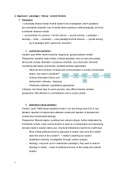
2. Approach - paradigm - theory - central themes
1) Paradigms
= universally shared model of what needs to be investigated, which questions
are considered essential, how to tackle these questions methodologically, and how
to interpret research results
→ accumulated via ruptures: ‘normal science → puzzle-solving → paradigm→
anomaly→ crisis → revolution → new paradigm/normal science → puzzle solving’
eg of paradigm shift; copernican revolution
a. mainstream paradigm
Context: post WWII, North American hegemony, growing bipolar context
Perspective: powerful mass media, a liberal-pluralistic view on man and society;
democratic society, liberalism, consensus-oriented, very structured, informed,
countering alternative (communist, socialist) societal organisation
- What are the functions of media and communication in society (functionalist
ideas), how does it contribute?
- Follows information theory and
behaviorism; stimulus - response
- Positivistic methods / quantitative approaches
Critiques; very linear idea of comm process, very effect-oriented, western
perspective, little attention to contradictions and to social context
b. alternative critical paradigm
Context: (post 1968) liberal-capitalist model is not how things work (US is very
divided), rejection of rational and utilitarian model and rejection of pluralist and
conservative functionalist ideology
Perspective: Marxist origins; a political and cultural critique, further elaborated by
Frankfurter schule, mass communication is seen as a manipulative and repressing
process made to sustain status quo, structural imbalances need to be overthrown
- More critical political-economy approach to media; who owns the media?
does this show in the content? → media is anything but neutral
- Qualitative methods, investigation through content analysis
- Ideology = key term (not in mainstream paradigm), they want to look for
ideology in media → basis of political-economy of the media and cultural
studies
1
, Theory:
= a logical set of connected (non-conflicting) statements, ideas and concepts
regarding (part of) empirical reality, formulated to induce testable hypotheses
→ gives a general explanation, an abstract way to understand communication
process, guides research in a particular direction
2) Classifying theories
→ fundamental differentiation in outlook on man and society, inclined towards
different/competing dimensions of several dichotomies
→ to clearly distinguish the different theories
a. Structure - agency
How are individuals connected in society?
structure agency
- explanations in terms of, determinism, - explanations in terms of freedom, choice,
social pressure, public opinion individuality, free will
- considering individuals as passive, they - considering individuals as active, they act
act within fixed structure on their own
- social structure determines the activities - structures are the result of the activities
and actions of individuals and actions of autonomous individuals
→ autonomous identity of social structures
b. Consensus - conflict
How do societies change?
consensus conflict
- evolutionary/linear approach; - social disorder and conflict
evolution→consensus→ progress
- social agents provoking conflict; class
- functionalist approach; complex and struggles
self-regulating system
- changes and ruptures
- continuity
2
1) Paradigms
= universally shared model of what needs to be investigated, which questions
are considered essential, how to tackle these questions methodologically, and how
to interpret research results
→ accumulated via ruptures: ‘normal science → puzzle-solving → paradigm→
anomaly→ crisis → revolution → new paradigm/normal science → puzzle solving’
eg of paradigm shift; copernican revolution
a. mainstream paradigm
Context: post WWII, North American hegemony, growing bipolar context
Perspective: powerful mass media, a liberal-pluralistic view on man and society;
democratic society, liberalism, consensus-oriented, very structured, informed,
countering alternative (communist, socialist) societal organisation
- What are the functions of media and communication in society (functionalist
ideas), how does it contribute?
- Follows information theory and
behaviorism; stimulus - response
- Positivistic methods / quantitative approaches
Critiques; very linear idea of comm process, very effect-oriented, western
perspective, little attention to contradictions and to social context
b. alternative critical paradigm
Context: (post 1968) liberal-capitalist model is not how things work (US is very
divided), rejection of rational and utilitarian model and rejection of pluralist and
conservative functionalist ideology
Perspective: Marxist origins; a political and cultural critique, further elaborated by
Frankfurter schule, mass communication is seen as a manipulative and repressing
process made to sustain status quo, structural imbalances need to be overthrown
- More critical political-economy approach to media; who owns the media?
does this show in the content? → media is anything but neutral
- Qualitative methods, investigation through content analysis
- Ideology = key term (not in mainstream paradigm), they want to look for
ideology in media → basis of political-economy of the media and cultural
studies
1
, Theory:
= a logical set of connected (non-conflicting) statements, ideas and concepts
regarding (part of) empirical reality, formulated to induce testable hypotheses
→ gives a general explanation, an abstract way to understand communication
process, guides research in a particular direction
2) Classifying theories
→ fundamental differentiation in outlook on man and society, inclined towards
different/competing dimensions of several dichotomies
→ to clearly distinguish the different theories
a. Structure - agency
How are individuals connected in society?
structure agency
- explanations in terms of, determinism, - explanations in terms of freedom, choice,
social pressure, public opinion individuality, free will
- considering individuals as passive, they - considering individuals as active, they act
act within fixed structure on their own
- social structure determines the activities - structures are the result of the activities
and actions of individuals and actions of autonomous individuals
→ autonomous identity of social structures
b. Consensus - conflict
How do societies change?
consensus conflict
- evolutionary/linear approach; - social disorder and conflict
evolution→consensus→ progress
- social agents provoking conflict; class
- functionalist approach; complex and struggles
self-regulating system
- changes and ruptures
- continuity
2