Bone structure and function
Florianne van Schaardenburgh – 2022
Lecture 1 – week 1
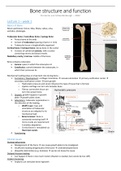
Basics of Bone
Most used bones: femur, tibia, fibula, radius, ulna,
vertebra, phalanges.
Trabecular bone / Cancellous bone / spongy bone:
• Porous bone at the ends
• Consist of trabeculae (spacing of pore ± 1 mm)
• Trabecular tissue is longitudinally organized
Cortical bone / Compact bone: dense bone in the center
• Consists of cylindrical osteons, with a center
containing nerves and blood vessels.
Medullary cavity / marrow: middle of the bone
Bone contains osteocytes
• Lacuna: space in which the osteocytes sit
• Canaliculus: cannels between the osteocytes, in
which their processes lie
Mechanical loading plays an important role during bone…
1. Formation / Development: cartilage mineralizes → neovascularization → primary ossification center →
secondary ossification center → bone growth
o Hydrostatic pressure and strain influence the type of tissue that is formed.
o Hyaline cartilage can turn into lamellar bone
o Fibrous connective tissue can
turn into woven bone.
2. Growth: growth happens in growth
plate → growth plate closes.
3. Adaptation: trabecular organization in
the direction of the loading.
o Wollf’s Law: mass and
orientation of trabecular
structure are adapted to its
mechanical load
o Bone turnover: bone is
constantly renewing itself →
micro-cracks are repaired and
it enables adaptation.
o Cortical bone is remodeled via
Haversian canals.
4. Functioning
Clinical issues
Skeletal deformities
• Misalignment of the force → can cause growth plate to be misaligned.
• Insufficient loading (magnitude) of the bone → underdeveloped bone
• Idiopathic deformities (e.g. Scoliosis) → we do not know the cause
Delayed fracture healing
• Can happen if there is too much motion (fixation is needed, but cannot be too stiff)
Implant loosening
• Implants can stimulate bone ingrowth
, • Major problems: loosening/insufficient ingrowth, bone resorption around implant
• Implants can remove load from bone which can slow down bone formation → stress shielding
Osteoarthritis
• Joint disease: affects cartilage, subchondral bone and synovial fluid
Osteoporosis
= Affection of the skeleton characterized by low bone mass, microarchitectural
changes and increased fragility. WHO definition: Bone Mineral Density (BMD) less
than 2.5 SD from the average at the age of 30.
• 1 SD below the average = osteopenic
• T-score: number of SDs from the average at the age of 30
• Z-score: number of SDs from the average of your age group
The bone mass changes over a lifetime (peak around 30 years). Females
experience a further and faster loss in bone mass than men after menopause.
BMD / areal Bone Mineral Density (aBMD) is measured via a Quantitative
measurement of bone density (DEXA).
• Is not a volumetric density, but is size-dependent (measured in cm2).
• Bone Mineral Content (BMC) is also measured (in grams).
𝑀 𝜋 𝑟2 𝑙 𝜌 𝜋𝑟
• 𝑎𝐷𝑀𝐵 = 𝐴
= 2𝑟𝑙
= 𝑙
𝜌
Incidence is 50% in women over 50, 90% in women over 75 and 30% in men over 50. Estrogen reduces osteoclast
activity. Low estrogen levels in women. After menopause can lead to osteoporosis.
Risk factors: female over 50 years, Nordic Caucasian, Physical inactivity, vitamin D deficiency, low weight, calcium
deficiency, alcohol, coffee, smoking, medication.
Real problem: increased risk of bone fractures. Often occur in the hip, wrist and vertebrae.
• Vertebral fractures sometimes go unnoticed.
• Wrist fractures typically heal well
• Hip fractures can be very dangerous (increased mortality)
Challenge: identify the patients that need treatment
• BMD is not an accurate predictor of bone fracture risk → more accurate
diagnosis is needed
• Improvement: FRAX (stochastic model that account for risk factors and
BMD) (provides the 10-year probability of a major osteoporotic fracture)
Treatments:
• Pharmacological
o Hormone Replacement Therapy (HRT/ERT) → side effect: increased risk of breast cancer
o Selective Estrogen Receptor Modulator (SERM)
o Bisphosphonates (alendronate, zoledronate, …) → will reduce osteoclast activity (most common)
o Parathyroid Hormone (PTH)
o Sclerostin antibody (Romosozumab) → still in test phase
o Vitamin D and calcium suppletion → only works if there is
insufficient of those
• Intervention: vertebroplasty
• Exercise: improve bone mass / strength
Reduction of fracture risk: increase bone strength, reduce the incidence
of falls, reduce impact of fall.
, Lecture 2 – week 1 – Bone cells
Specific bone cells:
• Osteoblasts: from bone tissue, secrete bone matrix.
o Stem from osteogenic cells → pre-
osteoblasts → osteoblasts → (if embedded in their own
matrix) osteocytes
o Not active osteoblasts: bone lining cells / resting or
inactive osteoblasts / surface osteocytes
• Osteocytes: are embedded in the bone matrix where they keep
the tissue alive and act as mechanosensors
• Osteoclasts: resorb damaged or superfluous bone tissue and
contribute crucially to bone shape
o Monocytes → pre-osteoclast → osteoclasts (can also come from macrophages)
Unspecific bone cells: (have indirect involvement in the bone tissue)
• Endothelial cells, smooth muscle cells → blood vessels
• Erythrocytes, leukocytes, thrombocytes → blood
• Nerve fibers, Schwann cells → nerve system
• Fibrocytes, fibroblasts → connective tissue
• Stem cells, blood cells → bone marrow
• Adipocytes → reticular connective tissue
• Macrophages, lymphocytes → immune system
Distinction of cells by: morphology (flat, cuboid, stellar, …), function (bone forming / resorbing / mechnosensing / …),
location (bone marrow, bone surface, embedded, …).
Histological images
Histology = the study of microscopic anatomy of cells and tissues of plants and
animals.
• The (chemical) fixation of the tissue can cause artifact.
• The angle at which the samples are cut can result in very different
images.
• Most used stain: Hematoxylin and Eosin stain (H&E stain) → used to get
an overview
o Hematoxylin colors nuclei of cells blue/purple
o Eosin colors basophilic/eosinophilic structures red/pink/orange
Osteoblasts
When active: cuboidal, 15 – 30 m diameter. Form an epithelium-like
layer. Functions:
1. produce bone matrix;
• Produce a collagen layer= osteoid
o Unmineralized portion of bone matrix.
o Osteoid consists of collagen type I + non-
collagenous proteins + ground substance (chondroitin sulfate + osteocalcin).
o Prior to maturation into bone tissue (50% of bone volume, 40% of bone weight).
• Produce alkaline phosphatase (ALP) → catalyzes mineralization
• Produce non-collagenous proteins: bone sialoprotein, osteopontin, osteonectin
2. Regulate the calcium and phosphate homeostasis
3. Regulate the hematopoiesis (blood formation)
4. Mechanosensors (at least in vitro)
Florianne van Schaardenburgh – 2022
Lecture 1 – week 1
Basics of Bone
Most used bones: femur, tibia, fibula, radius, ulna,
vertebra, phalanges.
Trabecular bone / Cancellous bone / spongy bone:
• Porous bone at the ends
• Consist of trabeculae (spacing of pore ± 1 mm)
• Trabecular tissue is longitudinally organized
Cortical bone / Compact bone: dense bone in the center
• Consists of cylindrical osteons, with a center
containing nerves and blood vessels.
Medullary cavity / marrow: middle of the bone
Bone contains osteocytes
• Lacuna: space in which the osteocytes sit
• Canaliculus: cannels between the osteocytes, in
which their processes lie
Mechanical loading plays an important role during bone…
1. Formation / Development: cartilage mineralizes → neovascularization → primary ossification center →
secondary ossification center → bone growth
o Hydrostatic pressure and strain influence the type of tissue that is formed.
o Hyaline cartilage can turn into lamellar bone
o Fibrous connective tissue can
turn into woven bone.
2. Growth: growth happens in growth
plate → growth plate closes.
3. Adaptation: trabecular organization in
the direction of the loading.
o Wollf’s Law: mass and
orientation of trabecular
structure are adapted to its
mechanical load
o Bone turnover: bone is
constantly renewing itself →
micro-cracks are repaired and
it enables adaptation.
o Cortical bone is remodeled via
Haversian canals.
4. Functioning
Clinical issues
Skeletal deformities
• Misalignment of the force → can cause growth plate to be misaligned.
• Insufficient loading (magnitude) of the bone → underdeveloped bone
• Idiopathic deformities (e.g. Scoliosis) → we do not know the cause
Delayed fracture healing
• Can happen if there is too much motion (fixation is needed, but cannot be too stiff)
Implant loosening
• Implants can stimulate bone ingrowth
, • Major problems: loosening/insufficient ingrowth, bone resorption around implant
• Implants can remove load from bone which can slow down bone formation → stress shielding
Osteoarthritis
• Joint disease: affects cartilage, subchondral bone and synovial fluid
Osteoporosis
= Affection of the skeleton characterized by low bone mass, microarchitectural
changes and increased fragility. WHO definition: Bone Mineral Density (BMD) less
than 2.5 SD from the average at the age of 30.
• 1 SD below the average = osteopenic
• T-score: number of SDs from the average at the age of 30
• Z-score: number of SDs from the average of your age group
The bone mass changes over a lifetime (peak around 30 years). Females
experience a further and faster loss in bone mass than men after menopause.
BMD / areal Bone Mineral Density (aBMD) is measured via a Quantitative
measurement of bone density (DEXA).
• Is not a volumetric density, but is size-dependent (measured in cm2).
• Bone Mineral Content (BMC) is also measured (in grams).
𝑀 𝜋 𝑟2 𝑙 𝜌 𝜋𝑟
• 𝑎𝐷𝑀𝐵 = 𝐴
= 2𝑟𝑙
= 𝑙
𝜌
Incidence is 50% in women over 50, 90% in women over 75 and 30% in men over 50. Estrogen reduces osteoclast
activity. Low estrogen levels in women. After menopause can lead to osteoporosis.
Risk factors: female over 50 years, Nordic Caucasian, Physical inactivity, vitamin D deficiency, low weight, calcium
deficiency, alcohol, coffee, smoking, medication.
Real problem: increased risk of bone fractures. Often occur in the hip, wrist and vertebrae.
• Vertebral fractures sometimes go unnoticed.
• Wrist fractures typically heal well
• Hip fractures can be very dangerous (increased mortality)
Challenge: identify the patients that need treatment
• BMD is not an accurate predictor of bone fracture risk → more accurate
diagnosis is needed
• Improvement: FRAX (stochastic model that account for risk factors and
BMD) (provides the 10-year probability of a major osteoporotic fracture)
Treatments:
• Pharmacological
o Hormone Replacement Therapy (HRT/ERT) → side effect: increased risk of breast cancer
o Selective Estrogen Receptor Modulator (SERM)
o Bisphosphonates (alendronate, zoledronate, …) → will reduce osteoclast activity (most common)
o Parathyroid Hormone (PTH)
o Sclerostin antibody (Romosozumab) → still in test phase
o Vitamin D and calcium suppletion → only works if there is
insufficient of those
• Intervention: vertebroplasty
• Exercise: improve bone mass / strength
Reduction of fracture risk: increase bone strength, reduce the incidence
of falls, reduce impact of fall.
, Lecture 2 – week 1 – Bone cells
Specific bone cells:
• Osteoblasts: from bone tissue, secrete bone matrix.
o Stem from osteogenic cells → pre-
osteoblasts → osteoblasts → (if embedded in their own
matrix) osteocytes
o Not active osteoblasts: bone lining cells / resting or
inactive osteoblasts / surface osteocytes
• Osteocytes: are embedded in the bone matrix where they keep
the tissue alive and act as mechanosensors
• Osteoclasts: resorb damaged or superfluous bone tissue and
contribute crucially to bone shape
o Monocytes → pre-osteoclast → osteoclasts (can also come from macrophages)
Unspecific bone cells: (have indirect involvement in the bone tissue)
• Endothelial cells, smooth muscle cells → blood vessels
• Erythrocytes, leukocytes, thrombocytes → blood
• Nerve fibers, Schwann cells → nerve system
• Fibrocytes, fibroblasts → connective tissue
• Stem cells, blood cells → bone marrow
• Adipocytes → reticular connective tissue
• Macrophages, lymphocytes → immune system
Distinction of cells by: morphology (flat, cuboid, stellar, …), function (bone forming / resorbing / mechnosensing / …),
location (bone marrow, bone surface, embedded, …).
Histological images
Histology = the study of microscopic anatomy of cells and tissues of plants and
animals.
• The (chemical) fixation of the tissue can cause artifact.
• The angle at which the samples are cut can result in very different
images.
• Most used stain: Hematoxylin and Eosin stain (H&E stain) → used to get
an overview
o Hematoxylin colors nuclei of cells blue/purple
o Eosin colors basophilic/eosinophilic structures red/pink/orange
Osteoblasts
When active: cuboidal, 15 – 30 m diameter. Form an epithelium-like
layer. Functions:
1. produce bone matrix;
• Produce a collagen layer= osteoid
o Unmineralized portion of bone matrix.
o Osteoid consists of collagen type I + non-
collagenous proteins + ground substance (chondroitin sulfate + osteocalcin).
o Prior to maturation into bone tissue (50% of bone volume, 40% of bone weight).
• Produce alkaline phosphatase (ALP) → catalyzes mineralization
• Produce non-collagenous proteins: bone sialoprotein, osteopontin, osteonectin
2. Regulate the calcium and phosphate homeostasis
3. Regulate the hematopoiesis (blood formation)
4. Mechanosensors (at least in vitro)