Unit 13: Applications of Inorganic Chemistry
C: Investigate a range of reactions involving solutions of transition metal ions in order
to understand the basis for their qualitative analysis.
Index.
Introduction,
Features of transition metal complexes,
Observations from practical work reactions of transition metal complexes,
Explained results of practical work involving transition metal complexes,
Reactions of transition metal complexes from practical work to show how
metal ions may be identified from the reactions that they undergo,
References.
Introduction.
This report will show the features of transition metal complexes and observations from practical work
reactions of transition metal complexes. It will also include an explanation of results from practical
work involving transition metal complexes. Finally the reactions of transition metal complexes from
practical work to show how metal ions may be identified from thee reactions that they undergo.
Transition Metals.
Transition metal characteristics arise from an incomplete d sub-level.
These characteristics include complex formation, high density, high melting points, formation of
coloured ions, variable oxidation state and catalytic activity.
Definitions
Transition Metals; Transition metals are elements that belong to the d block of the periodic table,
however aluminium does not; instead, it is located in the p block. Transition metals are metals with an
incomplete d sub level. Their electrons can create chemical interactions in more than one shell as a
result of this.
Complex ions: A complex ion is one that has a transition metal in the centre attached by dative
covalent bonds to other molecules and/or ions.
Ligand: Ligands are neutral molecules or ions that form a connection with the metal ion or
atom in the centre. They serve as electron pair donors, whereas the central atom to which
they are linked serves as an acceptor of electron pairs.
Lone Pair: This is the name given to the valence electron pair that are found in the further layer in
the molecule/atom, that are not attached or being shared with any other compounds.
Co-ordination Number: The co-ordination number of an atom is the number that represents how
many bond that atom is attached to.
Octahedral: This just considers the geometry of the bonds with the central atom and excludes any
changes between the ligands. The d subshell equality is removed in an octahedral complex. The
geometric arrangement becomes more intricate, and the metal ion's coordination number rises to six.
The octahedron has 8 planes and a square planar with ligands above and below the plane.
Bidentate: Name given to the bond (when it’s double) between the central atom and the
molecule/atom that it is attached to.
1
, Tetrahedral: This is where the central atom of an object is surrounded by four other atoms that are
bonded to the central one. These are the four different corners of the tetrahedron. When all four
substituent atoms are the same then the bond angles are roughly 109.5 degrees.
Square planar: When a centre atom is surrounded by constituent atoms, the corners of a square
are formed on the same plane. Transition metal complexes with d8 configurations also have a square
planar shape. The square planar depicts the spatial arrangement of the atoms, and this planar
contains several sets of orbitals, each with its own set of energies.
Practical
Risk Assessment.
Hydrochloric acid – Corrosive,
Sodium Hydroxide – Corrosive,
Ammonium Hydroxide – Corrosive,
Sodium Carbonate – Irritant,
Ammonia – Irritant.
Ammonium Iron Sulphate – Harmful and corrosive,
Iron 3 Chloride – Harmful and Corrosive,
Chromium Chloride – Toxic,
Iron Sulphate – Harmful and Corrosive,
Copper Sulphate – Harmful and Corrosive.
During this practical you will encounter chemicals that are extremely corrosive harmful and sometimes
toxic. To minimise risk of harming yourself you should wear gloves where necessary and be extra
careful when handling the corrosive substances. You should also wear eye protection at all times to
ensure your eyes don’t come into contact with any of the harmful substances. If any spillages occur
you should clean them up immediately this includes glassware as if there are any breakages you don’t
want to cut yourself. Lastly to ensure good ventilation you should have windows open.
Equipment.
Test Tubes,
Test Tube Rack,
Pipette,
Measuring Cylinder,
Hydrochloric Acid,
Sodium Hydroxide,
Ammonium Hydroxide,
Sodium Carbonate
Ammonia,
Iron 3 Chloride,
Chromium Chloride,
Iron Sulphate,
Copper Sulphate
Method.
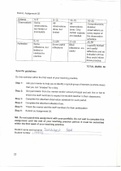
The method for this practical was to add 2M of sodium hydroxide one drop at a time into the solution.
This is done until an excess is present. Then add 2M of ammonium hydroxide solution, also one drop
at a time, again until excess is present. 1.5M of sodium carbonate is added one drop at a time until
excess is present again. One drop at a time add concentrated ammonia solution until excess is
present. Add again one drop of hydrochloric acid until an excess is present.
Results.
2
C: Investigate a range of reactions involving solutions of transition metal ions in order
to understand the basis for their qualitative analysis.
Index.
Introduction,
Features of transition metal complexes,
Observations from practical work reactions of transition metal complexes,
Explained results of practical work involving transition metal complexes,
Reactions of transition metal complexes from practical work to show how
metal ions may be identified from the reactions that they undergo,
References.
Introduction.
This report will show the features of transition metal complexes and observations from practical work
reactions of transition metal complexes. It will also include an explanation of results from practical
work involving transition metal complexes. Finally the reactions of transition metal complexes from
practical work to show how metal ions may be identified from thee reactions that they undergo.
Transition Metals.
Transition metal characteristics arise from an incomplete d sub-level.
These characteristics include complex formation, high density, high melting points, formation of
coloured ions, variable oxidation state and catalytic activity.
Definitions
Transition Metals; Transition metals are elements that belong to the d block of the periodic table,
however aluminium does not; instead, it is located in the p block. Transition metals are metals with an
incomplete d sub level. Their electrons can create chemical interactions in more than one shell as a
result of this.
Complex ions: A complex ion is one that has a transition metal in the centre attached by dative
covalent bonds to other molecules and/or ions.
Ligand: Ligands are neutral molecules or ions that form a connection with the metal ion or
atom in the centre. They serve as electron pair donors, whereas the central atom to which
they are linked serves as an acceptor of electron pairs.
Lone Pair: This is the name given to the valence electron pair that are found in the further layer in
the molecule/atom, that are not attached or being shared with any other compounds.
Co-ordination Number: The co-ordination number of an atom is the number that represents how
many bond that atom is attached to.
Octahedral: This just considers the geometry of the bonds with the central atom and excludes any
changes between the ligands. The d subshell equality is removed in an octahedral complex. The
geometric arrangement becomes more intricate, and the metal ion's coordination number rises to six.
The octahedron has 8 planes and a square planar with ligands above and below the plane.
Bidentate: Name given to the bond (when it’s double) between the central atom and the
molecule/atom that it is attached to.
1
, Tetrahedral: This is where the central atom of an object is surrounded by four other atoms that are
bonded to the central one. These are the four different corners of the tetrahedron. When all four
substituent atoms are the same then the bond angles are roughly 109.5 degrees.
Square planar: When a centre atom is surrounded by constituent atoms, the corners of a square
are formed on the same plane. Transition metal complexes with d8 configurations also have a square
planar shape. The square planar depicts the spatial arrangement of the atoms, and this planar
contains several sets of orbitals, each with its own set of energies.
Practical
Risk Assessment.
Hydrochloric acid – Corrosive,
Sodium Hydroxide – Corrosive,
Ammonium Hydroxide – Corrosive,
Sodium Carbonate – Irritant,
Ammonia – Irritant.
Ammonium Iron Sulphate – Harmful and corrosive,
Iron 3 Chloride – Harmful and Corrosive,
Chromium Chloride – Toxic,
Iron Sulphate – Harmful and Corrosive,
Copper Sulphate – Harmful and Corrosive.
During this practical you will encounter chemicals that are extremely corrosive harmful and sometimes
toxic. To minimise risk of harming yourself you should wear gloves where necessary and be extra
careful when handling the corrosive substances. You should also wear eye protection at all times to
ensure your eyes don’t come into contact with any of the harmful substances. If any spillages occur
you should clean them up immediately this includes glassware as if there are any breakages you don’t
want to cut yourself. Lastly to ensure good ventilation you should have windows open.
Equipment.
Test Tubes,
Test Tube Rack,
Pipette,
Measuring Cylinder,
Hydrochloric Acid,
Sodium Hydroxide,
Ammonium Hydroxide,
Sodium Carbonate
Ammonia,
Iron 3 Chloride,
Chromium Chloride,
Iron Sulphate,
Copper Sulphate
Method.
The method for this practical was to add 2M of sodium hydroxide one drop at a time into the solution.
This is done until an excess is present. Then add 2M of ammonium hydroxide solution, also one drop
at a time, again until excess is present. 1.5M of sodium carbonate is added one drop at a time until
excess is present again. One drop at a time add concentrated ammonia solution until excess is
present. Add again one drop of hydrochloric acid until an excess is present.
Results.
2