Food fermentation
- Very broad field of application.
Fermentation is a bioprocess driven by microorganisms and their enzymes which can yield a product with
desirable properties.
raw material + microorganisms = fermented product.
3 main microorganisms responsible for fermentation in food;
1. Lactic acid bacteria (LAB)
2. Yeasts
3. Mould
These microorganisms can grow at a low pH and lowered water activities.
Only LAB and facultative yeasts can grow in anaerobic environments and as a result are often found
together in fermented foods
Fermentation of food has many benefits;
- Food safety, increases microbial safety
- Shelf-life-extension, prevents spoilage
- Adds Nutritional value by improving concentration of certain vitamins
- Texture
- Aroma
- Taste
- Appearance
- Improved digestibility
- Fermentation is a sustainable process
In food fermentation the conditions of treatment and storage produce and environment in which certain
types of organisms can flourish and these can then have an effect on our food (not spoilage)
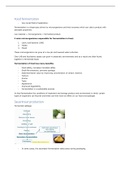
Sauerkraut production
Fermented cabbage
- In some cases, the secondary fermentation takes place during packaging.
,Why add salt?
1. The addition of salt has a selective effect on the microbiota that are present in/on the cabbage
which helps to inhibit naturally found microorganisms that could lead to spoilage and helps to
specifically select LAB.
2. Salt inhibits pectinolytic enzymes which are responsible for softening
3. Salt extracts juices within the cabbage through osmosis such as; sugars, amino acids, growth
stimulants and natural inhibitors of Gram-negative bacteria. This forms the brine in which the
fermentation will take place
Primary fermentation
- Sealing of the containers is necessary to exclude oxygen. Now the primary fermentation can
start.
- At the start of fermentation, the LAB comprises of only 1% of the total microflora but many of
the non-lactics fail to grow and 2 days later the LAB accounts for 90% of the total microflora.
- During this time, they produce enough acid to decrease the pH to below 4 which further inhibits
the growth of competing microflora
- The fermentation process starts with Leuconostoc mesenteroides which is a type of LAB and a
heterofermenter. This means;
1. it produces CO2 which replaces entrapped air and helps to establish an anaerobic within the
product
2. This further prevents the oxidation of vitamin C and the loss of colour.
- Fructose is present as an alternative electron acceptor and produces acetic acid which plays a
big role in the flavour of sauerkraut.
- Reduction of fructose leads to an accumulation of mannitol.
- As the pH drops due to the production of acid the Leuconostoc is inhibited and replaced at first
by heterofermentative Lactobacilli which is then replaced by acid-tolerant, homofermentative
Lactobacilli such as Lactobacillus Plantarum.
heterofermenter: Producing a fermentation that results in several end products, CO2 being one of the
end products. Testing for heterofermenters usually involves detection of gas (CO2)
homofermenter: Producing a fermentation that results in one single end-product.
Many metabolites are produced by the microorganisms during fermentation, some of which can be
converted into esters which is important in the formation of aromas
- Formic acid
- Acetic acid
- Lactic acid
- Ethanol
Secondary fermentation which results in the depletion of all fermentable sugars. Once this has
occurred the product can be packaged and sold in retail.
,Why is the Vitamin C content so high?
- The process has been taking place in the absence of oxygen
Production problems
- Defects of sauerkraut arise mostly as a result of yeast and mould growth which can produce off-
odours, loss of acidity and a slimy end-product
- Manganese deficiency leads to a slower growth of LAB which allows a yeast to take over
resulting in pink/grey discolouration
- Purely grey discolouration could be as a result of abnormal dominance of Gram-negative bacteria
The fermentation process of sauerkraut in characterised by a typical succession of hetero- and
homofermentative LAB
The production of sauerkraut uses a low-salt brine and is not desalted before use and as a result several
vitamins are partially conserved (Vitamin C)
Fermented sausages
Example: salami
Fermentation has a great effect on the shelf-life of products, extending it by months
- Unlike fermented milk products it is not possible to heat-treat the meat before processing as this
will destroy the sausage’s textural characteristics, but some are given a final pasteurization to
ensure safety.
- The curing salts that are added are a mixture of NaCl sodium nitrate and/or sodium nitrite. They
contribute to the colour, safety, taste and texture of the product.
, - Spices are added mainly for flavour, but they are also known to play an important role in slowing
down the growth of microbial spoilage and promoting LAB due to their manganese content.
- LAB needs manganese for growth.
- Acid production and the decrease of the pH below 5.2 promote the coagulation of the meat
proteins and this helps to expel moisture and develop the desired texture and flavour.
- It also plays an important role in the microbiological safety and stability of the product
- sausages can also be smoked, and this gives it a very distinct flavour but also the phenolic
components of the wood smoke also have important anti-oxidative and antimicrobial properties
which improve shelf-life.
Most aerobes contain Superoxide Dismutase (SOD) which scavenge the toxic superoxide anion radical
which is produced by the reduction of O2
Aerotolerant LAB do not have SOD but have developed an alternative protective mechanism based on the
accumulation of the manganous ion
The manganous ion (Mn2+) is regenerated through reduction, this increases the manganese content in
the medium stimulating LAB growth.
2 microorganisms of importance in the fermentation of meat products;
1. Micrococcus species: capable of nitrate reduction if the pH > 5.5 and this results in nitrite
formation which inhibits the growth of spoilage microorganisms. Therefore, nitrate needs to be
added to the product. This species also utilizes catalase. The main functionality of the
micrococcus species is food safety.
2. Lactic acid bacteria: responsible for acidification and flavour formation.
Examples in sausage making: Leuconostoc, lactobacillus plantarum and pediococcus species.
Role of Micrococcus
- Micrococcus is added in addition to LAB
- micrococcus species is not required in nitrite-cured products
- Micrococcus has an additional functionality; when the pH drops further during maturation, nitrite
(which can also take the form of nitrous acid) is in equilibrium with nitric acid and nitrous oxide.
- Nitrous oxide has an addition functionality in meat production and to understand this you need
to understand how the colour of meat is formed
- Very broad field of application.
Fermentation is a bioprocess driven by microorganisms and their enzymes which can yield a product with
desirable properties.
raw material + microorganisms = fermented product.
3 main microorganisms responsible for fermentation in food;
1. Lactic acid bacteria (LAB)
2. Yeasts
3. Mould
These microorganisms can grow at a low pH and lowered water activities.
Only LAB and facultative yeasts can grow in anaerobic environments and as a result are often found
together in fermented foods
Fermentation of food has many benefits;
- Food safety, increases microbial safety
- Shelf-life-extension, prevents spoilage
- Adds Nutritional value by improving concentration of certain vitamins
- Texture
- Aroma
- Taste
- Appearance
- Improved digestibility
- Fermentation is a sustainable process
In food fermentation the conditions of treatment and storage produce and environment in which certain
types of organisms can flourish and these can then have an effect on our food (not spoilage)
Sauerkraut production
Fermented cabbage
- In some cases, the secondary fermentation takes place during packaging.
,Why add salt?
1. The addition of salt has a selective effect on the microbiota that are present in/on the cabbage
which helps to inhibit naturally found microorganisms that could lead to spoilage and helps to
specifically select LAB.
2. Salt inhibits pectinolytic enzymes which are responsible for softening
3. Salt extracts juices within the cabbage through osmosis such as; sugars, amino acids, growth
stimulants and natural inhibitors of Gram-negative bacteria. This forms the brine in which the
fermentation will take place
Primary fermentation
- Sealing of the containers is necessary to exclude oxygen. Now the primary fermentation can
start.
- At the start of fermentation, the LAB comprises of only 1% of the total microflora but many of
the non-lactics fail to grow and 2 days later the LAB accounts for 90% of the total microflora.
- During this time, they produce enough acid to decrease the pH to below 4 which further inhibits
the growth of competing microflora
- The fermentation process starts with Leuconostoc mesenteroides which is a type of LAB and a
heterofermenter. This means;
1. it produces CO2 which replaces entrapped air and helps to establish an anaerobic within the
product
2. This further prevents the oxidation of vitamin C and the loss of colour.
- Fructose is present as an alternative electron acceptor and produces acetic acid which plays a
big role in the flavour of sauerkraut.
- Reduction of fructose leads to an accumulation of mannitol.
- As the pH drops due to the production of acid the Leuconostoc is inhibited and replaced at first
by heterofermentative Lactobacilli which is then replaced by acid-tolerant, homofermentative
Lactobacilli such as Lactobacillus Plantarum.
heterofermenter: Producing a fermentation that results in several end products, CO2 being one of the
end products. Testing for heterofermenters usually involves detection of gas (CO2)
homofermenter: Producing a fermentation that results in one single end-product.
Many metabolites are produced by the microorganisms during fermentation, some of which can be
converted into esters which is important in the formation of aromas
- Formic acid
- Acetic acid
- Lactic acid
- Ethanol
Secondary fermentation which results in the depletion of all fermentable sugars. Once this has
occurred the product can be packaged and sold in retail.
,Why is the Vitamin C content so high?
- The process has been taking place in the absence of oxygen
Production problems
- Defects of sauerkraut arise mostly as a result of yeast and mould growth which can produce off-
odours, loss of acidity and a slimy end-product
- Manganese deficiency leads to a slower growth of LAB which allows a yeast to take over
resulting in pink/grey discolouration
- Purely grey discolouration could be as a result of abnormal dominance of Gram-negative bacteria
The fermentation process of sauerkraut in characterised by a typical succession of hetero- and
homofermentative LAB
The production of sauerkraut uses a low-salt brine and is not desalted before use and as a result several
vitamins are partially conserved (Vitamin C)
Fermented sausages
Example: salami
Fermentation has a great effect on the shelf-life of products, extending it by months
- Unlike fermented milk products it is not possible to heat-treat the meat before processing as this
will destroy the sausage’s textural characteristics, but some are given a final pasteurization to
ensure safety.
- The curing salts that are added are a mixture of NaCl sodium nitrate and/or sodium nitrite. They
contribute to the colour, safety, taste and texture of the product.
, - Spices are added mainly for flavour, but they are also known to play an important role in slowing
down the growth of microbial spoilage and promoting LAB due to their manganese content.
- LAB needs manganese for growth.
- Acid production and the decrease of the pH below 5.2 promote the coagulation of the meat
proteins and this helps to expel moisture and develop the desired texture and flavour.
- It also plays an important role in the microbiological safety and stability of the product
- sausages can also be smoked, and this gives it a very distinct flavour but also the phenolic
components of the wood smoke also have important anti-oxidative and antimicrobial properties
which improve shelf-life.
Most aerobes contain Superoxide Dismutase (SOD) which scavenge the toxic superoxide anion radical
which is produced by the reduction of O2
Aerotolerant LAB do not have SOD but have developed an alternative protective mechanism based on the
accumulation of the manganous ion
The manganous ion (Mn2+) is regenerated through reduction, this increases the manganese content in
the medium stimulating LAB growth.
2 microorganisms of importance in the fermentation of meat products;
1. Micrococcus species: capable of nitrate reduction if the pH > 5.5 and this results in nitrite
formation which inhibits the growth of spoilage microorganisms. Therefore, nitrate needs to be
added to the product. This species also utilizes catalase. The main functionality of the
micrococcus species is food safety.
2. Lactic acid bacteria: responsible for acidification and flavour formation.
Examples in sausage making: Leuconostoc, lactobacillus plantarum and pediococcus species.
Role of Micrococcus
- Micrococcus is added in addition to LAB
- micrococcus species is not required in nitrite-cured products
- Micrococcus has an additional functionality; when the pH drops further during maturation, nitrite
(which can also take the form of nitrous acid) is in equilibrium with nitric acid and nitrous oxide.
- Nitrous oxide has an addition functionality in meat production and to understand this you need
to understand how the colour of meat is formed