

Chapter 15
Capital structure decisions Decisions about a firm’s debt-equity ratio à refers to
financial leverage
Capital restructurings Changes that also make the debt-equity ratio change
à these only benefit shareholders if and only if (!) the
market value of the firm increases
Which capital structure is the best: the one that maximizes the share’s value and thus
minimizes the WACC à managers will choose the capital structure that they think will have
the highest market value because this capital structure will be more beneficial to the firm’s
shareholders.
Target capital structure Optimal capital structure
Financial leverage Extend of the firm that relies on debt
Net income
EPS (earnings per share) =
# shares
𝑁𝑒𝑡 𝑖𝑛𝑐𝑜𝑚𝑒
𝑅𝑂𝐸 𝑟𝑒𝑡𝑢𝑟𝑛 𝑜𝑛 𝑒𝑞𝑢𝑖𝑡𝑦 =
𝑡𝑜𝑡𝑎𝑙 𝑒𝑞𝑢𝑖𝑡𝑦
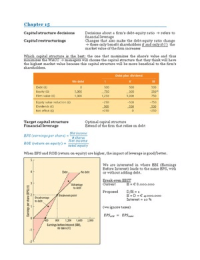
When EPS and ROE (return on equity) are higher, the impact of leverage is good/better.
We are interested in where EBI (Earnings
Before Interest) leads to the same EPS, with
or without adding debt.
Break-even EBIT
Current E = € 8.000.000
Proposed D/E = 1
E = D = € 4.000.000
Interest = 10 %
(we ignore taxes)
𝐸𝑃𝑆!"# = 𝐸𝑃𝑆!"#
,Based on autoveloce is stated that:
§ The effect of financial leverage depends on EBIT, when EBIT > BEP it is beneficial
§ In expected situation, leverage increases returns on shareholders (ROE and EPS)
§ Proposed situation gives more risks to shareholders (EPS and ROE are more
sensitive)
§ The capital structure is very important
Homemade leverage Use of personal borrowing to change overall amount of
financial leverage to which the individual or investor is
exposed (see also table 15.5 and example 15.2)
M & M: Modigliani and Miller
M&M I States that the value of the firm is independent f its capital structure (pie
model)
Key assumptions:
- No taxes
- No transaction costs
- Individual and corporate borrow at the same rate
M&M II States that the total value of the firm is not affected by the capital
structure, although debt and equity is (à cost equity and financial
leverage)
! !
WACC = 𝑥 𝑅𝑒 + 𝑥 𝑅𝑑
! !
V= E+D
!
Re = 𝑅𝑎 + 𝑅𝑎 − 𝑅𝑑 𝑥
!
The cost of equity (Re) depends on:
1. Required rate of return (Ra)
2. Cost of debt (Rd)
3. Debt-equity ratio (D/E)
See example 15.3
Business risk Equity risk that comes from nature of the operating activities à
in the formula; Ra
Financial risk Equity risk from the financial policies (capital structure) à by
using more debts à in formula; (Ra-Rd) X (D/E)
An all in equity firm, has a zero cost of equity!
There are 2 features of debt:
1. Interest paid over debt is tax deductible (positive)
2. Failure can mean direct bankruptcy (negative)
Interest tax shield Tax savings by a firm from the interest expense (see example
given on page 455).
𝑇! ×𝐷 ×𝑅!
𝑃𝑉 𝑜𝑓 𝑡𝑎𝑥 𝑠ℎ𝑖𝑒𝑙𝑑 = = 𝑇! ×𝐷
𝑅!
There are 2 different bankruptcy costs:
Direct Directly associated with bankruptcy (e.g. legal expenses)
Indirect Costs for avoiding bankruptcy
, Debt in a firm can cause conflicts of interests between shareholders and bondholders à most
of the time the shareholders go selfish, there are 3 different ‘selfish’ strategies for that:
1. Incentive to take large risks (high risks, low or negative NPV)
2. Incentive towards under investments (not investing in existing positive NPV projects)
3. Milking the property (pay out extra dividends or other distributions in times of
financial distress)
Static theory of A firm borrows to a point where tax benefit equals cost from
capital structure increased probability of financial distress (see figure 15.6)
The difference between the static value and the actual value is the loss in value from the
probability of financial distress.
In real life, most large firms use little debt à this is in contrary of what M&M states! à
Pecking-order theory Use of internal financing when possible, for example: selling
securities is expensive. But also, insiders have more information
about the firm!
1. Internal financing
2. Debt financing
3. Equity financing
Signaling theory Increasing debt levels signals firms expected higher profitability,
this is has a positive effect on a firm’s value à can be used to fool
investors
Implication in the pecking-order theory:
§ There’s no target capital structure
§ Profitable firms use less debt
§ Companies will want financial slack
Types of bankruptcy:
1. Business failure
2. Legal bankruptcy
3. Technical insolvency
4. Accounting insolvency
Capital structure decisions Decisions about a firm’s debt-equity ratio à refers to
financial leverage
Capital restructurings Changes that also make the debt-equity ratio change
à these only benefit shareholders if and only if (!) the
market value of the firm increases
Which capital structure is the best: the one that maximizes the share’s value and thus
minimizes the WACC à managers will choose the capital structure that they think will have
the highest market value because this capital structure will be more beneficial to the firm’s
shareholders.
Target capital structure Optimal capital structure
Financial leverage Extend of the firm that relies on debt
Net income
EPS (earnings per share) =
# shares
𝑁𝑒𝑡 𝑖𝑛𝑐𝑜𝑚𝑒
𝑅𝑂𝐸 𝑟𝑒𝑡𝑢𝑟𝑛 𝑜𝑛 𝑒𝑞𝑢𝑖𝑡𝑦 =
𝑡𝑜𝑡𝑎𝑙 𝑒𝑞𝑢𝑖𝑡𝑦
When EPS and ROE (return on equity) are higher, the impact of leverage is good/better.
We are interested in where EBI (Earnings
Before Interest) leads to the same EPS, with
or without adding debt.
Break-even EBIT
Current E = € 8.000.000
Proposed D/E = 1
E = D = € 4.000.000
Interest = 10 %
(we ignore taxes)
𝐸𝑃𝑆!"# = 𝐸𝑃𝑆!"#
,Based on autoveloce is stated that:
§ The effect of financial leverage depends on EBIT, when EBIT > BEP it is beneficial
§ In expected situation, leverage increases returns on shareholders (ROE and EPS)
§ Proposed situation gives more risks to shareholders (EPS and ROE are more
sensitive)
§ The capital structure is very important
Homemade leverage Use of personal borrowing to change overall amount of
financial leverage to which the individual or investor is
exposed (see also table 15.5 and example 15.2)
M & M: Modigliani and Miller
M&M I States that the value of the firm is independent f its capital structure (pie
model)
Key assumptions:
- No taxes
- No transaction costs
- Individual and corporate borrow at the same rate
M&M II States that the total value of the firm is not affected by the capital
structure, although debt and equity is (à cost equity and financial
leverage)
! !
WACC = 𝑥 𝑅𝑒 + 𝑥 𝑅𝑑
! !
V= E+D
!
Re = 𝑅𝑎 + 𝑅𝑎 − 𝑅𝑑 𝑥
!
The cost of equity (Re) depends on:
1. Required rate of return (Ra)
2. Cost of debt (Rd)
3. Debt-equity ratio (D/E)
See example 15.3
Business risk Equity risk that comes from nature of the operating activities à
in the formula; Ra
Financial risk Equity risk from the financial policies (capital structure) à by
using more debts à in formula; (Ra-Rd) X (D/E)
An all in equity firm, has a zero cost of equity!
There are 2 features of debt:
1. Interest paid over debt is tax deductible (positive)
2. Failure can mean direct bankruptcy (negative)
Interest tax shield Tax savings by a firm from the interest expense (see example
given on page 455).
𝑇! ×𝐷 ×𝑅!
𝑃𝑉 𝑜𝑓 𝑡𝑎𝑥 𝑠ℎ𝑖𝑒𝑙𝑑 = = 𝑇! ×𝐷
𝑅!
There are 2 different bankruptcy costs:
Direct Directly associated with bankruptcy (e.g. legal expenses)
Indirect Costs for avoiding bankruptcy
, Debt in a firm can cause conflicts of interests between shareholders and bondholders à most
of the time the shareholders go selfish, there are 3 different ‘selfish’ strategies for that:
1. Incentive to take large risks (high risks, low or negative NPV)
2. Incentive towards under investments (not investing in existing positive NPV projects)
3. Milking the property (pay out extra dividends or other distributions in times of
financial distress)
Static theory of A firm borrows to a point where tax benefit equals cost from
capital structure increased probability of financial distress (see figure 15.6)
The difference between the static value and the actual value is the loss in value from the
probability of financial distress.
In real life, most large firms use little debt à this is in contrary of what M&M states! à
Pecking-order theory Use of internal financing when possible, for example: selling
securities is expensive. But also, insiders have more information
about the firm!
1. Internal financing
2. Debt financing
3. Equity financing
Signaling theory Increasing debt levels signals firms expected higher profitability,
this is has a positive effect on a firm’s value à can be used to fool
investors
Implication in the pecking-order theory:
§ There’s no target capital structure
§ Profitable firms use less debt
§ Companies will want financial slack
Types of bankruptcy:
1. Business failure
2. Legal bankruptcy
3. Technical insolvency
4. Accounting insolvency



