TEST BANK BASED ON:
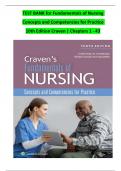
Calculating Drug Dosages
A Patient-Safe Approach to Nursing and Math
3rd Edition
• Author(s)Sandra Luz Martinez de Castillo;
Maryanne Werner-McCullough
1. Chapter 1 · Section 1.1 · Medication Safety Principles
Stem: A prescriber orders 0.5 mg of digoxin. You document the dose
on the MAR. Which is the safest way to write this dose?
A. .5 mg
B. 0.50 mg
C. 0.5 mg with no leading zero needed
D. 0.05 mg
Correct Answer: B
Rationales:
, • Correct (B): 0.50 mg — shows a leading zero before the decimal
and two significant digits; the leading zero prevents misreading
“.50” as “50.”
• A (.5 mg): Missing leading zero — risk of decimal point being
missed and tenfold error.
• C (0.5 mg with no leading zero needed): Statement contradicts
safe style; format shown is ambiguous without consistent digits.
• D (0.05 mg): Decimal place error — represents a tenfold smaller
dose.
Teaching Point: Always use a leading zero before a decimal (e.g., 0.5
mg).
2. Chapter 1 · Section 1.2 · Trailing Zero Rule
Stem: Which written dose on a medication label is unsafe and why?
A. 2 mg
B. 2.0 mg
C. 2 mg (enteric coated)
D. 2 mg PO q8h
Correct Answer: B
,Rationales:
• Correct (B): 2.0 mg — contains a trailing zero; can be misread as
20 mg if the decimal point is missed.
• A (2 mg): Correct format — no trailing zero, reduces decimal
misinterpretation.
• C (2 mg (enteric coated)): Correct and descriptive — no decimal
error.
• D (2 mg PO q8h): Complete and correct order; no trailing zero
problem.
Teaching Point: Never use a trailing zero (e.g., write 2 mg, not 2.0
mg).
3. Chapter 1 · Section 1.3 · Metric Conversion Basics
Stem: The medication label shows 250 mcg per tablet. How many
milligrams is one tablet?
A. 0.25 mg
B. 2.5 mg
C. 25 mg
D. 0.025 mg
, Correct Answer: A
Rationales:
• Correct (A): Convert micrograms to milligrams: 250 mcg ÷ 1000
= 0.250 mg (0.25 mg). Stepwise: 250 ÷ 1000 = 0.25 mg.
• B (2.5 mg): Decimal moved one place too far right (multiplied by
10 instead of dividing by 1000).
• C (25 mg): Decimal error by factor of 100 (wrong conversion).
• D (0.025 mg): Decimal moved one place too far left (÷10 too
many times).
Teaching Point: Convert mcg → mg by dividing by 1,000 (mcg ÷ 1000
= mg).
4. Chapter 1 · Section 1.4 · Dose Calculation — Tablet Rounding
Stem: Order: 75 mg oral. Available: scored 50 mg tablets. How many
tablets should you administer?
A. 1 tablet
B. 1.5 tablets
C. 2 tablets
D. 0.5 tablet
Calculating Drug Dosages
A Patient-Safe Approach to Nursing and Math
3rd Edition
• Author(s)Sandra Luz Martinez de Castillo;
Maryanne Werner-McCullough
1. Chapter 1 · Section 1.1 · Medication Safety Principles
Stem: A prescriber orders 0.5 mg of digoxin. You document the dose
on the MAR. Which is the safest way to write this dose?
A. .5 mg
B. 0.50 mg
C. 0.5 mg with no leading zero needed
D. 0.05 mg
Correct Answer: B
Rationales:
, • Correct (B): 0.50 mg — shows a leading zero before the decimal
and two significant digits; the leading zero prevents misreading
“.50” as “50.”
• A (.5 mg): Missing leading zero — risk of decimal point being
missed and tenfold error.
• C (0.5 mg with no leading zero needed): Statement contradicts
safe style; format shown is ambiguous without consistent digits.
• D (0.05 mg): Decimal place error — represents a tenfold smaller
dose.
Teaching Point: Always use a leading zero before a decimal (e.g., 0.5
mg).
2. Chapter 1 · Section 1.2 · Trailing Zero Rule
Stem: Which written dose on a medication label is unsafe and why?
A. 2 mg
B. 2.0 mg
C. 2 mg (enteric coated)
D. 2 mg PO q8h
Correct Answer: B
,Rationales:
• Correct (B): 2.0 mg — contains a trailing zero; can be misread as
20 mg if the decimal point is missed.
• A (2 mg): Correct format — no trailing zero, reduces decimal
misinterpretation.
• C (2 mg (enteric coated)): Correct and descriptive — no decimal
error.
• D (2 mg PO q8h): Complete and correct order; no trailing zero
problem.
Teaching Point: Never use a trailing zero (e.g., write 2 mg, not 2.0
mg).
3. Chapter 1 · Section 1.3 · Metric Conversion Basics
Stem: The medication label shows 250 mcg per tablet. How many
milligrams is one tablet?
A. 0.25 mg
B. 2.5 mg
C. 25 mg
D. 0.025 mg
, Correct Answer: A
Rationales:
• Correct (A): Convert micrograms to milligrams: 250 mcg ÷ 1000
= 0.250 mg (0.25 mg). Stepwise: 250 ÷ 1000 = 0.25 mg.
• B (2.5 mg): Decimal moved one place too far right (multiplied by
10 instead of dividing by 1000).
• C (25 mg): Decimal error by factor of 100 (wrong conversion).
• D (0.025 mg): Decimal moved one place too far left (÷10 too
many times).
Teaching Point: Convert mcg → mg by dividing by 1,000 (mcg ÷ 1000
= mg).
4. Chapter 1 · Section 1.4 · Dose Calculation — Tablet Rounding
Stem: Order: 75 mg oral. Available: scored 50 mg tablets. How many
tablets should you administer?
A. 1 tablet
B. 1.5 tablets
C. 2 tablets
D. 0.5 tablet