
• Verkeerd document? Gratis ruilen
  • Geschreven door studenten die geslaagd zijn
  • Direct beschikbaar na je betaling
  • Online lezen of als PDF
Verkopen
Kies je studieland
Kies je taal
Document preview thumbnail
Voorbeeld 4 van de 72 pagina's
Samenvatting

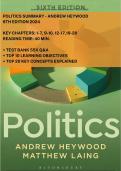
Summary Politics : Andrew Heywood 6th edition - KEY chapters: 1-7, 9-10, 12-17, 19-20 + test bank 55x Q&A + key concepts explained + top 10 learning objectives - Updated july 2025

Document preview thumbnail
Voorbeeld 4 van de 72 pagina's

This is the summary of the 6th edition from Heywood. The most important key chapters summarized - reading time 40 min. New interesting subjects: AI Governance, Green Political Economy, Post-Polarization and Multipolarity to name a few. Current developments added up to july 2025. With test bank 55x Q&A, key concepts you must know explained and the learning objectives. All in 1; optimal exam preparation. This document will be updated regularly, New versions can be downloaded for free.

Voorbeeld van de inhoud

Summary politics 6th edition andrew heywood 9781350356801

,Summary politics 6th edition andrew heywood 9781350356801

,Summary politics 6th edition andrew heywood 9781350356801

, Summary politics 6th edition andrew heywood 9781350356801


Great compact summary key chapters + test bank – 40 min reading
Chapter 1 - Status and ambitions

In 1775, Samuel Johnson observed that politics often serves as a mechanism for individuals to advance
their status and ambitions within society. This perspective still resonates today, especially in light of
the shifting dynamics of global leadership in the wake of recent elections and political upheavals in
major democracies.


1.1 Politics

1. Politics can be understood as a function of the specific setting in which actions acquire a
political character. The environment—whether a national parliament, a local council, or a
multinational organization like the United Nations—determines when and how conduct
becomes ‘political’. Recent examples include the rise of citizen assemblies across Europe in
2024, which have redefined traditional venues of political engagement.
2. Alternatively, politics may be viewed as a distinctive mode of conduct that manifests wherever
power relations exist, regardless of setting. This includes informal social contexts where
decisions about influence and authority are made, such as within corporations or grassroots
movements. The growing power of decentralized movements like those seen during the 2024
climate protests illustrates this fluid, process-driven view of politics.

Bernard Crick, in his influential work Defence of Politics, defines politics as the method through which
conflicting interests within a community are reconciled by distributing power relative to the
significance of each interest group. This view has gained renewed relevance as coalition governments
and power-sharing agreements, such as those formed in 2025 in countries like Israel and Germany,
have become essential tools for political stability.

Adrian Leftwich emphasized that politics at its core is about power—the capability to realize desired
objectives by whatever means available. The modern political landscape, marked by debates over
artificial intelligence regulation and digital sovereignty, demonstrates how power today increasingly
involves control over data and technology, not just physical or economic resources.

Bismarck’s assertion that politics is an art rather than a science highlights the adaptive, interpretative
nature of political leadership. This is vividly seen in the responses of leaders to complex crises in 2024
and 2025, from managing energy transitions to navigating the resurgence of regional conflicts in
Eastern Europe and Africa.

Politics is, in this sense, about steering societies through collective decision-making processes that are
as much about negotiation and vision as about formal procedures.
The term polis, from which the word politics is derived, referred to the ancient Greek city-state, the
foundational unit of political organization.

The modern echoes of this idea can be seen in the increasing relevance of cities as political actors on
the world stage, particularly as urban centers have spearheaded climate action compacts following the
stalled outcomes of global climate summits in 2024.

Inhoudsopgave

  1. 01 Great compact summary key chapters + test bank – 40 min reading 4
  2. 02 Chapter 1 - Status and ambitions 4
    1. 1.1 Politics 4
  3. 03 Chapter 2 – Ideologies 7
    1. 2.3 Conservatism 8
    2. 2.4 Paternalistic conservatism 8
    3. 2.5 Conservatism keys 9
    4. 2.6 Socialism 11
    5. 2.7 Classical Marxism 11
    6. 2.8 Fascism and other fun variations 12
  4. 04 Chapter 3 – The State 13
    1. 3.1 State 13
    2. 3.2 International 13
    3. 3.3 Four theories of the state 15
    4. 3.4 Capitalist state 15
    5. 3.5 Roles of state EXAM! 16
  5. 05 Chapter 4 – Types of Legitimizing Power 17
    1. 4.1 Three Ideal Types of Legitimizing Power (by Max Weber) 17
    2. 4.2 Democracy: Rule by the People (Bernard Crick) 19
  6. 06 Chapter 6 - Political Economic Competing Traditions 20
    1. 6.1 Varieties of Capitalism 21
    2. 6.2 Alternatives to Capitalism 21
    3. 6.3 Three Forms of Globalization 22
  7. 07 Chapter 7 - Society as a Political Framework 24
    1. 7.1 Modern Politics: The Era of Identity-Based Mobilization 24
    2. 7.2 Four Principal Dimensions of Identity 24
  8. 08 Chapter 9 - Conceptual Approaches to Political Representation 26
    1. 9.1 Key Functions of Elections in Contemporary Democracies 27
    2. 9.2 Contemporary Electoral Systems (2024–2025 Developments) 28
  9. 09 Chapter 10 - 4 ways of political party distinction 30
    1. 10.1 Cadre–Mass 30
    2. 10.2 Representation–Integration 30
    3. 10.3 Constitutional–Revolutionary 31
    4. 10.4 Left- and Right-wing parties 31
    5. 10.5 Functions of parties EXAM!!! 32
    6. 10.6 Party systems 33
  10. 10 Chapter 12 - “Three worlds” 35
    1. 12.1 Five Regimes of the world 36
  11. 11 Chapter 13 - Political executives 38
    1. 13.1 Functions of political executives 38
    2. 13.2 Four theories of leadership 41
    3. 13.3 Three distinctive styles of leadership 41
  12. 12 Chapter 14 - Functions of Assemblies 43
    1. 14.1 Unicameralism or Bicameralism 44
  13. 13 Chapter 15 - Classifying Constitutions 46
    1. 15.1 The Purpose of a Constitution 48
    2. 15.2 Are Judges Political? 49
  14. 14 Chapter 16 - Theories of decision-making 50
    1. 16.1 Rational actor models 50
    2. 16.2 Stages of policy process 51
    3. 16.3 Functions of the bureaucracy 52
  15. 15 Chapter 19 - After the Cold War 54
    1. 19.1 United Nations (1945) 55
  16. 16 Chapter 20 - Civic engagement declining since the 1950s 56
    1. 20.1 Blame everyone! test 56
  17. 17 Test bank 58
    1. 20 open questions – all answers last page 58
    2. 1. Political Concepts and Ideologies 58
    3. 2. The State and Governance 58
    4. 3. Political Systems, Parties, and Elections 58
    5. 4. Decision-Making, Civic Engagement, and Global Order 59
    6. 20 multiple choice questions 61
    7. 5. Political Authority and Legitimacy 61
    8. 6. Political Economy and Globalization 61
    9. 7. Society, Identity, and Participation 62
    10. 8. Policy-Making and Institutional Design 63
    11. 15 fill in the blank questions 66
    12. 9. Theories of the State and Power 66
    13. 10. Political Parties and Systems 66
    14. 11. Policy and Decision-Making 66
  18. 18 Top 10 learning objectives 68
  19. 19 Top 20 key concepts you must know 70

Gekoppeld boek
 image
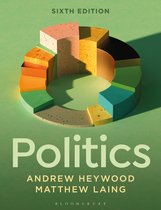
Andrew Heywood, Matthew Laing Politics
Uitgever: 14 november 2024 ISBN: 9781350356801 Druk: 6

Documentinformatie

Studie
Heel boek samengevat?
Nee
Wat is er van het boek samengevat?
Key cchapters: 1-7, 9-10, 12-17, 19-20
Geüpload op
4 juli 2025
Aantal pagina's
72
Geschreven in
2024/2025
Type
Samenvatting
€10,50

Verkeerd document? Gratis ruilen Binnen 14 dagen na aankoop en voor het downloaden kan je een ander document kiezen. Je kan het bedrag gewoon opnieuw besteden.
Geschreven door studenten die geslaagd zijn
Direct beschikbaar na je betaling
Online lezen of als PDF

Seller avatar
De reputatie van een verkoper is gebaseerd op het aantal documenten dat iemand tegen betaling verkocht heeft en de beoordelingen die voor die items ontvangen zijn. Er zijn drie niveau’s te onderscheiden: brons, zilver en goud. Hoe beter de reputatie, hoe meer de kwaliteit van zijn of haar werk te vertrouwen is.
Verkocht
8482
Volgers
2696
Items
2823
Laatst verkocht
13 uur geleden

Reviews van geverifieerde kopers


Waarom studenten kiezen voor Stuvia

Gemaakt door medestudenten, geverifieerd door reviews

Kwaliteit die je kunt vertrouwen: geschreven door studenten die slaagden en beoordeeld door anderen die dit document gebruikten.

Niet tevreden? Kies een ander document

Geen zorgen! Je kunt voor hetzelfde geld direct een ander document kiezen dat beter past bij wat je zoekt.

Betaal zoals je wilt, start meteen met leren

Geen abonnement, geen verplichtingen. Betaal zoals je gewend bent via Bancontact, iDeal of creditcard en download je PDF-document meteen.

Student with book image

“Gekocht, gedownload en geslaagd. Zo eenvoudig kan het zijn.”

Alisha Student

Bezig met je bronvermelding?

Maak nauwkeurige citaten in APA, MLA en Harvard met onze gratis bronnengenerator.

Bezig met je bronvermelding?

Veelgestelde vragen


