Chapter 20: Measuring a Nations Well-Being
The goal of macroeconomics is to explain the economic changes that affect many
households, firms, and markets simultaneously. Subjective wellbeing refers to the way in
which people evaluate their own happiness and Objective wellbeing refers to measures of
the quality of life and uses indicators such as educational attainment, measures of the
standard of living, life expectancy and so on. One of the most common ways in which the
well-being of an economy is measured is through gross domestic product, GDP, which
measures the total income of a nation.
The Economy’s Income and Expenditure
Incomes are used as a measure of well-being because incomes can be used to purchase
life’s necessities and luxuries. Income is, therefore, equated with the standard of living. To
judge whether an economy is doing well or poorly, we can look at the total income that
everyone in the economy is earning. This is the task of GDP. GDP measures two things at
once: the total income of everyone in the economy and the total expenditure on the
economy’s output of goods and services. Every transaction has two parties, a buyer and a
seller. Every euro of spending (buyer) is a euro of income (seller).
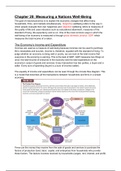
The equality of income and expenditure can be seen through the circular-flow diagram. This
is a model that describes all the transactions between households and firms in a simple
economy.
Firms use the money they receive from the sale of goods and services to purchase the
factors of production (land, labor, capital, and enterprise) from households who provide
these factors. The factors incomes received by households (wages, rent, interest, and profit)
, are used to pay for goods and services. In this economy, money flows from households to
firms and then back to households. Not all the money goes back into the economy, such as
taxes (T), savings (S) and spending on imports (M) are called leakages to the circular flow.
Governments and private entities can make injections into the circular flow as government
spending (G), investment spending (I) and revenue from exports (X). A common measure of
showing GDP is to add up the sum of expenditures in the economy - consumer spending
(C), investment spending (I), government spending (G), and the difference between imports
(M) and exports (X) (net exports, (X-M) or NX). This provides a measure of GDP given:
GDP=C+ I +G+ NX
The Measurement of Gross Domestic Product
GDP is the market value of all final goods and services produced within a country in a given
period of time.
“GDP is the market value” - GDP adds together many different kinds of products into a single
measure of the value of the economic activity. To do this, it uses market prices, because this
measures the amount people are willing to pay for different goods. If the price of an apple is
twice the price of an orange, then the apple contributes twice as much to the GDP as an
orange.
GDP includes all items produced in the economy and sold in markets. GDP measures the
market value of things such as books, films, haircuts, and housing services. But there are
many goods and services that are traded but not through officially recorded markets and
these transactions may not appear in GDP figures. Things such as babysitting go
undeclared thus this work is hidden from GDP figures. This type of work is referred to as,
‘informal’, ‘shadow’, or ‘black’ economy.
When a paper company sells the paper to a greetings card company, the paper is called an
intermediate good, and the card is called a final good. GDP includes only the value of the
final goods because the value of the intermediate good is already included in the prices of
the final goods. Adding the market value of the paper to the market value of the card would
be double counting. An important exception to this principle arises when an intermediate
good is produced and, rather than being used, is added to a firm’s inventory of goods to be
used or sold at a later date. Then the intermediate good is taken to be ‘final’ for the moment,
and its value as inventory investment is added to GDP.
GDP measures the value of production within the geographic confines of a country. When a
UK citizen owns a factory in Bulgaria, the production of that factory is not part of the UK
GDP, it’s part of Bulgaria’s GDP. Items are included in a nation’s GDP if they are produced
domestically, regardless of the nationality of the producer.
GDP measures the value of production that takes place within a specific interval of time.
Usually, that interval is a year or a quarter of a year. GDP measures the economy’s flow of
income and expenditure during that interval. When the government reports GDP for a
quarter, it usually presents GDP ‘at an annual rate.’ This means the figure reported for
quarterly GDP is the amount of income and expenditure during the quarter multiplied by 4.
When the government reports quarterly GDP, it presents the data after they have been
The goal of macroeconomics is to explain the economic changes that affect many
households, firms, and markets simultaneously. Subjective wellbeing refers to the way in
which people evaluate their own happiness and Objective wellbeing refers to measures of
the quality of life and uses indicators such as educational attainment, measures of the
standard of living, life expectancy and so on. One of the most common ways in which the
well-being of an economy is measured is through gross domestic product, GDP, which
measures the total income of a nation.
The Economy’s Income and Expenditure
Incomes are used as a measure of well-being because incomes can be used to purchase
life’s necessities and luxuries. Income is, therefore, equated with the standard of living. To
judge whether an economy is doing well or poorly, we can look at the total income that
everyone in the economy is earning. This is the task of GDP. GDP measures two things at
once: the total income of everyone in the economy and the total expenditure on the
economy’s output of goods and services. Every transaction has two parties, a buyer and a
seller. Every euro of spending (buyer) is a euro of income (seller).
The equality of income and expenditure can be seen through the circular-flow diagram. This
is a model that describes all the transactions between households and firms in a simple
economy.
Firms use the money they receive from the sale of goods and services to purchase the
factors of production (land, labor, capital, and enterprise) from households who provide
these factors. The factors incomes received by households (wages, rent, interest, and profit)
, are used to pay for goods and services. In this economy, money flows from households to
firms and then back to households. Not all the money goes back into the economy, such as
taxes (T), savings (S) and spending on imports (M) are called leakages to the circular flow.
Governments and private entities can make injections into the circular flow as government
spending (G), investment spending (I) and revenue from exports (X). A common measure of
showing GDP is to add up the sum of expenditures in the economy - consumer spending
(C), investment spending (I), government spending (G), and the difference between imports
(M) and exports (X) (net exports, (X-M) or NX). This provides a measure of GDP given:
GDP=C+ I +G+ NX
The Measurement of Gross Domestic Product
GDP is the market value of all final goods and services produced within a country in a given
period of time.
“GDP is the market value” - GDP adds together many different kinds of products into a single
measure of the value of the economic activity. To do this, it uses market prices, because this
measures the amount people are willing to pay for different goods. If the price of an apple is
twice the price of an orange, then the apple contributes twice as much to the GDP as an
orange.
GDP includes all items produced in the economy and sold in markets. GDP measures the
market value of things such as books, films, haircuts, and housing services. But there are
many goods and services that are traded but not through officially recorded markets and
these transactions may not appear in GDP figures. Things such as babysitting go
undeclared thus this work is hidden from GDP figures. This type of work is referred to as,
‘informal’, ‘shadow’, or ‘black’ economy.
When a paper company sells the paper to a greetings card company, the paper is called an
intermediate good, and the card is called a final good. GDP includes only the value of the
final goods because the value of the intermediate good is already included in the prices of
the final goods. Adding the market value of the paper to the market value of the card would
be double counting. An important exception to this principle arises when an intermediate
good is produced and, rather than being used, is added to a firm’s inventory of goods to be
used or sold at a later date. Then the intermediate good is taken to be ‘final’ for the moment,
and its value as inventory investment is added to GDP.
GDP measures the value of production within the geographic confines of a country. When a
UK citizen owns a factory in Bulgaria, the production of that factory is not part of the UK
GDP, it’s part of Bulgaria’s GDP. Items are included in a nation’s GDP if they are produced
domestically, regardless of the nationality of the producer.
GDP measures the value of production that takes place within a specific interval of time.
Usually, that interval is a year or a quarter of a year. GDP measures the economy’s flow of
income and expenditure during that interval. When the government reports GDP for a
quarter, it usually presents GDP ‘at an annual rate.’ This means the figure reported for
quarterly GDP is the amount of income and expenditure during the quarter multiplied by 4.
When the government reports quarterly GDP, it presents the data after they have been