Dynamics in Economic Geography,
Understanding spatial socio-economic inequalities
Ton van Rietbergen & Sierdjan Koster
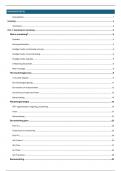
Inhoudsopgave
2. Regional development in a global society...........................................................................................2
3. Classical and neoclassical location theory...........................................................................................5
4. Competitive regions: Agglomeration and New Economic Geography...............................................10
5. How decisions are really made: The behavioural approach..............................................................14
6. Why rules matter: The institutional approach..................................................................................17
7. The slow pace of change: Evolutionary economic geography...........................................................20
8. Stimulating regional welfare and well-being.....................................................................................23
1
, 2. Regional development in a global society
This chapter sketches the global framework in which local and regional decisions by people, firms and
governments are made.
2.1 introduction
The mercantile system entails the idea of combining export with the highest possible level of self-
sufficiency. The global trade system was seen as a zero-sum game: one country’s loss was another
country’s gain, and the sum of all gains and losses was zero.
2.2 the founding fathers of classical economics and globalization
Smith: absolute advantage – i.e. the absolute cost difference for producing the same product.
- used to analyse the idea that trade allows production to be organized more efficiently across space
(table 2.1 and 2.2, p25).
two underlying reasons for an absolute advantage:
1. Natural advantage: the availability to a scarce natural resource, a particular climate or
geographic feature.
2. Acquired advantage: producing certain goods may acquire particular knowledge, skills or
infrastructure.
And thanks to international trade, consumers can either spend less than they would if they were to
buy their goods domestically only, or they can buy more for the same amount of money.
Ricardo: built on Smith’s idea -> comparative advantage (difference in productivity).
- even if one country has absolute advantage, trade with another country can still be beneficial as the
two countries specialize in the one they are most productive.
- to know who has comparative advantage, you calculate the opportunity cost. (e.g. how many cars
can you produce for each bicycle). The product with the lowest opportunity cost is the most efficient,
so both parties will specialize in that product. That results in residual money from the production the
other party is going to do, so that will sum up (total money that can be spend on the specialized
product). -> this will make it efficient to trade.
Smith: ‘the invisible hand’
metaphor for the interplay between self-interest, market forces and the law of supply and demand.
Together, these three mechanisms create economic stability.
- if the demand for product Y rises, the price goes up and more of it will be produced, and vice versa.
the economy thus has the ability to self-regulate by adjusting its production levels.
Important about these models: regions will only specialize in activities in which they have a
comparative advantage IF transport costs are low enough (limiting trade barriers). Because if the
transport costs are too high, it may be more efficient to produce domestically.
2.3 drivers of globalization
Strategic reasons for why firms choose to engage in foreign production (Dunning):
1. Resource seeking – firms engaging to acquire resources, in the form of materials or labour, at
relatively lower costs.
2. Market seeking – firms desire to access foreign demand markets.
2
Understanding spatial socio-economic inequalities
Ton van Rietbergen & Sierdjan Koster
Inhoudsopgave
2. Regional development in a global society...........................................................................................2
3. Classical and neoclassical location theory...........................................................................................5
4. Competitive regions: Agglomeration and New Economic Geography...............................................10
5. How decisions are really made: The behavioural approach..............................................................14
6. Why rules matter: The institutional approach..................................................................................17
7. The slow pace of change: Evolutionary economic geography...........................................................20
8. Stimulating regional welfare and well-being.....................................................................................23
1
, 2. Regional development in a global society
This chapter sketches the global framework in which local and regional decisions by people, firms and
governments are made.
2.1 introduction
The mercantile system entails the idea of combining export with the highest possible level of self-
sufficiency. The global trade system was seen as a zero-sum game: one country’s loss was another
country’s gain, and the sum of all gains and losses was zero.
2.2 the founding fathers of classical economics and globalization
Smith: absolute advantage – i.e. the absolute cost difference for producing the same product.
- used to analyse the idea that trade allows production to be organized more efficiently across space
(table 2.1 and 2.2, p25).
two underlying reasons for an absolute advantage:
1. Natural advantage: the availability to a scarce natural resource, a particular climate or
geographic feature.
2. Acquired advantage: producing certain goods may acquire particular knowledge, skills or
infrastructure.
And thanks to international trade, consumers can either spend less than they would if they were to
buy their goods domestically only, or they can buy more for the same amount of money.
Ricardo: built on Smith’s idea -> comparative advantage (difference in productivity).
- even if one country has absolute advantage, trade with another country can still be beneficial as the
two countries specialize in the one they are most productive.
- to know who has comparative advantage, you calculate the opportunity cost. (e.g. how many cars
can you produce for each bicycle). The product with the lowest opportunity cost is the most efficient,
so both parties will specialize in that product. That results in residual money from the production the
other party is going to do, so that will sum up (total money that can be spend on the specialized
product). -> this will make it efficient to trade.
Smith: ‘the invisible hand’
metaphor for the interplay between self-interest, market forces and the law of supply and demand.
Together, these three mechanisms create economic stability.
- if the demand for product Y rises, the price goes up and more of it will be produced, and vice versa.
the economy thus has the ability to self-regulate by adjusting its production levels.
Important about these models: regions will only specialize in activities in which they have a
comparative advantage IF transport costs are low enough (limiting trade barriers). Because if the
transport costs are too high, it may be more efficient to produce domestically.
2.3 drivers of globalization
Strategic reasons for why firms choose to engage in foreign production (Dunning):
1. Resource seeking – firms engaging to acquire resources, in the form of materials or labour, at
relatively lower costs.
2. Market seeking – firms desire to access foreign demand markets.
2