Finance book part 2
(chapter 8,10,11)
Chapter 8:
l01
financial accounting: follows strict guidelines defined by general accepted accounting
principles when on past operations to external users.
Managerial accounting: to plan, control and measure an organization’s current and future
operations and make decisions about products and services for managers and people
throughout the organization.
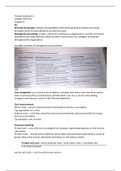
The IMA (institute of management accountants):
LO2
Cost recognition is to control costs of objects, calculate how many units should be sold to
have a certain profit (cost behaviour), identify what costs are or aren’t value adding,
recognize and measure costs for the financial statement.
Cost measurement:
Direct costs – can be measured and economically traced by a cost object.
E.g: ingredients of a meal.
Indirect costs – costs that cannot be measured conveniently and economically by tracing
then to a cost object.
E.g transport costs of meal.
Financial reporting:
Period costs – costs that are not assigned to a product. (operating expenses on the income
statement)
Product costs – include direct materials, direct labor and overhead costs(indirect), (costs of
goods sold on the income statement) (inventory on the balance sheet).
Product unit cost = Direct material costs + direct labor costs + overhead cost.
# of units produced
service unit costs – cost to perform one service
,direct material costs – costs that can be conveniently and economically measured when
making the product. (meat in a hamburger)
direct labor costs – costs of hands on labor. (wages of production makers)
overhead costs – costs that cannot be measured. As indirect material costs and indirect
labor costs.
Prime costs and conversion costs:
Prime: primary costs of production. (sum of direct material costs and direct labor costs.)
Conversion: costs of converting direct materials into a finished product. (sum of direct labor
costs and overhead costs)
Exhibit 3
Cost behaviour:
Variable cost: cost that changes in direct proportion to the output.
Fixed cost: cost that remains constant.
Value adding and non-value adding.
Value adding: costs of activity that increases the market value of your product.
Non- value: cost of activity that does not increase the market value of your product. (think
about human research department)
LO3
Document flows and cost flows through the inventory accounts.
, Purchase of materials:
1 Acquiring the materials
2 Receiving the materials
3 Paying for the materials
Production of goods
4 Preparing the materials for production
5 sending the materials into production
6 Producing goods
product completion and sale
7 Completing goods
8 Selling goods
Manufacturing the cost flow:
Manufacturing cost flow is the flow of direct materials, direct labor and overhead costs
through the materials inventory, work in process inventory and finished goods inventory
accounts into the costs of goods sold.
• Materials inventory account: shows the balance of costs of unused materials.
• Work in process inventory account: shows costs have been occurred but the product
is not completely finished.
• Finished goods inventory account: costs that are assigned to all complete not sold
products.
Exhibit 6
(chapter 8,10,11)
Chapter 8:
l01
financial accounting: follows strict guidelines defined by general accepted accounting
principles when on past operations to external users.
Managerial accounting: to plan, control and measure an organization’s current and future
operations and make decisions about products and services for managers and people
throughout the organization.
The IMA (institute of management accountants):
LO2
Cost recognition is to control costs of objects, calculate how many units should be sold to
have a certain profit (cost behaviour), identify what costs are or aren’t value adding,
recognize and measure costs for the financial statement.
Cost measurement:
Direct costs – can be measured and economically traced by a cost object.
E.g: ingredients of a meal.
Indirect costs – costs that cannot be measured conveniently and economically by tracing
then to a cost object.
E.g transport costs of meal.
Financial reporting:
Period costs – costs that are not assigned to a product. (operating expenses on the income
statement)
Product costs – include direct materials, direct labor and overhead costs(indirect), (costs of
goods sold on the income statement) (inventory on the balance sheet).
Product unit cost = Direct material costs + direct labor costs + overhead cost.
# of units produced
service unit costs – cost to perform one service
,direct material costs – costs that can be conveniently and economically measured when
making the product. (meat in a hamburger)
direct labor costs – costs of hands on labor. (wages of production makers)
overhead costs – costs that cannot be measured. As indirect material costs and indirect
labor costs.
Prime costs and conversion costs:
Prime: primary costs of production. (sum of direct material costs and direct labor costs.)
Conversion: costs of converting direct materials into a finished product. (sum of direct labor
costs and overhead costs)
Exhibit 3
Cost behaviour:
Variable cost: cost that changes in direct proportion to the output.
Fixed cost: cost that remains constant.
Value adding and non-value adding.
Value adding: costs of activity that increases the market value of your product.
Non- value: cost of activity that does not increase the market value of your product. (think
about human research department)
LO3
Document flows and cost flows through the inventory accounts.
, Purchase of materials:
1 Acquiring the materials
2 Receiving the materials
3 Paying for the materials
Production of goods
4 Preparing the materials for production
5 sending the materials into production
6 Producing goods
product completion and sale
7 Completing goods
8 Selling goods
Manufacturing the cost flow:
Manufacturing cost flow is the flow of direct materials, direct labor and overhead costs
through the materials inventory, work in process inventory and finished goods inventory
accounts into the costs of goods sold.
• Materials inventory account: shows the balance of costs of unused materials.
• Work in process inventory account: shows costs have been occurred but the product
is not completely finished.
• Finished goods inventory account: costs that are assigned to all complete not sold
products.
Exhibit 6