Philosophy & Psychology Summary
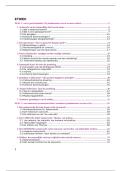
INDEX
PART I. THE MIND-BODY PROBLEM 2
1. Dualism & Behaviorism 2
2. Identity theory & Functionalism 4
3. Churchland & Dennett 5
4. Embodied Cognition 7
PART II. PSYCHOLOGY AS A SCIENTIFIC DISCIPLINE 8
5. The Common-sense Concept of Science & Inductivism 8
6. Falsification (Bayesianism, NHST) in Psychology 9
7. The Problem of (mental) Causation 11
8. Mechanistic Explanation 12
PART III. SELECTED TOPICS IN PHILOSOPHICAL PSYCHOLOGY 14
9. Free Will 14
10. Consciousness 16
11. Moral Judgment & Emotion 19
12. Personal Identity & Cognitive Enhancement 22
EXTRA. MOCK EXAM QUESTIONS
This summary includes (almost) everything from the lectures and info from the book chapters
CLAIMER
This summary was made by a student!
Studying from it and relying on it for 100% is your own responsibility.
THANKS & GOOD LUCK!!! J
J YOU CAN DO IT!!! CA
, 2
Part I. The Mind-Body Problem
- Philosophy – between criticism and speculation
1) Assessing the certainty of claims, the strength of arguments and the meaning of concepts
2) Interpretation of the results
3) Speculating about the metaphysical (i.e. thinking ‘outside the box’)
- Mental states: natural phenomena? à difficult to understand
1. They are about something: thoughts refer to specific topics
2. Experiences have experiential quality (subjective/qualia)
1 Dualism & Behaviorism
DUALISM
- Substance dualism (Descartes) – human beings consist of two substances: mental (mind) and physical
(body)
o ‘substance’ is a fundamental building block of reality
§ Physical substance = extension (size, shape, location in space) à body
§ Mental substance = thinking (consciousness) à mind
- Substance dualism argues that the mind & body can exist independently/are distinct entities, but that
they have a continuous interaction
o The mind = a domain of thinking “me” that is separated from the outside world, but connected to
the world through senses & behavior
- Arguments for substance dualism
1. Rationality, language, consciousness
• Something physical is not conscious, cannot reason or use language
2. Cogito ergo sum – I think, therefore I am
§ So Descartes said that we can doubt the existence of our own bodies and brains, but that we
cannot doubt our own existence as thinking things. Therefore, these thinking things (which
would be the mind) have a property that our bodies lack, so according to Leibniz’s principle,
this shows that mind and body must be distinct entities.
§ Leibniz’s principle – x = y, but only when x and y share all properties
• E.g. two similar billiard balls (look exactly the same), however, they are not identical,
because they do not share the same place in space and time! So even though visually
they are entirely the same, they both have several unique individual properties
• For dualism:
a) I can doubt that I have a body
b) I cannot doubt that I exist
c) Ergo, I am not identical with my body
Problems with dualism
1. Leibniz’s principle does not work for psychological states (thinking, doubting, perceiving)
o What I think about something, is not necessarily a property of that thing!
o E.g. morning vs evening star: the fact that they are perceived at different times, does not mean
that they can’t be the same star à so even though I can doubt I have no body, this does not
imply that I am not identical with my body!
o Epistemology – study of what we know and how we can know it (mind ßà body in terms of
what we can doubt)
o Ontology – study of what really exists (mind ßà body are distinct entities)
o Here, argument fails because it draws an ontological conclusion from an epistemological
difference
, 3
2. The “material entities cannot be conscious” argument is not current anymore à computers can
reason (does not mean they’re like humans, but we cannot deny that they might be in the future)
3. Methodological problem: introspection
o Descartes: we know our mind by introspection (direct awareness of own mental states)
§ But how reliable is introspection as a method?
o Self-knowledge is based on interpretation + consciousness is only the tip of the iceberg!
4. Theoretical problem: interaction problem – how is causal interaction between mental and physical
substances possible?
o How can an immaterial soul move the arm of a body, or how can the body cause changes in the
immaterial soul (e.g. conscious sensory perception)?
§ Descartes: body belongs to different realm of reality than souls, but this problem could be
explained by forces streaming from the soul into the body
§ Inability to explain ≠ does not exist!
• HOWEVER, nowadays there are too many physical explanations to support dualism.
BEHAVIORISM
Psychological behaviorism
- Def. (John Watson) – psychology should be a purely objective experimental branch, with no use of
introspection, which theoretical goal is the prediction and control of behavior.
- Central focus = explanation of behavior in terms of S-R responses
o Classical conditioning (Pavlov, Watson), operant conditioning (Thorndike, Skinner)
- Against postulating internal mental states and introspection
- Problems with psychological behaviorism
1. What is wrong with postulating mental states?
2. The S-R paradigm does not work for complex interactions
3. The “poverty of the stimulus argument” (Chomsky)
o How is it, if we learn in terms of S-R, that children become so proficient at language, and can use
words in ways they have never heard before? They cannot yet have had enough interactions for
that, so there must be e.g. a module in the brain, and not just S-R learning
Philosophical behaviorism (or logical behaviorism)
- Def. – mental states are behavioral dispositions
o Disposition – tendency to display certain behavior in certain circumstances (e.g. glass has the
disposition to shatter when you hit it with a baseball bat)
o Observable behavior operationalizes the meaning of mental states
o However, a disposition is not the cause of behavior, and it does not guarantee that it will occur!
- So in reaction to psychological behaviorism, Ryle wanted to argue against the following:
o Para-mechanical hypothesis (Cartesianism) – intelligent behavior (e.g. engaging in a
conversation) is caused by the mind while non-intelligent behavior (e.g. sneezing) is a purely
bodily affair
§ So this hypothesis states that the body and the mind are merely mechanistically connected à
behavior is not part of the mind
§ Behaviorists like Watson actually pride themselves in ignoring the mind, which makes their
conceptualization of the mind very Cartesian-like.
o Ryle wants to attack this para-mechanical hypothesis: the mind is not a ‘thing’ that causes our
behavior, but a concept that refers to a set of behavioral dispositions
§ He says: why do we need this causal foundation? We can already make a conceptual
distinction between intelligent and non-intelligent behavior – why should we do extra effort
for an explanation when it does not add anything?
o Ryle also argues that substance dualism is based on category mistake: “Where is the mind? I can’t
see it” However, we also cannot see “team spirit”, but we definitely know it’s there!
- According to philosophical behaviorism, there is no asymmetry between how we know ourselves and
how we know others
INDEX
PART I. THE MIND-BODY PROBLEM 2
1. Dualism & Behaviorism 2
2. Identity theory & Functionalism 4
3. Churchland & Dennett 5
4. Embodied Cognition 7
PART II. PSYCHOLOGY AS A SCIENTIFIC DISCIPLINE 8
5. The Common-sense Concept of Science & Inductivism 8
6. Falsification (Bayesianism, NHST) in Psychology 9
7. The Problem of (mental) Causation 11
8. Mechanistic Explanation 12
PART III. SELECTED TOPICS IN PHILOSOPHICAL PSYCHOLOGY 14
9. Free Will 14
10. Consciousness 16
11. Moral Judgment & Emotion 19
12. Personal Identity & Cognitive Enhancement 22
EXTRA. MOCK EXAM QUESTIONS
This summary includes (almost) everything from the lectures and info from the book chapters
CLAIMER
This summary was made by a student!
Studying from it and relying on it for 100% is your own responsibility.
THANKS & GOOD LUCK!!! J
J YOU CAN DO IT!!! CA
, 2
Part I. The Mind-Body Problem
- Philosophy – between criticism and speculation
1) Assessing the certainty of claims, the strength of arguments and the meaning of concepts
2) Interpretation of the results
3) Speculating about the metaphysical (i.e. thinking ‘outside the box’)
- Mental states: natural phenomena? à difficult to understand
1. They are about something: thoughts refer to specific topics
2. Experiences have experiential quality (subjective/qualia)
1 Dualism & Behaviorism
DUALISM
- Substance dualism (Descartes) – human beings consist of two substances: mental (mind) and physical
(body)
o ‘substance’ is a fundamental building block of reality
§ Physical substance = extension (size, shape, location in space) à body
§ Mental substance = thinking (consciousness) à mind
- Substance dualism argues that the mind & body can exist independently/are distinct entities, but that
they have a continuous interaction
o The mind = a domain of thinking “me” that is separated from the outside world, but connected to
the world through senses & behavior
- Arguments for substance dualism
1. Rationality, language, consciousness
• Something physical is not conscious, cannot reason or use language
2. Cogito ergo sum – I think, therefore I am
§ So Descartes said that we can doubt the existence of our own bodies and brains, but that we
cannot doubt our own existence as thinking things. Therefore, these thinking things (which
would be the mind) have a property that our bodies lack, so according to Leibniz’s principle,
this shows that mind and body must be distinct entities.
§ Leibniz’s principle – x = y, but only when x and y share all properties
• E.g. two similar billiard balls (look exactly the same), however, they are not identical,
because they do not share the same place in space and time! So even though visually
they are entirely the same, they both have several unique individual properties
• For dualism:
a) I can doubt that I have a body
b) I cannot doubt that I exist
c) Ergo, I am not identical with my body
Problems with dualism
1. Leibniz’s principle does not work for psychological states (thinking, doubting, perceiving)
o What I think about something, is not necessarily a property of that thing!
o E.g. morning vs evening star: the fact that they are perceived at different times, does not mean
that they can’t be the same star à so even though I can doubt I have no body, this does not
imply that I am not identical with my body!
o Epistemology – study of what we know and how we can know it (mind ßà body in terms of
what we can doubt)
o Ontology – study of what really exists (mind ßà body are distinct entities)
o Here, argument fails because it draws an ontological conclusion from an epistemological
difference
, 3
2. The “material entities cannot be conscious” argument is not current anymore à computers can
reason (does not mean they’re like humans, but we cannot deny that they might be in the future)
3. Methodological problem: introspection
o Descartes: we know our mind by introspection (direct awareness of own mental states)
§ But how reliable is introspection as a method?
o Self-knowledge is based on interpretation + consciousness is only the tip of the iceberg!
4. Theoretical problem: interaction problem – how is causal interaction between mental and physical
substances possible?
o How can an immaterial soul move the arm of a body, or how can the body cause changes in the
immaterial soul (e.g. conscious sensory perception)?
§ Descartes: body belongs to different realm of reality than souls, but this problem could be
explained by forces streaming from the soul into the body
§ Inability to explain ≠ does not exist!
• HOWEVER, nowadays there are too many physical explanations to support dualism.
BEHAVIORISM
Psychological behaviorism
- Def. (John Watson) – psychology should be a purely objective experimental branch, with no use of
introspection, which theoretical goal is the prediction and control of behavior.
- Central focus = explanation of behavior in terms of S-R responses
o Classical conditioning (Pavlov, Watson), operant conditioning (Thorndike, Skinner)
- Against postulating internal mental states and introspection
- Problems with psychological behaviorism
1. What is wrong with postulating mental states?
2. The S-R paradigm does not work for complex interactions
3. The “poverty of the stimulus argument” (Chomsky)
o How is it, if we learn in terms of S-R, that children become so proficient at language, and can use
words in ways they have never heard before? They cannot yet have had enough interactions for
that, so there must be e.g. a module in the brain, and not just S-R learning
Philosophical behaviorism (or logical behaviorism)
- Def. – mental states are behavioral dispositions
o Disposition – tendency to display certain behavior in certain circumstances (e.g. glass has the
disposition to shatter when you hit it with a baseball bat)
o Observable behavior operationalizes the meaning of mental states
o However, a disposition is not the cause of behavior, and it does not guarantee that it will occur!
- So in reaction to psychological behaviorism, Ryle wanted to argue against the following:
o Para-mechanical hypothesis (Cartesianism) – intelligent behavior (e.g. engaging in a
conversation) is caused by the mind while non-intelligent behavior (e.g. sneezing) is a purely
bodily affair
§ So this hypothesis states that the body and the mind are merely mechanistically connected à
behavior is not part of the mind
§ Behaviorists like Watson actually pride themselves in ignoring the mind, which makes their
conceptualization of the mind very Cartesian-like.
o Ryle wants to attack this para-mechanical hypothesis: the mind is not a ‘thing’ that causes our
behavior, but a concept that refers to a set of behavioral dispositions
§ He says: why do we need this causal foundation? We can already make a conceptual
distinction between intelligent and non-intelligent behavior – why should we do extra effort
for an explanation when it does not add anything?
o Ryle also argues that substance dualism is based on category mistake: “Where is the mind? I can’t
see it” However, we also cannot see “team spirit”, but we definitely know it’s there!
- According to philosophical behaviorism, there is no asymmetry between how we know ourselves and
how we know others