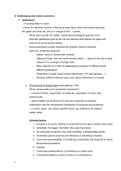
8. Gatekeeping and media economics
1) Gatekeeping
→ Founding father is Lewin
= result of a selection process, a filtering process about which info/content gets past
the ‘gates’ and what not, who is in charge of this? → power
- White came up with ‘Mr. Gates’: individual-psychological approach (one
particular gatekeeper gets all the info and decides what passes the gates and
what has to be developed further)
- second generation studies extended the analysis; beyond individual
approach, systematic approach:
- Gieber: focus on bureaucratic routines
- Galtung & Ruge: How do events become news? → focus on the role of news
values in the coverage of foreign news
- Bass: selection in a chain of gatekeeping processes on different levels;
different gatekeepers
- Shoemaker: broader social context (advertisers, PR, lobby groups, ...)
- McQuail: different national values and cultural influences in a society
a. The structure of foreign news (Galtung&Ruge, 1965)
Which characteristics are considered newsworthy?
→ universal factors: organisation of media eg; organisation of news, bias,
recent events
→ genre related: eg; preference for news that responds to audience
expectations and fits interpretative frameworks of producers and audiences
→ in some cases; very culture specific factors, eg; preference for western
values, elites
Universal factors:
1. Frequency of events; whether an event fits into the day of certain news outlet
2. Amplitude; ‘the bigger, the better’, they want big stories
3. No ambiguity/complexity; they want simplified, understandable stories
4. Familiarity/cultural proximity and relevance; if something is familiar
5. Consonance/predictability; if something is predictable and responds to media
framework/expectations
6. Surprise
7. Continuity/correspondence; if it follows up on other event
8. Composition/balance; positive stories to counterbalance
1
, Culture specific factors:
1. Elite countries; china, US, neighbouring countries
2. Elite persons; depends on country
3. Personification; putting a face on issue through movie, eg: swimmers
4. Bad news
b. 3 hypotheses
1. Selection: the more an event fulfils these criteria, the more likely to be
selected
2. Distortion: once a news item is selected, the factors making it
newsworthy will be emphasised
3. Replication: Both the processes of selection and distortion recur at
each phase of the chain from event to recipient
→ critiques; too vague, contradiction, it changes in different decades, it all depends on
location/sector, focused on psychological approach
→ Different views on the role of journalists and news media: objective reality or
creation of the news?
2) Basic principles of media economics
a. Use and exchange value
→ changing relation and tension between use value and exchange value,
exchange value is becoming dominant in the rise of media, main goal
nowadays is profit, often at the cost of use value
- use value is what flows from product itself, what it brings eg; news
reports provide info and view on the world
- exchange value is economic form, related to profit, important
relationship with advertising
b. Two-sided markets
→ media operate on 2 markets, 2 types of products that they sell
- Consumer market; direct sale of products or permanent media
services
- Advertising market; the attention of consumers are being sold to
advertisers eg; product placement, sponsoring…
2
1) Gatekeeping
→ Founding father is Lewin
= result of a selection process, a filtering process about which info/content gets past
the ‘gates’ and what not, who is in charge of this? → power
- White came up with ‘Mr. Gates’: individual-psychological approach (one
particular gatekeeper gets all the info and decides what passes the gates and
what has to be developed further)
- second generation studies extended the analysis; beyond individual
approach, systematic approach:
- Gieber: focus on bureaucratic routines
- Galtung & Ruge: How do events become news? → focus on the role of news
values in the coverage of foreign news
- Bass: selection in a chain of gatekeeping processes on different levels;
different gatekeepers
- Shoemaker: broader social context (advertisers, PR, lobby groups, ...)
- McQuail: different national values and cultural influences in a society
a. The structure of foreign news (Galtung&Ruge, 1965)
Which characteristics are considered newsworthy?
→ universal factors: organisation of media eg; organisation of news, bias,
recent events
→ genre related: eg; preference for news that responds to audience
expectations and fits interpretative frameworks of producers and audiences
→ in some cases; very culture specific factors, eg; preference for western
values, elites
Universal factors:
1. Frequency of events; whether an event fits into the day of certain news outlet
2. Amplitude; ‘the bigger, the better’, they want big stories
3. No ambiguity/complexity; they want simplified, understandable stories
4. Familiarity/cultural proximity and relevance; if something is familiar
5. Consonance/predictability; if something is predictable and responds to media
framework/expectations
6. Surprise
7. Continuity/correspondence; if it follows up on other event
8. Composition/balance; positive stories to counterbalance
1
, Culture specific factors:
1. Elite countries; china, US, neighbouring countries
2. Elite persons; depends on country
3. Personification; putting a face on issue through movie, eg: swimmers
4. Bad news
b. 3 hypotheses
1. Selection: the more an event fulfils these criteria, the more likely to be
selected
2. Distortion: once a news item is selected, the factors making it
newsworthy will be emphasised
3. Replication: Both the processes of selection and distortion recur at
each phase of the chain from event to recipient
→ critiques; too vague, contradiction, it changes in different decades, it all depends on
location/sector, focused on psychological approach
→ Different views on the role of journalists and news media: objective reality or
creation of the news?
2) Basic principles of media economics
a. Use and exchange value
→ changing relation and tension between use value and exchange value,
exchange value is becoming dominant in the rise of media, main goal
nowadays is profit, often at the cost of use value
- use value is what flows from product itself, what it brings eg; news
reports provide info and view on the world
- exchange value is economic form, related to profit, important
relationship with advertising
b. Two-sided markets
→ media operate on 2 markets, 2 types of products that they sell
- Consumer market; direct sale of products or permanent media
services
- Advertising market; the attention of consumers are being sold to
advertisers eg; product placement, sponsoring…
2