


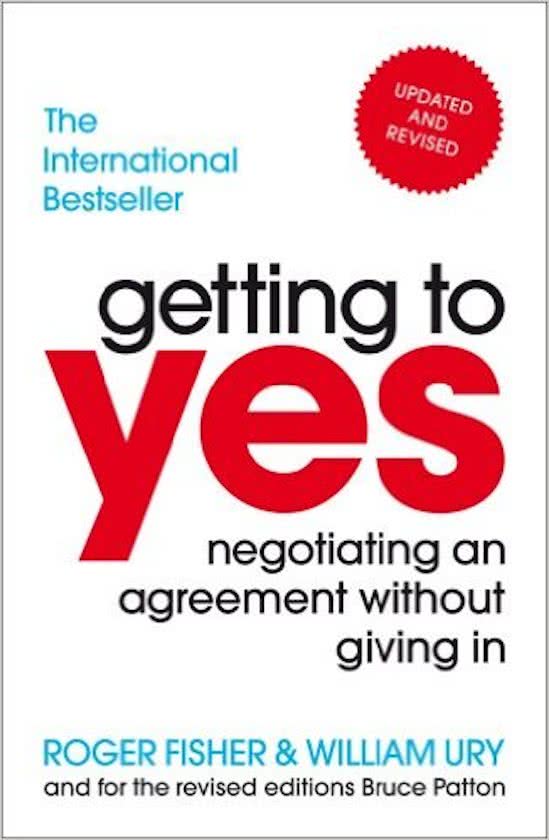
Managing Negotiations: Getting To Yes
Lecture 1
Negotiating is often learned by practice and feedback (small group of natural neg.)
3 parts in course
1. Rational & strategic
2. Emotional & psychological
3. Cross-cultural
Negotiating by Robbins (2001) - ‘A process in which two or more parties exchange goods or
services and attempt to agree upon the exchange rate for them’
Negotiating by Thompson (2015) - ‘Negotiation is an interpersonal decision-making process
necessary whenever we cannot achieve our objectives single-handedly’
Scope
Types
SINGLE ISSUE, DISTRIBUTIVE NEGOTIATION = One party’s gain is the other
party’s loss
,BARGAINING ZONE / ZOPA
→ Small bargaining zone needs skilled negotiators
→ No bargaining zone – no deal – exercise BATNA/outside option
• Target point/ aspiration point:
Price you would be happy with
• Reservation point:
Price at which you are indifferent between getting the deal or
not getting the deal (worst acceptable outcome)
• Bargaining zone/ zone of possible agreements:
Range between reservation points of both negotiators
How to determine reservation point?
- Before the start of negotiation
- Know consequences of failing and have alternative
- Determine BATNA - Best Alternative To a Negotiated Agreement
o lowest value acceptable
o don’t reach agreement → settle for BATNA
o Any deal higher than your BATNA is better than impasse
o Time sensitive
o Better BATNA = greater power
o Protects against
▪ Accepting an agreement you should reject
▪ Rejecting an agreement you should accept
Negotiation power is
- Not defined by money, power, friends
- But by your alternative (attractiveness of not reaching this specific
agreement)
3 possible problems
, 1. Under-aspiring negotiator: Settles for too low; often, first offer is accepted
immediately
2. Over-aspiring negotiator: Wants to settle for too high; refuses to make concessions
3. Grass is greener negotiator: Doesn’t know what s/he wants to settle for, only that
it’s more/different than what the other party is willing to offer (reactive)
Other rules
- Don’t fall in love with your “goal”
- Keep multiple options open
- Improve BATNA
Lecture 2
BATNA
- Objective based on reality, facts and evidence
- Not based on opponent,
You can
1. Brainstorm your alternatives
2. Evaluate each alternative
3. Attempt to improve your BATNA
4. Determine your reservation price
Benjamin Franklin
- Trades are advantageous to both but both want the best bargain
- Worst outcome is by greed → no outcome at all i.o. advantageous outcome for both
Bazerman & Neale, 1992
- ‘The goal of negotiating is not to reach just any agreement, but to reach an agreement
that is better for you than what you would get without one’
- ‘We are not concerned with “getting to yes”. Our work shows that in many cases, no
agreement at all is better than “getting to yes”’
Game theory
- Understanding situation/game
- Interpreting and revealing information.
- Putting yourself in others’ shoes and predict and influence what they will do.
* Outdoing an adversary if s/he is trying to do the same to you.
* Finding ways to cooperate, even when others are motivated by self-interest, not
benevolence.
- Studies strategic environments (= games) that involve several players who make
choices.
- Identifying determinants of human decisions in strategic situations.
- Mathematical models that describe strategic situations.
Lecture 1
Negotiating is often learned by practice and feedback (small group of natural neg.)
3 parts in course
1. Rational & strategic
2. Emotional & psychological
3. Cross-cultural
Negotiating by Robbins (2001) - ‘A process in which two or more parties exchange goods or
services and attempt to agree upon the exchange rate for them’
Negotiating by Thompson (2015) - ‘Negotiation is an interpersonal decision-making process
necessary whenever we cannot achieve our objectives single-handedly’
Scope
Types
SINGLE ISSUE, DISTRIBUTIVE NEGOTIATION = One party’s gain is the other
party’s loss
,BARGAINING ZONE / ZOPA
→ Small bargaining zone needs skilled negotiators
→ No bargaining zone – no deal – exercise BATNA/outside option
• Target point/ aspiration point:
Price you would be happy with
• Reservation point:
Price at which you are indifferent between getting the deal or
not getting the deal (worst acceptable outcome)
• Bargaining zone/ zone of possible agreements:
Range between reservation points of both negotiators
How to determine reservation point?
- Before the start of negotiation
- Know consequences of failing and have alternative
- Determine BATNA - Best Alternative To a Negotiated Agreement
o lowest value acceptable
o don’t reach agreement → settle for BATNA
o Any deal higher than your BATNA is better than impasse
o Time sensitive
o Better BATNA = greater power
o Protects against
▪ Accepting an agreement you should reject
▪ Rejecting an agreement you should accept
Negotiation power is
- Not defined by money, power, friends
- But by your alternative (attractiveness of not reaching this specific
agreement)
3 possible problems
, 1. Under-aspiring negotiator: Settles for too low; often, first offer is accepted
immediately
2. Over-aspiring negotiator: Wants to settle for too high; refuses to make concessions
3. Grass is greener negotiator: Doesn’t know what s/he wants to settle for, only that
it’s more/different than what the other party is willing to offer (reactive)
Other rules
- Don’t fall in love with your “goal”
- Keep multiple options open
- Improve BATNA
Lecture 2
BATNA
- Objective based on reality, facts and evidence
- Not based on opponent,
You can
1. Brainstorm your alternatives
2. Evaluate each alternative
3. Attempt to improve your BATNA
4. Determine your reservation price
Benjamin Franklin
- Trades are advantageous to both but both want the best bargain
- Worst outcome is by greed → no outcome at all i.o. advantageous outcome for both
Bazerman & Neale, 1992
- ‘The goal of negotiating is not to reach just any agreement, but to reach an agreement
that is better for you than what you would get without one’
- ‘We are not concerned with “getting to yes”. Our work shows that in many cases, no
agreement at all is better than “getting to yes”’
Game theory
- Understanding situation/game
- Interpreting and revealing information.
- Putting yourself in others’ shoes and predict and influence what they will do.
* Outdoing an adversary if s/he is trying to do the same to you.
* Finding ways to cooperate, even when others are motivated by self-interest, not
benevolence.
- Studies strategic environments (= games) that involve several players who make
choices.
- Identifying determinants of human decisions in strategic situations.
- Mathematical models that describe strategic situations.

