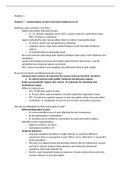
Notes for week 5 – 4.3C SMI
Slade Chapter 5 Ethical rationale
Working with the consumer
- services should be oriented towards to individual to achieve personally valued goals /
life goals rather than goals professionals might have for them
- treatment should be a means to an end of individual life goals, not the end in itself
- professional expertise is resource to be offered to the consumer
- this is the ethical justification for a focus on personal recovery
- there are sometimes obligations to do things not based on life goals with which
person might not agree
Compulsion justification 1: benefit society
- social values are mandated behavioral constraints and they can change over time
- in relation to mental health: no one will be left to die (suicide or neglect) or allowed
to harm others non-negotiable behavioral constraints
- mental health professionals can justify constraints on behavior to uphold these
societal values
- professional judgement about whether the person has crossed these values?
- compulsion is not necessarily in the patient’s best interest, some respond positively
and some respond negatively
- the justification is to uphold societal values rather than to benefit the patient
Compulsion justification: best interests
- ethical justification to intervene when there’s a risk to damage a person’s life, health,
well-being
- a recovery orientation doesn’t mean standing back when a person refuses help while
their life is slipping away
- ethical justification is paternalism: a clinician acts paternal when: his action benefits
the patient, involves violating a moral rule to the patient, does not have patient’s
past, present, future consent
- doing things to a person on the basis of professional beliefs about what’s in their best
interest
- actions are justified on the basis of duty; one group knows what is best for another
group leading to an assumption that best interests are necessarily defined by
professionals should NOT be the case
- challenges to this^ assumption:
o now, ethical imperative emphasizes personal responsibility > societal values
o professionals no longer have sole access to info about treatment
o interests of people with mental illnesses have not been served well when the
responsibility is assumed by others
o inconsistent with modern capacity-based legislation
- so: best interests are a justification for compulsion in a recovery focused system
o the closer the person’s view of their own best interest the compulsion is, the
more ethically it can be justified
o the person can state their wishes prior, if not family/friends can be consulted
, o if this is not possible, then clinician’s perspective on best interest is the
remaining approach
Balancing ethical imperatives
- 4 guiding principles:
o respect for autonomy: importance of personal choice and self determination
o non-maleficence: avoiding hopelessness and dependency
o beneficence: focus on providing effective treatments and interventions
o justice: support to exercise citizenship rights
- emphasis on values positions the application of scientific knowledge as a means not
an end
- debates about method get recognized as debates about values and ethics
- goal of services become based on what the person aspires in their life
Slade Chapter 13 Professional relationships
types of clinician-consumer relationships
- real relationship: genuineness and realism
- partnership relationship: collaboration and joint working mental health context
- detached relationships: context-based involve therapeutic models
- the key point within this continuum is power
- detached relationships give the power to interpret, understand, define and control
the experience of mental illness to the professional at worst promotes neglect,
abuse, at best promotes paternalism and tokenism
- partnership relationships share power promotes genuine co-working, context in
which self-determination can develop
- real relationships promote self-determination even more
- in mental health context most emphasis on detached relationships, some
important for partnership relationships but real relationships are seen unprofessional
detached and partnership relationships
- detached the power to make decision is with professional, it’s nominally shared,
but in realist lies with the professional
o contains professional jargon, not the patient’s words
o plan targets reducing deficits not strengthening to build on them
o goal is to avoid bad things from happening, not making good things happen
o responsibility of actions lies on staff, not patient
o authored by professional, not patient, family or an advocate
o collaboration is shown by patient’s signature or patient having a copy of plan
o care plan rarely created ethical, organizational or behavioral challenges for
the system
o listening is done for careful assessment, monitor mental state and fit the
person into a clinical model, might make the person not understood
- partnership user is the decision maker, clinician in this relationship seeks to be led
by the individual and their wishes, goals and dreams
o experience of mental illness is normally meaningful
Slade Chapter 5 Ethical rationale
Working with the consumer
- services should be oriented towards to individual to achieve personally valued goals /
life goals rather than goals professionals might have for them
- treatment should be a means to an end of individual life goals, not the end in itself
- professional expertise is resource to be offered to the consumer
- this is the ethical justification for a focus on personal recovery
- there are sometimes obligations to do things not based on life goals with which
person might not agree
Compulsion justification 1: benefit society
- social values are mandated behavioral constraints and they can change over time
- in relation to mental health: no one will be left to die (suicide or neglect) or allowed
to harm others non-negotiable behavioral constraints
- mental health professionals can justify constraints on behavior to uphold these
societal values
- professional judgement about whether the person has crossed these values?
- compulsion is not necessarily in the patient’s best interest, some respond positively
and some respond negatively
- the justification is to uphold societal values rather than to benefit the patient
Compulsion justification: best interests
- ethical justification to intervene when there’s a risk to damage a person’s life, health,
well-being
- a recovery orientation doesn’t mean standing back when a person refuses help while
their life is slipping away
- ethical justification is paternalism: a clinician acts paternal when: his action benefits
the patient, involves violating a moral rule to the patient, does not have patient’s
past, present, future consent
- doing things to a person on the basis of professional beliefs about what’s in their best
interest
- actions are justified on the basis of duty; one group knows what is best for another
group leading to an assumption that best interests are necessarily defined by
professionals should NOT be the case
- challenges to this^ assumption:
o now, ethical imperative emphasizes personal responsibility > societal values
o professionals no longer have sole access to info about treatment
o interests of people with mental illnesses have not been served well when the
responsibility is assumed by others
o inconsistent with modern capacity-based legislation
- so: best interests are a justification for compulsion in a recovery focused system
o the closer the person’s view of their own best interest the compulsion is, the
more ethically it can be justified
o the person can state their wishes prior, if not family/friends can be consulted
, o if this is not possible, then clinician’s perspective on best interest is the
remaining approach
Balancing ethical imperatives
- 4 guiding principles:
o respect for autonomy: importance of personal choice and self determination
o non-maleficence: avoiding hopelessness and dependency
o beneficence: focus on providing effective treatments and interventions
o justice: support to exercise citizenship rights
- emphasis on values positions the application of scientific knowledge as a means not
an end
- debates about method get recognized as debates about values and ethics
- goal of services become based on what the person aspires in their life
Slade Chapter 13 Professional relationships
types of clinician-consumer relationships
- real relationship: genuineness and realism
- partnership relationship: collaboration and joint working mental health context
- detached relationships: context-based involve therapeutic models
- the key point within this continuum is power
- detached relationships give the power to interpret, understand, define and control
the experience of mental illness to the professional at worst promotes neglect,
abuse, at best promotes paternalism and tokenism
- partnership relationships share power promotes genuine co-working, context in
which self-determination can develop
- real relationships promote self-determination even more
- in mental health context most emphasis on detached relationships, some
important for partnership relationships but real relationships are seen unprofessional
detached and partnership relationships
- detached the power to make decision is with professional, it’s nominally shared,
but in realist lies with the professional
o contains professional jargon, not the patient’s words
o plan targets reducing deficits not strengthening to build on them
o goal is to avoid bad things from happening, not making good things happen
o responsibility of actions lies on staff, not patient
o authored by professional, not patient, family or an advocate
o collaboration is shown by patient’s signature or patient having a copy of plan
o care plan rarely created ethical, organizational or behavioral challenges for
the system
o listening is done for careful assessment, monitor mental state and fit the
person into a clinical model, might make the person not understood
- partnership user is the decision maker, clinician in this relationship seeks to be led
by the individual and their wishes, goals and dreams
o experience of mental illness is normally meaningful