

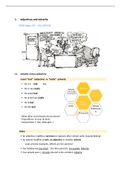
1. Adjectives and Adverbs
OEGC pages 215 – 216, 220-226
1.1. Adverbs versus adjectives
Insert “bad” (adjective) or “badly” (adverb)
He is a bad boy
He is very badly Nouns adjectives
(zelfstandige
He acted bad naamwoorden)
adverbs
He acted very badly
He is bad Word
Classes
Verbs Articles
He felt bad
(lidwoorde
n)
Pronouns
What other word classes do you know?
Prepositions voor de kooi…
Conjunctions (= but, athought…)
Rules
An adjective modifies a pronoun or appears after certain verbs (copula/linking)
An adverb modifies a verb, an adjective or another adverb.
Look at these examples. Where are the adverbs?
Our holiday was too short – the time passed v ery quickly. Adverbs
Two people were s eriously injured in the accident. Adverbs
, Many adverbs are formed from an adjective + -ly = Adverb
Adjective: quick serious careful quiet heavy bad
Adverb: quickly seriously carefully quietly heavily badly
Watch out: not all words ending in –ly are adverbs. Some adjectives end in –ly too.
Adjective: friendly lively elderly lonely silly lovely
• He is a friendly man. (friendly = adjective)
• He greets us in a friendly way. ( friendly= adjective)
VAN BUITEN KENNEN !
Some words are both adjectives and adverbs:
adjective + adverb fast loud daily seldom (= ZELDEN)
(mostly used as adverb)
OEGC page 216, exercise 1 and 2
OEGC page 223, exercises 1 and 2
nouns
Adjectives modify
pronouns (with copula verbs)
verbs
adjectives
Adverbs modify
other adverbs
Copular verbs, or linking verbs, link the adjective that follows with the subject (noun,
pronouns, etc) of the sentence. So instead of ‘saying something more’ about the verb,
the adjective that is used describes the subject (it complements the subject).
The most common copular verb in English is be. Other common copular verbs in
English are appear, become, feel, get, grow, look, prove, remain, resemble, seem,
smell, sound, stay, taste, and turn.
1.2. Adverbs versus adverbials (= WAT IS DE WOORD IN DE ZIN, BETEKENIS)
He behaves v ery badly. John lives i n a beautiful house.
Adverbial
She sings b eautifully.
OEGC pages 215 – 216, 220-226
1.1. Adverbs versus adjectives
Insert “bad” (adjective) or “badly” (adverb)
He is a bad boy
He is very badly Nouns adjectives
(zelfstandige
He acted bad naamwoorden)
adverbs
He acted very badly
He is bad Word
Classes
Verbs Articles
He felt bad
(lidwoorde
n)
Pronouns
What other word classes do you know?
Prepositions voor de kooi…
Conjunctions (= but, athought…)
Rules
An adjective modifies a pronoun or appears after certain verbs (copula/linking)
An adverb modifies a verb, an adjective or another adverb.
Look at these examples. Where are the adverbs?
Our holiday was too short – the time passed v ery quickly. Adverbs
Two people were s eriously injured in the accident. Adverbs
, Many adverbs are formed from an adjective + -ly = Adverb
Adjective: quick serious careful quiet heavy bad
Adverb: quickly seriously carefully quietly heavily badly
Watch out: not all words ending in –ly are adverbs. Some adjectives end in –ly too.
Adjective: friendly lively elderly lonely silly lovely
• He is a friendly man. (friendly = adjective)
• He greets us in a friendly way. ( friendly= adjective)
VAN BUITEN KENNEN !
Some words are both adjectives and adverbs:
adjective + adverb fast loud daily seldom (= ZELDEN)
(mostly used as adverb)
OEGC page 216, exercise 1 and 2
OEGC page 223, exercises 1 and 2
nouns
Adjectives modify
pronouns (with copula verbs)
verbs
adjectives
Adverbs modify
other adverbs
Copular verbs, or linking verbs, link the adjective that follows with the subject (noun,
pronouns, etc) of the sentence. So instead of ‘saying something more’ about the verb,
the adjective that is used describes the subject (it complements the subject).
The most common copular verb in English is be. Other common copular verbs in
English are appear, become, feel, get, grow, look, prove, remain, resemble, seem,
smell, sound, stay, taste, and turn.
1.2. Adverbs versus adverbials (= WAT IS DE WOORD IN DE ZIN, BETEKENIS)
He behaves v ery badly. John lives i n a beautiful house.
Adverbial
She sings b eautifully.


