
GOOD CLINICAL PRACTICE
1) HOOFDSTUK 1: INLEIDING
For a academic study or a clinical study, there are several points were a biomedical scientist can help
or is needed:
- conception: conception of the idea -> the moment when a idea is first formed or originally
Conceived
What can we do and how will we do it as a trial
BMS also has a different point of view than f.e. a pharmacist
- internal review: is this a good study or do we have to do it in another way
- funding acquisition: you need money for the study
- regulatory review: the study has to be approved by the regulatory authority
- data acquisition
- data analysis
- trial report/ publication
2) HOOFDSTUK 2: PRINCIPLES OF REGULATIONS AND LEGISLATION
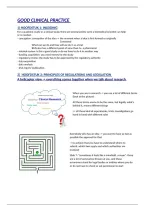
A helicopter view -> everything comes together when we talk about research
When you are in research -> you use a lot of different terms
(look at the picture)
All these terms seems to be the same, but legally, what’s
behind it, means different things
=> all these kind of experiments, trials, investigations go
hand in hand with different rules
Everybody who has an idea -> you want to have as fast as
possible the approval for that
-> to achieve that you have to understand where to
submit, which laws apply and which authorities are
involved
Slide 7: “sometimes it feels like a minefield, a maze”: there
are a lot of acronames thrown at you, and these
acronames stand for legal bodies or entities where you do
or do not have to check or ask permission to start
,The maze: the different entities at (inter)national level
FAMHP= federal agency for medicines and health products -> no clinical drug trial can start
without their approval (belgische overheid die klinische studies met geneesmiddelen
goedkeurt)
CT-college: in charge of appointing in Belgium one ethics committee that will look into the
submission dossier for research
-> will give scientific/ethical advice to FAMHP for complex trials
(bepalen of studie veilig en ethisch is)
CTIS: clinical trials information system -> all clinical trials must be submitted here
EUDAMED: EU database for medical devices: device studies must register here
(registratie van alle medische devices)
CESP: Common European Submission Portal -> used to send regulatory documents to
authorities
EudraVigilance: for safety reporting during clinical trials
The maze: at local (UZ Gent) level
Research Portal: depending on the type of research you do and the questions you are asked ,
it will guide you through the right connections
BioBank: if you do research with human body materials, you will come in contact with
biobank
DSI= data science institute: If you use the electronic patients records, you will have to go
through DSI
HIRUZ = health, innovation and research institute: helps with submission, data, quality,…
CME: , no study can start without ethical approval, if you prospectief research, will have to pe
approved by the CME
DAC= data acces committee -> if you are using data that is already existing, it has to be
approved by DAC
The framework
If we look at all these legal frameworks and guidances, you can divine them in 4 (later meer uitleg)
CTIS (11-14):
Belgium is a top country for clinical research: it conduct 20% of all EU trials but only has 4% of the
sites (bv 1 site = UZ gent) -> belgium sites are very productive and highly trusted by sponsers
, 1) experiment: any test, study or research carried out on
human subjects, with the aim of developing knowledge
specific to the practice of healthcare professions (Belgian law)
(elke test op mensen om medische kennis te vergoten)
2) clinical trial: een studie met geneesmiddelen die voldoet
aan minstens 1 van deze criteria:
- therapeutische strategie is op voorhand bepaald
- beslissing om medicatie voor te schrijven aan een patient,
enkel als die patient in de studie mee doet
- extra diagnostiek procedures buiten de normale
3) Clinical investigation: any systematic investigation involving
one or more human subjects, undertaken to assess the safety
and/or performance of a medica device
HIRUZ
“HIRUZ ondersteunt onderzoekers bij het opzetten en uitvoeren van klinisch onderzoek aan U(Z)
gent”
Centrale ondersteuning: central point of contact (CPOC) for researchers at university of Ghent
Hulp bij indienen van studies: - EC: ethical aproval
- FAMHP
- research portal, CTIS en CESP
Study management (= praktisch organiseren van de studie) – projectmanagement
- datamanagement
- quality management (QMS)
Electronic Data capture (data verzamelen) -> use REDCap (elektronisch system om
onderzoeksdata van patiënten veilig te registreren)
Controle van studiegegevens: monitoring, SDR, SDV
Contracten en financiering: - academic and commercial clinical research contract handling
- Grant writing and/or national/institutional funding applications
Betrekken van de patiënten: PAWO
(inter)national clinical research framework
Green: ethical (everything that has something to do with ethics)
Red: European
Grey: national
Blue: local
!! all these different kinds of clinical research purposes, they have a very important role for the
sponsor (= opdrachtgever)
Sponsor = the one that is driving the intellectual idea behind the research
It can be split up in 2 different kind of approaches: 1) commercial -> a company
2) academic -> when you have your own
Investigators
, Can delegate certain tasks to a CRO
Sponsor has nothing to do with money -> money comes from a funder
Participating site
= hospital, general practitioner, nursing home, …
Your team will look like this
spo
sponsor
= individual, company or institution
National law vs directives/regulations
The CTR, MDR and the IVDR, they all regulated on European level and have separated laws
Nog tot slide 40
Turn-around Times/ “doorlooptijden”
-> this section explains how long it takes from submitting a clinical trial application to starting the
study.
We will look at the zoom-out: how fast is the EU, the VS and the APAC
The zoom-in: how fast is Belgium
Clinical trial: there is a difference between CTD and CTR
CTD = clinical trial directive -> has to be translated in national law
= het is een richtlijn dat elk EU land de regels zelf moet omzetten in nationale wetgeving
Je kreeg hierdoor 27 verschillende procedures (allemaal andere interpretaties van andere
landen
In belgië werd CTD omgezet via de wet van 7mei 2004
Voor elk land moet je:
- CA-submission and approval
- EC-submission and approval
-trial can start
=> dus studie in 5 langen = 5 verschillende procedures
Voor belgie: all research has to be approved within 28 days, for phase I trials = 15 days
CTR= clinical trial regulation -> immediately into force
In alle landen zelfde regels, zelfde tijdslijn en zelfde procedure
CTR uses CTIS = centraal EU-portaal
1 dossier voor alle landen : - validation
- part I AR door RMS
- part II AD door MSc’s
Timeline: 60 days


