INVESTMENT & INSURANCE
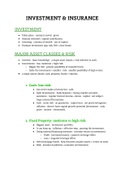
INVESTMENT
● Takes place - money is saved - grow.
● Amount invested = capital contribution.
● Investing - creation of wealth - use of capital.
● Evaluate investment opp: risk, ROI + time frame.
MAJOR ASSET CLASSES & RISK
● Investor - basic knowledge - 4 major asset classes + risk inherent in each.
● Investments - low, moderate + high risk.
○ Bigger the risk - greater possibility of reward/return.
○ Safer the investment + smaller - risk - smaller possibility of high return.
● 4 major assets classes: cash, property, bonds + equities.
1. Cash- low risk:
● Can never make a fortune but - safe.
● Cash investments - bank deposits + money market accounts -
assurance - regular interest income + know - capital - not subject -
huge external fluctuations.
● Cash - some risk - no guarantee - capital sum - not protected against
inflation - doesn’t have capital growth potential (investment - only
grow - income - reinvested).
2. Fixed Property- moderate to high risk:
● Biggest asset - investment portfolio.
● It can keep up - inflation + effective way - gearing the investment.
● Using external financing investors - increase return on investment.
○ Profit - borrowed money = positive leverage effect.
○ Loss = negative leverage effect
● Debt (mortgage bond) - help investors acquire assets + return on asset.
● Risk - location & political + economic environment.
, ● Property market - shown good strength.
● Drawback - lack of liquidity (can’t sell as quickly as other assets).
● Property speculation (buying + selling) - left to experts.
3. Bonds- moderate risk:
● bonds/gilts = interest-bearing securities - issued by gov/companies -
borrow money.
● It is an IOU - promise to pay lender interest + pay back capital sum -
specific date.
● Capital sum - fluctuate but interest - higher than on cash.
4. Equities- high risk:
● Investors - equities (shares/stocks) - part-ownership - company
(shareholders).
● Some companies - stock exchange - shares - traded freely. (JSE Ltd)
● It has best chance - beating inflation - long term - if invested in blue
chip shares (stable companies - Coca Cola).
● Longer time before retirement - more investment - equities.
● Offers capital growth + when value of shares - increases - profit -
dividends.
*Diversification: spreading investment risk - various asset classes.
● Investment plans - combo - 4 major asset classes.
● Combo of equities, bonds + money market instruments - greater chance - higher
returns + can control risk + reward.
RISK PROFILING
● Investment brokers + companies - investment risk profile - investor - type of
investment - best suited for the investor.
● Risk profile - help create - understanding - investor’s tolerance for risk + if expected
return - acceptable.
● Issues - investors - consider:
○ Time horizon - investment
○ Current financial position - investor
INVESTMENT
● Takes place - money is saved - grow.
● Amount invested = capital contribution.
● Investing - creation of wealth - use of capital.
● Evaluate investment opp: risk, ROI + time frame.
MAJOR ASSET CLASSES & RISK
● Investor - basic knowledge - 4 major asset classes + risk inherent in each.
● Investments - low, moderate + high risk.
○ Bigger the risk - greater possibility of reward/return.
○ Safer the investment + smaller - risk - smaller possibility of high return.
● 4 major assets classes: cash, property, bonds + equities.
1. Cash- low risk:
● Can never make a fortune but - safe.
● Cash investments - bank deposits + money market accounts -
assurance - regular interest income + know - capital - not subject -
huge external fluctuations.
● Cash - some risk - no guarantee - capital sum - not protected against
inflation - doesn’t have capital growth potential (investment - only
grow - income - reinvested).
2. Fixed Property- moderate to high risk:
● Biggest asset - investment portfolio.
● It can keep up - inflation + effective way - gearing the investment.
● Using external financing investors - increase return on investment.
○ Profit - borrowed money = positive leverage effect.
○ Loss = negative leverage effect
● Debt (mortgage bond) - help investors acquire assets + return on asset.
● Risk - location & political + economic environment.
, ● Property market - shown good strength.
● Drawback - lack of liquidity (can’t sell as quickly as other assets).
● Property speculation (buying + selling) - left to experts.
3. Bonds- moderate risk:
● bonds/gilts = interest-bearing securities - issued by gov/companies -
borrow money.
● It is an IOU - promise to pay lender interest + pay back capital sum -
specific date.
● Capital sum - fluctuate but interest - higher than on cash.
4. Equities- high risk:
● Investors - equities (shares/stocks) - part-ownership - company
(shareholders).
● Some companies - stock exchange - shares - traded freely. (JSE Ltd)
● It has best chance - beating inflation - long term - if invested in blue
chip shares (stable companies - Coca Cola).
● Longer time before retirement - more investment - equities.
● Offers capital growth + when value of shares - increases - profit -
dividends.
*Diversification: spreading investment risk - various asset classes.
● Investment plans - combo - 4 major asset classes.
● Combo of equities, bonds + money market instruments - greater chance - higher
returns + can control risk + reward.
RISK PROFILING
● Investment brokers + companies - investment risk profile - investor - type of
investment - best suited for the investor.
● Risk profile - help create - understanding - investor’s tolerance for risk + if expected
return - acceptable.
● Issues - investors - consider:
○ Time horizon - investment
○ Current financial position - investor