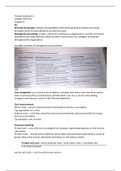
Final summary QRM
Lecture 2 and Chapter 2 Navarro
Moderator: Men are more satisfied with
red product, old people are more likely to
return shiny product than young
individuals.
Mediator: Customers are more satisfied
with red products because the colour red
indicates joy.
Moderated mediation: Old people are
more likely to return shiny products
because it does not fit with their
furniture.
Types of variables:
Continuous variables: it is logically possible for
any two measurements to have another value in
between. E.g., weight, height, speed, …
Discrete variables: are not continuous. There is
nothing in the middle. E.g. age (in years),
outcomes of a coin flip, …
Scale of measurement:
- Nominal scale: no particular relationship between different possibilities, there is nos
scale or average. E.g. modes of transportation.
- Ordinal scale: there is a natural, meaningful way to order the different possibilities,
but the numerical value is not meaningful. E.g., finishing position in a race.
- Interval scale: difference between the numbers are interpretable, but the number has
no natural zero value. E.g., temperature -> 20 degrees is not twice as hot as 10, zero
degrees means nothing.
- Ratio scale: zero means zero, you can divide and multiply with this value. E.g.,
financial performance of a firm.
Quasi interval: likert-scale. Between an ordinal and interval scale.
Measurement:
The data has to represent the right information. Therefore, we need to ask the right questions
and record all necessary variables. In measurements it is important to consider the following:
,Validity: a measure is valid when it represents what you are trying to measure. Written text is
a invalid measure of musical ability. Are students’ evaluations a valid measure of teaching
quality?
- Construct validity: a measurement has good construct validity is it is actually
measuring the correct theoretical construct.
- Internal validity: the extent to which you are able to draw the correct conclusions
about the causal relationships between variables.
- External validity: the extend to which your findings are generalisable to the broader
population and different settings.
Threats to internal validity: internal validity is the extend to which we can draw correct
conclusions about the causal relationship between variables.
Omitted variable bias: you left out an important measurement that is influencing your
results. When researching how well we work at home, omitting the number the children in our
analysis will lead to an underestimation effect of teleworking. Omitted variable bias occurs
when we leave out important dependent variables (confounding variables).
Sample selection bias: the selection of data for analysis in such a way that proper
randomization is not achieved, leading to an unrepresentative sample of the population
intended to be analysed. Solution: random sample, to draw an independent an identically
distributed sample. The people selected have different characteristics, that could potentially
become confounding.
Non-response bias: you send out 1000 requests and get 300 replies. These 300 people,
because they responded, are systematically different the people who did not respond, makes
the findings hard to generalise. Also, a lot did not answer a question, this can also be a
problem, especially if this is an important question. In essence, what your dealing with here is
what’s called the problem of missing data. As long as it is randomly lost, there is no problem.
Measurements errors: the difference between a measured quantity and its true value.
- Random error: naturally occurring errors that are to be expected -> no problem as
they are distributed randomly
- Systematic error: Caused by a wrong instrument that affects all measurement -> a
scale that is always 1 pound of -> problematic.
Regression to the mean: you select data/respondents based on an extreme. By change, any
subsequent measure will likely be less extreme because. Things will even out over time.
Bad/good luck makes you perform worse/better, but in both cases the next time you will move
back to the mean. Picking the top 20 students can lead to disappointing results.
Experimenter bias: the experimenter can accidentally influence the results by subtly
communicating the right answer or desired behaviour. A possible solution is a doubly-blind
study, experimenter and participant don’t know of the conditions. Pygmalion effect: when you
expect great things, people tend to rise to the occasion.
Demands and effect reactivity: it’s near impossible to stop people from knowing they are
being studied. The knowledge of being watched can influence our behaviour: demand effect.
We tend to react in one of the following ways:
, - The good participant: tries to be too helpful: seeks to affirm hypothesis
- The negative participant: does the exact opposite of the good participant
- The faithful participant: perfectly follows instruction -> no realistic happening
- The apprehensive participant: gets nervous so behaviour becomes unnatural.
Placebo effect: rarely happens: specific type of demand effect; it’s the situation where the
fact of being measured causes an improvement in outcome. A true placebo is rare, normally
it’s a combination of other things.
Identically distributed: no overall trends, the distribution does not fluctuate and all items in
the sample are taken from the same probability distribution.
Independent: the sample items are alle independent events.
Difference random sample and experimental data: in experimental data, researchers set values
of the explanatory findings.
Threats to external validity: external validity relates to the generalisability of the findings?
Differences in population: e.g. you estimate the effect of teleworking only for men.
Difference in settings: e.g. the effect of teleworking can differ between the Netherlands and
Belgium due to differences in culture.
Artefacts: a result is an artefact if it only holds true in a special situation.
Reliability: the degree to which a measure
produces stable/repeatable and consistent
results. Is the measurement reliable, can we
trust a scale to accurately measure weight?
When holding a brick on scale, you have a
reliable but invalid measurement. We need
reliability to ensure validity.
Reliability measures precision, whereas
validity measures accuracy.
Lecture 2 and Chapter 2 Navarro
Moderator: Men are more satisfied with
red product, old people are more likely to
return shiny product than young
individuals.
Mediator: Customers are more satisfied
with red products because the colour red
indicates joy.
Moderated mediation: Old people are
more likely to return shiny products
because it does not fit with their
furniture.
Types of variables:
Continuous variables: it is logically possible for
any two measurements to have another value in
between. E.g., weight, height, speed, …
Discrete variables: are not continuous. There is
nothing in the middle. E.g. age (in years),
outcomes of a coin flip, …
Scale of measurement:
- Nominal scale: no particular relationship between different possibilities, there is nos
scale or average. E.g. modes of transportation.
- Ordinal scale: there is a natural, meaningful way to order the different possibilities,
but the numerical value is not meaningful. E.g., finishing position in a race.
- Interval scale: difference between the numbers are interpretable, but the number has
no natural zero value. E.g., temperature -> 20 degrees is not twice as hot as 10, zero
degrees means nothing.
- Ratio scale: zero means zero, you can divide and multiply with this value. E.g.,
financial performance of a firm.
Quasi interval: likert-scale. Between an ordinal and interval scale.
Measurement:
The data has to represent the right information. Therefore, we need to ask the right questions
and record all necessary variables. In measurements it is important to consider the following:
,Validity: a measure is valid when it represents what you are trying to measure. Written text is
a invalid measure of musical ability. Are students’ evaluations a valid measure of teaching
quality?
- Construct validity: a measurement has good construct validity is it is actually
measuring the correct theoretical construct.
- Internal validity: the extent to which you are able to draw the correct conclusions
about the causal relationships between variables.
- External validity: the extend to which your findings are generalisable to the broader
population and different settings.
Threats to internal validity: internal validity is the extend to which we can draw correct
conclusions about the causal relationship between variables.
Omitted variable bias: you left out an important measurement that is influencing your
results. When researching how well we work at home, omitting the number the children in our
analysis will lead to an underestimation effect of teleworking. Omitted variable bias occurs
when we leave out important dependent variables (confounding variables).
Sample selection bias: the selection of data for analysis in such a way that proper
randomization is not achieved, leading to an unrepresentative sample of the population
intended to be analysed. Solution: random sample, to draw an independent an identically
distributed sample. The people selected have different characteristics, that could potentially
become confounding.
Non-response bias: you send out 1000 requests and get 300 replies. These 300 people,
because they responded, are systematically different the people who did not respond, makes
the findings hard to generalise. Also, a lot did not answer a question, this can also be a
problem, especially if this is an important question. In essence, what your dealing with here is
what’s called the problem of missing data. As long as it is randomly lost, there is no problem.
Measurements errors: the difference between a measured quantity and its true value.
- Random error: naturally occurring errors that are to be expected -> no problem as
they are distributed randomly
- Systematic error: Caused by a wrong instrument that affects all measurement -> a
scale that is always 1 pound of -> problematic.
Regression to the mean: you select data/respondents based on an extreme. By change, any
subsequent measure will likely be less extreme because. Things will even out over time.
Bad/good luck makes you perform worse/better, but in both cases the next time you will move
back to the mean. Picking the top 20 students can lead to disappointing results.
Experimenter bias: the experimenter can accidentally influence the results by subtly
communicating the right answer or desired behaviour. A possible solution is a doubly-blind
study, experimenter and participant don’t know of the conditions. Pygmalion effect: when you
expect great things, people tend to rise to the occasion.
Demands and effect reactivity: it’s near impossible to stop people from knowing they are
being studied. The knowledge of being watched can influence our behaviour: demand effect.
We tend to react in one of the following ways:
, - The good participant: tries to be too helpful: seeks to affirm hypothesis
- The negative participant: does the exact opposite of the good participant
- The faithful participant: perfectly follows instruction -> no realistic happening
- The apprehensive participant: gets nervous so behaviour becomes unnatural.
Placebo effect: rarely happens: specific type of demand effect; it’s the situation where the
fact of being measured causes an improvement in outcome. A true placebo is rare, normally
it’s a combination of other things.
Identically distributed: no overall trends, the distribution does not fluctuate and all items in
the sample are taken from the same probability distribution.
Independent: the sample items are alle independent events.
Difference random sample and experimental data: in experimental data, researchers set values
of the explanatory findings.
Threats to external validity: external validity relates to the generalisability of the findings?
Differences in population: e.g. you estimate the effect of teleworking only for men.
Difference in settings: e.g. the effect of teleworking can differ between the Netherlands and
Belgium due to differences in culture.
Artefacts: a result is an artefact if it only holds true in a special situation.
Reliability: the degree to which a measure
produces stable/repeatable and consistent
results. Is the measurement reliable, can we
trust a scale to accurately measure weight?
When holding a brick on scale, you have a
reliable but invalid measurement. We need
reliability to ensure validity.
Reliability measures precision, whereas
validity measures accuracy.