Garantie de satisfaction à 100% Disponible immédiatement après paiement En ligne et en PDF Tu n'es attaché à rien 4.2 TrustPilot
logo-home
Examen

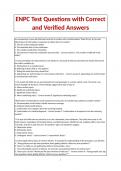
ENPC Test Questions with Correct and Verified Answers

Note
-
Vendu
-
Pages
4
Qualité
A+
Publié le
25-03-2024
Écrit en
2023/2024

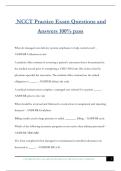
ENPC Test Questions with Correct and Verified Answers An unresponsive 2-year-old child was found by his mother with a bottle labeled "Elavil 50 mg" by his side. Which piece of information is important to obtain from his mother? A. The size of the medication bottle. B. The expiration date of the medication. C. The number of pills left in the bottle. D. The person for whom the medication was prescribe. - Correct answer C. The number of pills left in the bottle." "A nurse providing crisis intervention to the family of a seriously ill child can best keep the family informed of the child's condition by: A. Placing them in a secluded room. B. Referring to their child as "the patient". C. Telling the family how they should feel. D. Appointing one staff member to communicate with them. - Correct answer D. Appointing one staff member to communicate with them." "A 16-month-old child was an unrestrained front seat passenger in a motor vehicle crash. The chest x-ray reveals multiple rib fractures. These findings suggest what type of injury? A. Minor surface injury. B. Significant underlying injury. C. Significant surface injury. D. Minor underlying injury. - Correct answer B. Significant underlying injury." "Which piece of information is most important to know prior to transferring a patient to another facility? A. Documentation of the family's health insurance coverage. B. Pertinent family health history. C. Confirmation of acceptance from the receiving hospital. D. Confirmation of a medical diagnosis. - Correct answer C. Confirmation of acceptance from the receiving hospital." "A 10-year-old child who was struck by a car has a distended, tense abdomen. The child's heart rate is 144 beats/minute, respirations 24 breaths/minute, and blood pressure 120/80 mm Hg. Capillary refill is more than 3 seconds, and skin is pale and cool. The patient's signs and symptoms suggest: A. Obstructive shock. B. Distributive shock. C. Hypovolemic shock. D. Cardiogenic shock. - Correct answer C. Hypovolemic shock." "A school-aged child is about to receive stitches. To evaluate his understanding of the procedure, you tell him: A. "Young people your age have questions about getting stitches. What are your questions?" B. "Don't cry while you are getting the stitches. Be brave like a man." C. "You will probably receive 10 stitches. Do you have any questions before we restrain you?" D. "Does your cut hurt? Would you like your mommy to hold you?" - Correct answer A. "Young people your age have questions about getting stitches. What are your questions?"" "What is the preferred sit for intraosseous access in the infant? A. Lateral malleolus B. Iliac crest C. Proximal femur D. Anteromedial tibia - Correct answer D. Anteromedial tibia" "An important consideration in the assessment of pain for an adolescent patient is that they: A. May deny or minimize their pain when friends visit for fear of losing control. B. Have difficulty localizing or describing the pain. C. Are unable to use the 1 to 10 scale to report their pain. D. Feel that the pain is a punishment for something they did wrong. - Correct answer A. May deny or minimize their pain when friends visit for fear of losing control." "An 8-month-old infant with pneumonia has severe intercostal and substernal retractions, weak muscle tone, lethargy, and gray skin color. The infant's condition does not improve after bag-mask ventilation. The next step in treatment is most likely to be: A. Administration of epinephrine. B. Supplemental warming measures. C. Rapid sequence intubation. D. Administration of albuterol. - Correct answer C. Rapid sequence intubation." "Which combination of medications is best to have prepared for a pediatric resuscitation? A. Dopamine and sodium bicarbonate. B. Epinephrine and glucose. C. Naloxone and lidocaine. D. Pentothal and vecuronium. - Correct answer B. Epinephrine and glucose." "A 20-day-old infant has a 1-week history of not eating well. The infant has a weak cry and is jittery. Which laboratory test is indicated? A. Arterial blood gas. B. Finger-stick glucose. C. Complete blood count with differential. D. Toxicology screen. - Correct answer B. Finger-stick glucose." "Which intervention should be performed next if tactile stimulation, positioning, drying, and blow-by oxygen administration do not increase a newborn's heart rate? A. Chest compressions. B. Umbilical vein cannulation. C. Endotracheal intubation. D. Bag-mask ventilation. - Correct answer D. Bag-mask ventilation." "A 10-kg child has deep partial-thickness burns over 35% of the total body surface area. Which evaluation parameter indicates that fluid resuscitation is adequate? A. Heart rate of 160 beats/minute. B. Respiratory rate of 34 breaths/minute. C. Blood pressure of 80/60 mm Hg. D. Urine output of 11 ml/hour. - Correct answer D. Urine output of 11 ml/hour." "A 7-year-old female sustains a minor head injury and did not lose consciousness. She does not respond to commands and groans in response to questions. Which action will quickly determine if her behavior indicates a serious head injury? A. Review her medical record for pre-existing developmental problems. B. Obtain a head computerized tomography scan. C. Conduct a developmental screening test. D. Ask the parents if her behavior is unusual. - Correct answer D. Ask the parents if her behavior is unusual." "An 8-month-old child presents with purpura, irritability, and a rectal temperature of 39.4�C (102.9�F). An intervention of high priority is: A. Encouraging the caregiver to hold and comfort the child. B. Monitoring for signs and symptoms of increased intracranial pressure (ICP). C. Collecting urine for toxicology screen. D. Encouraging oral fluids and food. - Correct answer B. Monitoring for signs and symptoms of increased intracranial pressure (ICP)." "The Pediatric Assessment Triangle is used to: A. Identify all life-threatening conditions that the child presents with. B. Perform a complete head-to-toe assessment on the child. C. Assess the status of the child's airway only upon arrive in the ED. D. Determine the severity of the child's illness or injury using the "across-the-room" assessment. - Correct answer D. Determine the severity of the child's illness or injury using the "across-the-room" assessment." "The caregivers of a 6-year-old boy who is brought to the emergency department for abdominal pain should first be asked: A. "Are his immunizations current?" B. "Has anything happened to him at school recently?" C. "What is the reason for the child's visit and how long has he been ill?" D. "Has he been complaining of a sore throat or earache?" - Correct answer C. "What is the reason for the child's visit and how long has he been ill?"" "A 9-month-old infant is crying loudly through the nursing assessment, and the caregiver is becoming distraught. The nurse should ask the caregiver to: A. Read a story to the infant. B. Offer the infant a pacifier. C. Return when the infant is consoled. D. Ignore the infant's behavior. - Correct answer B. Offer the infant a pacifier." "During an intubation attempt, the child�s heart rate drops to 40 beats/minute. Which intervention is indicated? A. Ask the physician to stop the intubation attempt and perform bag-mask ventilation. B. Apply cricoid pressure and establish intravenous access. C. Inform the physician of the heart rate and ask the physician to intubate faster. D. Administer blow-by oxygen and begin chest compressions. - Correct answer A. Ask the physician to stop the intubation attempt and perform bag-mask ventilation." "A 6- week-old infant is pale, has marked substernal retractions, expiratory grunting, and poor muscle tone. The emergency nurse should first: A. Obtain intravenous access. B. Apply a pulse oximeter. C. Prepare a chest x-ray. D. Administer 100% oxygen. - Correct answer D. Administer 100% oxygen." "The best method to open the airway in an injured child is: A. Placing the head and neck in hyperextension. B. Using the jaw thrust maneuver. C. Placing the head and neck in flexion. D. Using the head tilt maneuver. - Correct answer B. Using the jaw thrust maneuver." "A 4-year-old child with a history of the flu has a heart rate of 80 beats/minute, respirations of 16 breaths/minute, and capillary refill of more than 3 seconds. The proper sequence for nursing interventions would be: A. Position the airway, administer 100% oxygen, obtain venous access, and administer 20 ml/kg of an isotonic solution. B. Administer 100% oxygen, obtain venous access, administer 0. 1 mg/kg of epinephrine 1:10,000, and prepare for endotracheal intubation. C. Position the airway, provide bag-mask ventilation, provide synchronized cardioversion, and provide supplemental warmth. D. Administer 100% oxygen, prepare for a venous cutdown, administer 20 ml/kg of an isotonic solution, and obtain a chest x-ray. - Correct answer A. Position the airway, administer 100% oxygen, obtain venous access, and administer 20 ml/kg of an isotonic solution." "A 3-year-old is transported by prehospital personnel after being struck by a car. The parents are en route. The child is screaming and uncooperative. Which is the best approach while conducting the secondary survey? A. Hold the child to comfort him. B. Wait for the parent's arrival. C. Observe for behavioral pain cues. D. Use a doll to demonstrate the examination. - Correct answer C. Observe for behavioral pain cues." "Which ocular finding is associated with child maltreatment? A. Glaucoma. B. Conjunctivitis. C. Iritis. D. Retinal hemorrhage. - Correct answer D. Retinal hemorrhage." "A pregnant 18-year-old woman arrives at the emergency department about ready to deliver a full-term infant. She states that she noticed a large amount of dark green fluid the last time she went to the bathroom. During the delivery, the nurse should prepare to: A. Dry and arm the infant as soon as is it delivered. B. Stimulate and ventilate the infant immediately after delivery. C. Suction the mouth and nose of the infant while on the perineum. D. Administer blow-by oxygen and rub the back immediately after delivery. - Correct answer C. Suction the mouth and nose of the infant while on the perineum."

Montrer plus Lire moins
Établissement
ENPC
Cours
ENPC


Oups ! Impossible de charger votre document. Réessayez ou contactez le support.

Infos sur le Document

Publié le
25 mars 2024
Nombre de pages
4
Écrit en
2023/2024
Type
Examen
Contenu
Questions et réponses

Sujets

Aperçu du contenu

ENPC Test Questions with Correct
and Verified Answers
An unresponsive 2-year-old child was found by his mother with a bottle labeled "Elavil 50 mg" by his side.
Which piece of information is important to obtain from his mother?
A. The size of the medication bottle.
B. The expiration date of the medication.
C. The number of pills left in the bottle.
D. The person for whom the medication was prescribe. - Correct answer C. The number of pills left in the
bottle."

"A nurse providing crisis intervention to the family of a seriously ill child can best keep the family informed of
the child's condition by:
A. Placing them in a secluded room.
B. Referring to their child as "the patient".
C. Telling the family how they should feel.
D. Appointing one staff member to communicate with them. - Correct answer D. Appointing one staff member
to communicate with them."

"A 16-month-old child was an unrestrained front seat passenger in a motor vehicle crash. The chest x-ray
reveals multiple rib fractures. These findings suggest what type of injury?
A. Minor surface injury.
B. Significant underlying injury.
C. Significant surface injury.
D. Minor underlying injury. - Correct answer B. Significant underlying injury."

"Which piece of information is most important to know prior to transferring a patient to another facility?
A. Documentation of the family's health insurance coverage.
B. Pertinent family health history.
C. Confirmation of acceptance from the receiving hospital.
D. Confirmation of a medical diagnosis. - Correct answer C. Confirmation of acceptance from the receiving
hospital."

"A 10-year-old child who was struck by a car has a distended, tense abdomen. The child's heart rate is 144
beats/minute, respirations 24 breaths/minute, and blood pressure 120/80 mm Hg. Capillary refill is more than
3 seconds, and skin is pale and cool. The patient's signs and symptoms suggest:
A. Obstructive shock.
B. Distributive shock.
C. Hypovolemic shock.
D. Cardiogenic shock. - Correct answer C. Hypovolemic shock."

"A school-aged child is about to receive stitches. To evaluate his understanding of the procedure, you tell him:
A. "Young people your age have questions about getting stitches. What are your questions?"
B. "Don't cry while you are getting the stitches. Be brave like a man."
C. "You will probably receive 10 stitches. Do you have any questions before we restrain you?"
D. "Does your cut hurt? Would you like your mommy to hold you?" - Correct answer A. "Young people your age
have questions about getting stitches. What are your questions?""

1

Faites connaissance avec le vendeur

Seller avatar
Les scores de réputation sont basés sur le nombre de documents qu'un vendeur a vendus contre paiement ainsi que sur les avis qu'il a reçu pour ces documents. Il y a trois niveaux: Bronze, Argent et Or. Plus la réputation est bonne, plus vous pouvez faire confiance sur la qualité du travail des vendeurs.
Smith01 Chamberlain College Of Nursing
Voir profil
S'abonner Vous devez être connecté afin de pouvoir suivre les étudiants ou les formations
Vendu
70
Membre depuis
4 année
Nombre de followers
10
Documents
562
Dernière vente
2 semaines de cela
Excellence Bank

On my page you will find latest exam questions with verified answers to help in your revision. Having graduated recently, I believe I have an up-to-date materials and information that will provide you with what you require for the upcoming exams. I cover a wide range of subjects in my research and put together quality materials on this page. I am always available to help others excel.

4,7

18 revues

5
14
4
3
3
1
2
0
1
0

Récemment consulté par vous

Pourquoi les étudiants choisissent Stuvia

Créé par d'autres étudiants, vérifié par les avis

Une qualité sur laquelle compter : rédigé par des étudiants qui ont réussi et évalué par d'autres qui ont utilisé ce document.

Le document ne convient pas ? Choisis un autre document

Aucun souci ! Tu peux sélectionner directement un autre document qui correspond mieux à ce que tu cherches.

Paye comme tu veux, apprends aussitôt

Aucun abonnement, aucun engagement. Paye selon tes habitudes par carte de crédit et télécharge ton document PDF instantanément.

Student with book image

“Acheté, téléchargé et réussi. C'est aussi simple que ça.”

Alisha Student

Foire aux questions