🌐
1
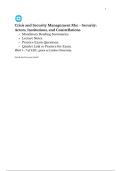
Crisis and Security Management Msc - Security:
Actors, Institutions, and Constellations
+ Mandatory Reading Summaries.
+ Lecture Notes.
+ Practice Exam Questions.
+ Quizlet Link to Practice for Exam.
Week 1 - 7 of SAIC, given at Leiden University.
Good luck on your final!
, 2
Required Readings:
Lecture/Workgroup Reading
Lecture 1 – Introduction: (Popper, 1963)
On Empirics, Understanding, Puzzles, and Methods
(Due the 30th of Oct)
(Mahoney & Goertz, 2006)
(Gerring, 1999)
(Melogno, 2024)
Lecture 2 – Rethinking Terrorism: (Kydd & Walter, 2006)
Quantitative Methods and Rational Actor Modeling
(Due the 6th of Nov)
(Thomas, 2014)
(Tokdemir & Klein, 2021)
Lecture 3 – Crisis, Coordination, Change and (Weick, 1993)
Complexity: Experimental Methods (Due the 13th of
Nov)
(Barton & Sutcliffe, 2009)
(Wolbers et al., 2018)
(Wolbers, 2024)
Lecture 4 – Countering Disinformation: Mixing (Druckman et al., 2011)
Survey Experiments and Narrative Analysis Methods
(Due the 27th of Nov)
(Wagnsson & Barzanje, 2021)
(Hellman, 2024)
(Hoyle et al., 2024)
, 3
Lecture 5 – Sanctions and (In) Securite Qualitative (Levy, 2008)
Case Studies (Due the 20th of Nov)
(Farrell & Newman, 2019)
(Drezner, 2022)
(Hoye, 2024)
Lecture 6 – EU at War Process Tracing and (Costa & Barbé, 2023)
Elite-Interview Methods (Due the 4th of Dec)
(Gonzalez-Ocantos & Masullo,
2024)
(Menzies, 2025)
(Dimitrova et al., 2025)
Lecture 7 – Frontex, Migration, and (In)Security: (Menjívar, 2014)
Ethnography (Due the 10th of Dec)
(Cusumano, 2019)
(Maher, 2018)
(Moreno‐Lax, 2018)
(Brodkin, 2017)
(Clemens, 2022)
, 4
Lecture 1
Popper, K. R. (1963). Science as Falsification. In Conjectures and Refutation (pp.
33–39). Routledge.
Popper's Core Philosophy: Conjecture and Refutation
● The common theme uniting Popper’s essays is that knowledge progresses by a
method of conjecture and refutation.
● This method involves proposing a hypothesis (a conjecture) and then subjecting it to
scrutiny by attempting to prove that it is false. If the hypothesis survives these tests, it
is provisionally accepted, but “its truth can never be known.”
Arguments
● Scientists begin not with observations, but with a problem or set of problems.
● Theories are considered pure conjectures, "free creations of our own minds", and the
result of "an almost poetic intuition".
● They are "self-made instruments of thought" and are not compelled by observations or
prior theories.
The Role of Observation and Demarcation
● The role is not in generating a theory but in testing it, criticising it, and trying to refute
it.
● Observations can never verify theories because general statements (which theories
contain) cannot be logically inferred from any finite number of observation
statements.
● Popper = rejects verificationism. Instead, he uses falsifiability (or testability) as the
criterion of demarcation to separate science from metaphysics.
Key principles of falsifiability and progress:
1. Irrefutability is not a virtue: Falsifiability admits of degrees (there’s no strict boundary
between science and metaphysics). Many scientific theories developed from myths
which were initially untestable, later gaining testable components.
2. Testability and Risk: Theories are "highly informative guesses" that, while not
verifiable, must be submitted to severe tests. Every genuine test is an attempt to
disprove or refute the theory.
3. Aiming for Truth: Popper compares truth to a mountain peak hidden by clouds: the
climber may never know when the peak has been found, but will know if they have
not reached it (i.e., if the theory is refuted).
4. Requirements for Progress: For progress to occur, theories must satisfy three criteria:
a. They should proceed from a simple, new, and powerful unifying idea.
b. They must have testable consequences beyond those they were originally
designed to explain.
c. They must pass some new and severe tests.
, 5
Popper also introduced the concept of verisimilitude (approximating the truth). Given two
theories, Tv1, and Tv2.
● Tv2 = greater degree of verisimilitude if the class of true logical consequences
(truth-content) of Tv2 is greater than that of Tv1 (but not its false logical
consequences), or if Tv1's false logical consequences (falsity-content) is greater than
Tv2's (but not its truth-content).
Critiques of Popper's View
1. Limitations of the Conjecture/Refutation Model
a. The history of science does not always fit neatly into the proposing or testing
of theories. Scientific progress is often achieved through activities that are
neither proposing nor testing a hypothesis, such as:
2. Experimental Determination
a. Millikan's oil drop experiment aimed to make an exact determination of the
value of the elementary electrical charge, which was neither the proposing nor
testing of a pre-existing hypothesis regarding that specific value.
3. Constructing Analogies
a. Maxwell’s work to offer a "simplification and reduction of the results of
previous investigation" by elaborating a physical analogy (like the
incompressible fluid analogy for the electric field) was neither proposing nor
testing a theory.
4. Other Activities
a. Reformulating hypotheses mathematically, introducing and defining new
concepts (like Gibbs' ensemble), redefining existing concepts (like Mach's
mass), or applying a theory to idealised systems (like Clausius applied
thermodynamics to a perfect gas) also contribute significantly to progress but
do not necessarily involve conjecturing or testing.
Promoting scientific understanding is a sufficient condition for progress, which can be
achieved through these various activities, not just by leading to new conjectures or tests.
The Role of Observation in Theory Development
Popper insists that the role of observation is solely or mainly critical (testing), Eg
(Conservation of Strangeness): Gell-Mann and Nishijima observed specific nuclear reactions
that failed to occur despite being permitted by known conservation laws. These experimental
results were crucial in suggesting the existence of the principle of the conservation of
strangeness.
Drawing on Hanson’s concept of retroduction, a modified inference pattern where a
surprising phenomenon (P) is observed against a theoretical background, is proposed, and
since P would be explicable if hypothesis (H) were true, there is reason to think H is true.
The Paradox of Falsification and Knowledge
Popper retains the early Positivist definition that a theory is verifiable if and only if it is
deducible from observation statements (Premise 1). Since he rejects the idea that scientific
1
Crisis and Security Management Msc - Security:
Actors, Institutions, and Constellations
+ Mandatory Reading Summaries.
+ Lecture Notes.
+ Practice Exam Questions.
+ Quizlet Link to Practice for Exam.
Week 1 - 7 of SAIC, given at Leiden University.
Good luck on your final!
, 2
Required Readings:
Lecture/Workgroup Reading
Lecture 1 – Introduction: (Popper, 1963)
On Empirics, Understanding, Puzzles, and Methods
(Due the 30th of Oct)
(Mahoney & Goertz, 2006)
(Gerring, 1999)
(Melogno, 2024)
Lecture 2 – Rethinking Terrorism: (Kydd & Walter, 2006)
Quantitative Methods and Rational Actor Modeling
(Due the 6th of Nov)
(Thomas, 2014)
(Tokdemir & Klein, 2021)
Lecture 3 – Crisis, Coordination, Change and (Weick, 1993)
Complexity: Experimental Methods (Due the 13th of
Nov)
(Barton & Sutcliffe, 2009)
(Wolbers et al., 2018)
(Wolbers, 2024)
Lecture 4 – Countering Disinformation: Mixing (Druckman et al., 2011)
Survey Experiments and Narrative Analysis Methods
(Due the 27th of Nov)
(Wagnsson & Barzanje, 2021)
(Hellman, 2024)
(Hoyle et al., 2024)
, 3
Lecture 5 – Sanctions and (In) Securite Qualitative (Levy, 2008)
Case Studies (Due the 20th of Nov)
(Farrell & Newman, 2019)
(Drezner, 2022)
(Hoye, 2024)
Lecture 6 – EU at War Process Tracing and (Costa & Barbé, 2023)
Elite-Interview Methods (Due the 4th of Dec)
(Gonzalez-Ocantos & Masullo,
2024)
(Menzies, 2025)
(Dimitrova et al., 2025)
Lecture 7 – Frontex, Migration, and (In)Security: (Menjívar, 2014)
Ethnography (Due the 10th of Dec)
(Cusumano, 2019)
(Maher, 2018)
(Moreno‐Lax, 2018)
(Brodkin, 2017)
(Clemens, 2022)
, 4
Lecture 1
Popper, K. R. (1963). Science as Falsification. In Conjectures and Refutation (pp.
33–39). Routledge.
Popper's Core Philosophy: Conjecture and Refutation
● The common theme uniting Popper’s essays is that knowledge progresses by a
method of conjecture and refutation.
● This method involves proposing a hypothesis (a conjecture) and then subjecting it to
scrutiny by attempting to prove that it is false. If the hypothesis survives these tests, it
is provisionally accepted, but “its truth can never be known.”
Arguments
● Scientists begin not with observations, but with a problem or set of problems.
● Theories are considered pure conjectures, "free creations of our own minds", and the
result of "an almost poetic intuition".
● They are "self-made instruments of thought" and are not compelled by observations or
prior theories.
The Role of Observation and Demarcation
● The role is not in generating a theory but in testing it, criticising it, and trying to refute
it.
● Observations can never verify theories because general statements (which theories
contain) cannot be logically inferred from any finite number of observation
statements.
● Popper = rejects verificationism. Instead, he uses falsifiability (or testability) as the
criterion of demarcation to separate science from metaphysics.
Key principles of falsifiability and progress:
1. Irrefutability is not a virtue: Falsifiability admits of degrees (there’s no strict boundary
between science and metaphysics). Many scientific theories developed from myths
which were initially untestable, later gaining testable components.
2. Testability and Risk: Theories are "highly informative guesses" that, while not
verifiable, must be submitted to severe tests. Every genuine test is an attempt to
disprove or refute the theory.
3. Aiming for Truth: Popper compares truth to a mountain peak hidden by clouds: the
climber may never know when the peak has been found, but will know if they have
not reached it (i.e., if the theory is refuted).
4. Requirements for Progress: For progress to occur, theories must satisfy three criteria:
a. They should proceed from a simple, new, and powerful unifying idea.
b. They must have testable consequences beyond those they were originally
designed to explain.
c. They must pass some new and severe tests.
, 5
Popper also introduced the concept of verisimilitude (approximating the truth). Given two
theories, Tv1, and Tv2.
● Tv2 = greater degree of verisimilitude if the class of true logical consequences
(truth-content) of Tv2 is greater than that of Tv1 (but not its false logical
consequences), or if Tv1's false logical consequences (falsity-content) is greater than
Tv2's (but not its truth-content).
Critiques of Popper's View
1. Limitations of the Conjecture/Refutation Model
a. The history of science does not always fit neatly into the proposing or testing
of theories. Scientific progress is often achieved through activities that are
neither proposing nor testing a hypothesis, such as:
2. Experimental Determination
a. Millikan's oil drop experiment aimed to make an exact determination of the
value of the elementary electrical charge, which was neither the proposing nor
testing of a pre-existing hypothesis regarding that specific value.
3. Constructing Analogies
a. Maxwell’s work to offer a "simplification and reduction of the results of
previous investigation" by elaborating a physical analogy (like the
incompressible fluid analogy for the electric field) was neither proposing nor
testing a theory.
4. Other Activities
a. Reformulating hypotheses mathematically, introducing and defining new
concepts (like Gibbs' ensemble), redefining existing concepts (like Mach's
mass), or applying a theory to idealised systems (like Clausius applied
thermodynamics to a perfect gas) also contribute significantly to progress but
do not necessarily involve conjecturing or testing.
Promoting scientific understanding is a sufficient condition for progress, which can be
achieved through these various activities, not just by leading to new conjectures or tests.
The Role of Observation in Theory Development
Popper insists that the role of observation is solely or mainly critical (testing), Eg
(Conservation of Strangeness): Gell-Mann and Nishijima observed specific nuclear reactions
that failed to occur despite being permitted by known conservation laws. These experimental
results were crucial in suggesting the existence of the principle of the conservation of
strangeness.
Drawing on Hanson’s concept of retroduction, a modified inference pattern where a
surprising phenomenon (P) is observed against a theoretical background, is proposed, and
since P would be explicable if hypothesis (H) were true, there is reason to think H is true.
The Paradox of Falsification and Knowledge
Popper retains the early Positivist definition that a theory is verifiable if and only if it is
deducible from observation statements (Premise 1). Since he rejects the idea that scientific