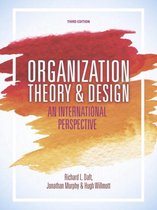
Organization theory & design: An international perspective
Richard L. Daft, Jonathan Murphy & Hugh Willmott
Tilburg University KOW
Index
CH1: What are organizations?................................................................................................... 2
CH2: Perspectives on organizations .......................................................................................... 3
CH3: Strategy, organization design and effectiveness ............................................................. 5
CH4: Fundamentals of organization structure.......................................................................... 7
CH5: The external environment .............................................................................................. 10
CH6: Interorganizational relationships ................................................................................... 12
CH7: Designing organizations for the international environment......................................... 14
CH8: Manufacturing and service technologies ....................................................................... 17
CH9: Information technology and control .............................................................................. 20
CH10: Organization size, life cycle and decline ...................................................................... 21
CH11: Organizational culture and ethical values ................................................................... 23
CH12: Innovation and change ................................................................................................. 25
CH13: Decision-making processes........................................................................................... 28
CH14: Conflict, power and politics .......................................................................................... 32
,CH1: What are organizations?
Organizations are (1) social entities that are (2) goal-directed, are (3) designed as
deliberately structured and coordinated activity systems, and (4) are linked to the external
environment.
Organizations are made up of people and their relationships. The organization gets
structured to achieve purposes. Nowadays, there is a trend towards improving horizontal
coordination.
Purpose of this book: Focussing on how behaviour in organizations is shaped within the
structure of social relations in which it occurs. How is the structure influenced by the
environment, and how do key-decision-makers attempt to manage their environment by
designing effective structures.
The importance of organizations:
1. Bringing together resources to achieve desired goals and outcomes.
2. Producing goods and services.
3. Facilitating innovation.
4. Harnessing modern manufacturing, service and information technologies.
5. Adapting to and influencing a changing environment.
6. Creating value.
7. Accommodating ongoing challenges of diversity, ethics and the motivation and
coordination of employees.
Current challenges for organizations
1. Globalisation
Companies are searching for the structures and processes that can help them reap the
advantages of global interdependence and minimize the disadvantages.
2. Ethics and social responsibility
Social responsibility has become more important over the years (fraud, losing personal
data, avoiding taxation).
3. Responsiveness
Companies have to be responsive because of environmental changes, crises or shifting
customer expectations. Services and knowledge of employees becomes more important
than the means of production.
4. Digital workplace
Digital supply-chain networks and virtual teams are current challenges for organizations
(especially now, during the pandemic).
5. Diversity
Managing cultural diversity at the workplace, glass ceiling etc.
,CH2: Perspectives on organizations
Organizations can be studied using different perspectives. The 4 perspectives used in this
book are:
1. Social systems approach
The social systems approach focusses on (1) natural VS rational & (2) open VS closed.
Using these 2 perspectives organizations can be seen as natural-open, natural-closed,
rational-open and rational-closed.
- Natural: Organizations are organic, the people and their behaviour shape the
organization.
- Rational: Organizations are mechanic, the structures and processes shape the
organization.
- Open: The organization and the interaction with the environment (external).
- Closed: The organization on its own (internal).
2. Organization configurations
The organization configurations approach divides the organization into 5 groups with
their own responsibilities:
- Top management: Defining the strategy.
- Middle management: Controlling the entire organization.
- Technical core: Production.
- Technical support: Innovation.
- Administrative support: Supporting the management.
3. Organization design
The organization design approach divides all aspects of organizations into 2 groups:
- Structural (centralization, formalization, specialization, hierarchy, personnel ratio etc.).
- Contextual (culture, environment, strategy, technology etc.).
4. Classical perspectives
The classical perspectives approach consists of 3 different perspectives:
- Scientific management approach (Taylor): ‘Organizations are structured ‘machines’,
workers are part of that machine. Effectiveness is the most important aspect of work’.
- Administrative theory (Fayol): ‘Managing is a job, there has to be paid attention to the
organization as a whole and the workers as people’.
- Bureaucratic theory (Weber): ‘Standardisation leads to greater outcomes’.
+ Stakeholder approach: Balancing the preferences of different groups. The satisfaction
of each group can be an indication of the organizations performance and effectiveness.
, The evolution of organization theory and design
Capitalism in the 19th and 20th century→ Factories with mass production. This led to the
development of scientific management: Turning organizations into efficient, well-oiled
machines based on closed system thinking. This led to the greatest output, but there was
limited attention to the social context and human feelings. This came to an end with the
administrative principle.
Administrative principle: The organizations as a whole, more attention for employees.
Similar activities in an organization should be grouped together under one manager.
➔ Development of bureaucratic organizations (establishing clearly defined authority and
responsibility).
Later on, these perspectives got competition from modern perspectives. The Hawthorne
studies proved that treating your employees well improves their motivation and
productivity. In the 1970’s and 1980’s, new design principles based on teamwork, flexibility,
adaptiveness and well-motivated employees became more popular. What structure or
system is viable depends upon the circumstances or context (Contingency).
Learning organizations: Shifts
Since organizations become more flexible, the following shifts are very common:
1. Vertical structure → Horizontal structure.
2. Narrowly defined routine tasks → Having empowered roles in a team.
3. Formal control systems → Shared information, having knowledge about many aspects of
the organization, open communication.
4. Competitiveness → Organic design, empowered workforce to contribute to strategy,
partnerships with suppliers, more diffuse boundaries, exchanging ideas.
5. Rigid → Adaptive. More openness, equality, continuous improvement and change.
Richard L. Daft, Jonathan Murphy & Hugh Willmott
Tilburg University KOW
Index
CH1: What are organizations?................................................................................................... 2
CH2: Perspectives on organizations .......................................................................................... 3
CH3: Strategy, organization design and effectiveness ............................................................. 5
CH4: Fundamentals of organization structure.......................................................................... 7
CH5: The external environment .............................................................................................. 10
CH6: Interorganizational relationships ................................................................................... 12
CH7: Designing organizations for the international environment......................................... 14
CH8: Manufacturing and service technologies ....................................................................... 17
CH9: Information technology and control .............................................................................. 20
CH10: Organization size, life cycle and decline ...................................................................... 21
CH11: Organizational culture and ethical values ................................................................... 23
CH12: Innovation and change ................................................................................................. 25
CH13: Decision-making processes........................................................................................... 28
CH14: Conflict, power and politics .......................................................................................... 32
,CH1: What are organizations?
Organizations are (1) social entities that are (2) goal-directed, are (3) designed as
deliberately structured and coordinated activity systems, and (4) are linked to the external
environment.
Organizations are made up of people and their relationships. The organization gets
structured to achieve purposes. Nowadays, there is a trend towards improving horizontal
coordination.
Purpose of this book: Focussing on how behaviour in organizations is shaped within the
structure of social relations in which it occurs. How is the structure influenced by the
environment, and how do key-decision-makers attempt to manage their environment by
designing effective structures.
The importance of organizations:
1. Bringing together resources to achieve desired goals and outcomes.
2. Producing goods and services.
3. Facilitating innovation.
4. Harnessing modern manufacturing, service and information technologies.
5. Adapting to and influencing a changing environment.
6. Creating value.
7. Accommodating ongoing challenges of diversity, ethics and the motivation and
coordination of employees.
Current challenges for organizations
1. Globalisation
Companies are searching for the structures and processes that can help them reap the
advantages of global interdependence and minimize the disadvantages.
2. Ethics and social responsibility
Social responsibility has become more important over the years (fraud, losing personal
data, avoiding taxation).
3. Responsiveness
Companies have to be responsive because of environmental changes, crises or shifting
customer expectations. Services and knowledge of employees becomes more important
than the means of production.
4. Digital workplace
Digital supply-chain networks and virtual teams are current challenges for organizations
(especially now, during the pandemic).
5. Diversity
Managing cultural diversity at the workplace, glass ceiling etc.
,CH2: Perspectives on organizations
Organizations can be studied using different perspectives. The 4 perspectives used in this
book are:
1. Social systems approach
The social systems approach focusses on (1) natural VS rational & (2) open VS closed.
Using these 2 perspectives organizations can be seen as natural-open, natural-closed,
rational-open and rational-closed.
- Natural: Organizations are organic, the people and their behaviour shape the
organization.
- Rational: Organizations are mechanic, the structures and processes shape the
organization.
- Open: The organization and the interaction with the environment (external).
- Closed: The organization on its own (internal).
2. Organization configurations
The organization configurations approach divides the organization into 5 groups with
their own responsibilities:
- Top management: Defining the strategy.
- Middle management: Controlling the entire organization.
- Technical core: Production.
- Technical support: Innovation.
- Administrative support: Supporting the management.
3. Organization design
The organization design approach divides all aspects of organizations into 2 groups:
- Structural (centralization, formalization, specialization, hierarchy, personnel ratio etc.).
- Contextual (culture, environment, strategy, technology etc.).
4. Classical perspectives
The classical perspectives approach consists of 3 different perspectives:
- Scientific management approach (Taylor): ‘Organizations are structured ‘machines’,
workers are part of that machine. Effectiveness is the most important aspect of work’.
- Administrative theory (Fayol): ‘Managing is a job, there has to be paid attention to the
organization as a whole and the workers as people’.
- Bureaucratic theory (Weber): ‘Standardisation leads to greater outcomes’.
+ Stakeholder approach: Balancing the preferences of different groups. The satisfaction
of each group can be an indication of the organizations performance and effectiveness.
, The evolution of organization theory and design
Capitalism in the 19th and 20th century→ Factories with mass production. This led to the
development of scientific management: Turning organizations into efficient, well-oiled
machines based on closed system thinking. This led to the greatest output, but there was
limited attention to the social context and human feelings. This came to an end with the
administrative principle.
Administrative principle: The organizations as a whole, more attention for employees.
Similar activities in an organization should be grouped together under one manager.
➔ Development of bureaucratic organizations (establishing clearly defined authority and
responsibility).
Later on, these perspectives got competition from modern perspectives. The Hawthorne
studies proved that treating your employees well improves their motivation and
productivity. In the 1970’s and 1980’s, new design principles based on teamwork, flexibility,
adaptiveness and well-motivated employees became more popular. What structure or
system is viable depends upon the circumstances or context (Contingency).
Learning organizations: Shifts
Since organizations become more flexible, the following shifts are very common:
1. Vertical structure → Horizontal structure.
2. Narrowly defined routine tasks → Having empowered roles in a team.
3. Formal control systems → Shared information, having knowledge about many aspects of
the organization, open communication.
4. Competitiveness → Organic design, empowered workforce to contribute to strategy,
partnerships with suppliers, more diffuse boundaries, exchanging ideas.
5. Rigid → Adaptive. More openness, equality, continuous improvement and change.