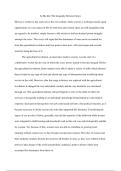
In His Ink: The Inequality Between Sexes
History is written in ink, and even in the 21st century, where society is working towards equal
opportunities in every aspect of life for both men and women, there are still inequalities that
are argued to be justified, simply because a life written in ink has destined power struggles
amongst the sexes. This essay will argue that the dominance of men can be accounted for
from the agricultural revolution until our point in time now, with stereotypes and societal
structure being the base of it.
The agricultural revolution, an innovative mark in society, was the start of a
collaborative world, but also one in which the sexes' power started to become unequal. Before
the agricultural revolution, homo-sapiens were able to attain a variety of skills which allowed
them to hunt for any type of food and absorb any type of information that would help them
survive in the wild. However, after this stage in history was replaced with the agricultural
revolution, it changed the way individuals worked, and the way hierarchy was structured
through sex. The agricultural industry allowed Sapiens to rely on the skills of others for
survival, consequently leading to an individual's knowledge being limited to a tiny field of
expertise. Each person having their own job could easily fall into a hierarchical structure, as it
became necessary to divide society into roles that supported this hierarchy. Considering the
aspect of sex in roles of labor, generally, men did the majority of the fieldwork while women
were relegated to child-bearing and household work as this role was only biologically suitable
for women. Yet, because of this, women were not able to contribute to growing food,
meaning without control over it, they became second-class citizens. The roles of women and
their motherly instincts became the norm for all females to obey, as they were robbed of their
power to take charge of the world around them, marking a point in history where men
accounted for dominance from there on.
History is written in ink, and even in the 21st century, where society is working towards equal
opportunities in every aspect of life for both men and women, there are still inequalities that
are argued to be justified, simply because a life written in ink has destined power struggles
amongst the sexes. This essay will argue that the dominance of men can be accounted for
from the agricultural revolution until our point in time now, with stereotypes and societal
structure being the base of it.
The agricultural revolution, an innovative mark in society, was the start of a
collaborative world, but also one in which the sexes' power started to become unequal. Before
the agricultural revolution, homo-sapiens were able to attain a variety of skills which allowed
them to hunt for any type of food and absorb any type of information that would help them
survive in the wild. However, after this stage in history was replaced with the agricultural
revolution, it changed the way individuals worked, and the way hierarchy was structured
through sex. The agricultural industry allowed Sapiens to rely on the skills of others for
survival, consequently leading to an individual's knowledge being limited to a tiny field of
expertise. Each person having their own job could easily fall into a hierarchical structure, as it
became necessary to divide society into roles that supported this hierarchy. Considering the
aspect of sex in roles of labor, generally, men did the majority of the fieldwork while women
were relegated to child-bearing and household work as this role was only biologically suitable
for women. Yet, because of this, women were not able to contribute to growing food,
meaning without control over it, they became second-class citizens. The roles of women and
their motherly instincts became the norm for all females to obey, as they were robbed of their
power to take charge of the world around them, marking a point in history where men
accounted for dominance from there on.