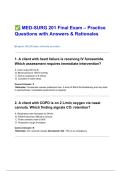
✅ MED-SURG 201 Final Exam – Practice
Questions with Answers & Rationales
(Original, NCLEX-style, clinically accurate)
1. A client with heart failure is receiving IV furosemide.
Which assessment requires immediate intervention?
A. Urine output 60 mL/hr
B. Blood pressure 102/70 mmHg
C. Serum potassium 2.9 mEq/L
D. Crackles in lower lobes
Correct Answer: C
Rationale: Furosemide causes potassium loss. A level of 2.9 is life-threatening and may lead
to dysrhythmias. Immediate replacement is required.
2. A client with COPD is on 2 L/min oxygen via nasal
cannula. Which finding signals CO₂ retention?
A. Respiratory rate increases to 24/min
B. Patient becomes difficult to arouse
C. Pulse oximetry rises to 95%
D. Productive cough increases
Correct Answer: B
Rationale: CO₂ narcosis causes decreased LOC. This is an emergency.
,3. A post-op patient reports sudden chest pain and
dyspnea. What is the priority action?
A. Give morphine
B. Raise HOB
C. Check surgical dressing
D. Increase IV fluids
Correct Answer: B
Rationale: Symptoms indicate possible pulmonary embolism. Elevate HOB to improve
ventilation while calling rapid response.
4. A client with diabetes has a blood glucose of 48 mg/dL
and is awake but shaky. What is the priority?
A. Give 1 mg glucagon IM
B. Recheck glucose in 15 min
C. Give 15 g fast-acting carbs
D. Call provider
Correct Answer: C
Rationale: Conscious + hypoglycemic → give fast carbs immediately.
5. Which assessment indicates digoxin toxicity?
A. Tachycardia
B. Yellow vision
C. Hypertension
D. Increased appetite
Correct Answer: B
Rationale: Xanthopsia (yellow/green halos) is classic digoxin toxicity.
6. A patient with pneumonia has RR 32/min, accessory
muscle use, and SpO₂ 88% on room air. Priority?
,A. Notify provider
B. Apply 2 L/min oxygen
C. Give prescribed cough suppressant
D. Encourage deep breathing
Correct Answer: B
7. A patient on heparin infusion has an aPTT of 115
seconds. What is the nurse’s action?
A. Increase infusion
B. Stop infusion
C. Give aspirin
D. Flush IV line
Correct Answer: B
Rationale: Therapeutic aPTT = 60–80 sec. 115 = high → stop infusion and assess bleeding.
8. Which food should a client on warfarin avoid excessive
intake of?
A. Bananas
B. Spinach
C. Milk
D. Chicken
Correct Answer: B
Rationale: Spinach is high in vitamin K, which decreases warfarin effectiveness.
9. A client with acute pancreatitis is NPO. Which finding
indicates worsening condition?
A. Decreasing pain
B. Elevated serum lipase
C. Grey Turner's sign
D. Hypoactive bowel sounds
, Correct Answer: C
Rationale: Flank bruising indicates internal bleeding.
10. Which intervention prevents venous
thromboembolism in a post-op patient?
A. Restrict fluids
B. Apply compression devices
C. Place in high Fowler’s
D. Encourage coughing only
Correct Answer: B
11. A client with renal failure has K⁺ = 6.8 mEq/L. What is
the nurse’s priority?
A. Limit protein
B. Administer insulin + dextrose
C. Give furosemide
D. Increase oral fluids
Correct Answer: B
Rationale: Insulin shifts potassium into the cells—rapid treatment for hyperkalemia.
12. A patient with DKA is receiving IV insulin. Which lab
must be monitored closely?
A. Calcium
B. Potassium
C. Sodium
D. BUN
Correct Answer: B
Rationale: Insulin lowers blood K⁺ → risk of hypokalemia.
Questions with Answers & Rationales
(Original, NCLEX-style, clinically accurate)
1. A client with heart failure is receiving IV furosemide.
Which assessment requires immediate intervention?
A. Urine output 60 mL/hr
B. Blood pressure 102/70 mmHg
C. Serum potassium 2.9 mEq/L
D. Crackles in lower lobes
Correct Answer: C
Rationale: Furosemide causes potassium loss. A level of 2.9 is life-threatening and may lead
to dysrhythmias. Immediate replacement is required.
2. A client with COPD is on 2 L/min oxygen via nasal
cannula. Which finding signals CO₂ retention?
A. Respiratory rate increases to 24/min
B. Patient becomes difficult to arouse
C. Pulse oximetry rises to 95%
D. Productive cough increases
Correct Answer: B
Rationale: CO₂ narcosis causes decreased LOC. This is an emergency.
,3. A post-op patient reports sudden chest pain and
dyspnea. What is the priority action?
A. Give morphine
B. Raise HOB
C. Check surgical dressing
D. Increase IV fluids
Correct Answer: B
Rationale: Symptoms indicate possible pulmonary embolism. Elevate HOB to improve
ventilation while calling rapid response.
4. A client with diabetes has a blood glucose of 48 mg/dL
and is awake but shaky. What is the priority?
A. Give 1 mg glucagon IM
B. Recheck glucose in 15 min
C. Give 15 g fast-acting carbs
D. Call provider
Correct Answer: C
Rationale: Conscious + hypoglycemic → give fast carbs immediately.
5. Which assessment indicates digoxin toxicity?
A. Tachycardia
B. Yellow vision
C. Hypertension
D. Increased appetite
Correct Answer: B
Rationale: Xanthopsia (yellow/green halos) is classic digoxin toxicity.
6. A patient with pneumonia has RR 32/min, accessory
muscle use, and SpO₂ 88% on room air. Priority?
,A. Notify provider
B. Apply 2 L/min oxygen
C. Give prescribed cough suppressant
D. Encourage deep breathing
Correct Answer: B
7. A patient on heparin infusion has an aPTT of 115
seconds. What is the nurse’s action?
A. Increase infusion
B. Stop infusion
C. Give aspirin
D. Flush IV line
Correct Answer: B
Rationale: Therapeutic aPTT = 60–80 sec. 115 = high → stop infusion and assess bleeding.
8. Which food should a client on warfarin avoid excessive
intake of?
A. Bananas
B. Spinach
C. Milk
D. Chicken
Correct Answer: B
Rationale: Spinach is high in vitamin K, which decreases warfarin effectiveness.
9. A client with acute pancreatitis is NPO. Which finding
indicates worsening condition?
A. Decreasing pain
B. Elevated serum lipase
C. Grey Turner's sign
D. Hypoactive bowel sounds
, Correct Answer: C
Rationale: Flank bruising indicates internal bleeding.
10. Which intervention prevents venous
thromboembolism in a post-op patient?
A. Restrict fluids
B. Apply compression devices
C. Place in high Fowler’s
D. Encourage coughing only
Correct Answer: B
11. A client with renal failure has K⁺ = 6.8 mEq/L. What is
the nurse’s priority?
A. Limit protein
B. Administer insulin + dextrose
C. Give furosemide
D. Increase oral fluids
Correct Answer: B
Rationale: Insulin shifts potassium into the cells—rapid treatment for hyperkalemia.
12. A patient with DKA is receiving IV insulin. Which lab
must be monitored closely?
A. Calcium
B. Potassium
C. Sodium
D. BUN
Correct Answer: B
Rationale: Insulin lowers blood K⁺ → risk of hypokalemia.