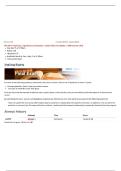
Preliminary Risk Identification and Prioritization in Healthcare Organizations
This formative assessment focuses on teaching students how to conduct a preliminary
risk identification and prioritization exercise within their healthcare organization. This
activity will introduce them to the types of risks they’ll analyze in the final SWOT
assessment and establish a foundation for more comprehensive risk evaluation.
Instructions:
Conduct a preliminary analysis of potential risks within a healthcare organization,
focusing on patient safety, operational stability, and quality of care. Choose two key areas
relevant to healthcare risk assessment, such as patient safety, financial stability, staff
turnover, or resource availability.
Within each chosen category, identify at least two specific risks. For each risk, describe:
Why it’s relevant to patient safety, organizational effectiveness, or quality of care.
Potential impact on the organization or team if not managed effectively.
Based on potential impact and likelihood, rank the risks you identified from highest to
lowest priority. Briefly justify your prioritization choices, considering which risks pose
immediate challenges and which may be more manageable.
Write a reflection on how this exercise helps you understand the complexities of risk
assessment and its importance in organizational planning and patient safety.
, Healthcare organizations operate in complex environments where patient safety, staff
performance, and resource management intersect to determine quality outcomes. Risk
identification and prioritization are critical components of proactive healthcare
management because they enable organizations to anticipate, mitigate, and prevent
adverse events. This report presents a preliminary analysis of potential risks within a mid-
sized community hospital. Two key areas have been selected for evaluation: patient
safety and staff turnover. Each area includes two identified risks, their relevance to
patient outcomes and organizational performance, and a prioritization ranking based on
potential impact and likelihood.
Category 1: Patient Safety
Risk 1: Medication Errors
Medication errors remain one of the most persistent threats to patient safety across
healthcare systems. They are relevant to quality of care because incorrect dosing, drug
interactions, or transcription mistakes can lead to adverse drug events, prolonged hospital
stays, or even mortality. According to the World Health Organization (2022), medication
errors account for nearly 50% of preventable harm in medical care globally. The potential
impact on the organization includes reputational damage, legal liability, and financial loss
through litigation and regulatory penalties. If not managed effectively, these errors
undermine patient trust and contribute to higher readmission rates.
Risk 2: Hospital-Acquired Infections (HAIs)
Hospital-acquired infections, such as MRSA, Clostridium difficile, and surgical site
infections, pose severe risks to patient safety. They are relevant because they reflect
This formative assessment focuses on teaching students how to conduct a preliminary
risk identification and prioritization exercise within their healthcare organization. This
activity will introduce them to the types of risks they’ll analyze in the final SWOT
assessment and establish a foundation for more comprehensive risk evaluation.
Instructions:
Conduct a preliminary analysis of potential risks within a healthcare organization,
focusing on patient safety, operational stability, and quality of care. Choose two key areas
relevant to healthcare risk assessment, such as patient safety, financial stability, staff
turnover, or resource availability.
Within each chosen category, identify at least two specific risks. For each risk, describe:
Why it’s relevant to patient safety, organizational effectiveness, or quality of care.
Potential impact on the organization or team if not managed effectively.
Based on potential impact and likelihood, rank the risks you identified from highest to
lowest priority. Briefly justify your prioritization choices, considering which risks pose
immediate challenges and which may be more manageable.
Write a reflection on how this exercise helps you understand the complexities of risk
assessment and its importance in organizational planning and patient safety.
, Healthcare organizations operate in complex environments where patient safety, staff
performance, and resource management intersect to determine quality outcomes. Risk
identification and prioritization are critical components of proactive healthcare
management because they enable organizations to anticipate, mitigate, and prevent
adverse events. This report presents a preliminary analysis of potential risks within a mid-
sized community hospital. Two key areas have been selected for evaluation: patient
safety and staff turnover. Each area includes two identified risks, their relevance to
patient outcomes and organizational performance, and a prioritization ranking based on
potential impact and likelihood.
Category 1: Patient Safety
Risk 1: Medication Errors
Medication errors remain one of the most persistent threats to patient safety across
healthcare systems. They are relevant to quality of care because incorrect dosing, drug
interactions, or transcription mistakes can lead to adverse drug events, prolonged hospital
stays, or even mortality. According to the World Health Organization (2022), medication
errors account for nearly 50% of preventable harm in medical care globally. The potential
impact on the organization includes reputational damage, legal liability, and financial loss
through litigation and regulatory penalties. If not managed effectively, these errors
undermine patient trust and contribute to higher readmission rates.
Risk 2: Hospital-Acquired Infections (HAIs)
Hospital-acquired infections, such as MRSA, Clostridium difficile, and surgical site
infections, pose severe risks to patient safety. They are relevant because they reflect