Research Skills summary slides + videos
Manon Kooning, 29-09-2025
Week 1 - Introduction
Research is ‘creative and systematic work undertaking to increase
the stock of knowledge’
Why do business research? Three main goals
1. Describe (how does something work?)
2. Explain (why does something work this way?)
3. Predict (how will something look in the future?)
Another definition states that ‘research is a process of steps used
to collect and analyse information to increase our understanding
of a topic or issue’. It consists of three topics: pose a question, collect
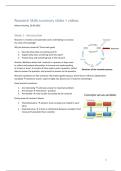
Structure of the research process
data to answer the question, and present an answer to the question.
Research questions are fact-oriented, information-gathering (e.g. which factors influence [dependent
variable]) Literature-search, expert-insight, key factors (can’t research everything!)
Good research questions:
1. Are interesting unknown answer to important problem
2. Are relevant theoretical + practical
3. Are feasible must be able to actually do the research
Doing research involves 2 planes
• Theoretical plane abstract, how concepts are related to each
other
• Empirical plane is there a relationship between variables? And
measure/manipulate these variables
1
,From MQ (broad) to RQ to conceptual models
1. MQ (management question): How can we fix communication between departments?
suggests a DV
1. Step 1: a central concept (dv) narrows down topic
o Concepts = Broad, abstract ideas that researchers want to study (e.g., "happiness,"
"social status," "motivation"). They are theoretical and cannot be measured directly.
o Variables = To study a concept, it must be made more
concrete. A variable is how a concept is defined in
measurable terms. For example, the concept "happiness"
might be turned into a variable like "self-reported life
satisfaction." In the diagram: Concepts are operationalized
by variables.
→ This means concepts are translated into variables that can
be tested.
o Indicators = These are the specific measurements or data
points used to assess the variable. For example, if the variable is "self-reported life
satisfaction," an indicator could be a survey question like: "On a scale from 1–10, how
satisfied are you with your life?" In the diagram: Variables are measured by
indicators.
2. Step 2: IV/factors and Propositions
o A conceptual model is like a map of your theory. It
translates what you think happens (based on prior
literature or logic) into a simple diagram with boxes
(variables) and arrows (relationships). It’s about
direction!
o why & when not represented
3. Step 3: explanatory mechanism why do we expect a relationship?
o E.g. prior work has found relationship x y, but why? What makes your study
different?
o A moderator is a variable that influences the strength or direction of the relationship
between an independent variable (IV) and a dependent variable (DV).
o If employees have a lot of intercultural experience, the negative impact of cultural
differences is weaker. If they have little intercultural experience, the negative effect is
stronger.
Moderator = changes the strength/direction of a relationship (3th variable)
o Mediator = explains the mechanism behind a relationship
Meta-analysis = study that uses and compares previous studies to find patterns
A proposition is a tentative and conjectural relationship between constructs that is stated in a
declarative form. An example of a proposition is: ‘An increase in student intelligence causes an
increase in their academic achievement’. This declarative statement does not have to be true, but
must be empirically testable using data, so that we can judge whether it is true or false. Propositions
are generally derived based on logic or empirical observations.
2
, Week 2 – Reviewing the Literature: The Process
Searching for sources; the process:
1. Stage 1: Decide on your literature search topic
o Refine the ideas into a reasonably clear and specific topic of what you wish to search
for in the literature
2. Stage 2: Identify the keywords and phrases you will use
o A search term is a word or phrase that describes your research topic, question(s), or
objectives. It can be used either on its own or in combination with other phrases
o How to choose search terms:
Look at the literature you’ve already read Example: if you read about
“downsizing,” “redundancy” might also be relevant.
Use both broad and narrow terms Example: “services” (broad) and
“restaurant” (narrow).
Include synonyms
Consider alternative spellings Example: “organization” vs. “organisation.”
Include abbreviations and full terms
Include old and new place names if relevant
3. Stage 3: Choose your (online) databases (e.g. University Library, Google Scholar)
o Use reference works to shape your search efforts
o Bibliographic works provide abstracts summarizing significant articles or books on a
topic
o Forward and backward search which papers did this article cite & which papers
cited this article?
o Google is useful to get our bearings on a new topic, to explore potential keywords,
etc (be wary of copyrighted materials!)
4. Stage 4: Undertake your search
o Use Boolean operators (‘and’, ‘or’, ‘not’) to link search terms
o Use wild cards (* or ?) to truncate search terms
o If you have found a key paper, trace backwards & forward
5. Stage 5: Obtain the articles
3
Manon Kooning, 29-09-2025
Week 1 - Introduction
Research is ‘creative and systematic work undertaking to increase
the stock of knowledge’
Why do business research? Three main goals
1. Describe (how does something work?)
2. Explain (why does something work this way?)
3. Predict (how will something look in the future?)
Another definition states that ‘research is a process of steps used
to collect and analyse information to increase our understanding
of a topic or issue’. It consists of three topics: pose a question, collect
Structure of the research process
data to answer the question, and present an answer to the question.
Research questions are fact-oriented, information-gathering (e.g. which factors influence [dependent
variable]) Literature-search, expert-insight, key factors (can’t research everything!)
Good research questions:
1. Are interesting unknown answer to important problem
2. Are relevant theoretical + practical
3. Are feasible must be able to actually do the research
Doing research involves 2 planes
• Theoretical plane abstract, how concepts are related to each
other
• Empirical plane is there a relationship between variables? And
measure/manipulate these variables
1
,From MQ (broad) to RQ to conceptual models
1. MQ (management question): How can we fix communication between departments?
suggests a DV
1. Step 1: a central concept (dv) narrows down topic
o Concepts = Broad, abstract ideas that researchers want to study (e.g., "happiness,"
"social status," "motivation"). They are theoretical and cannot be measured directly.
o Variables = To study a concept, it must be made more
concrete. A variable is how a concept is defined in
measurable terms. For example, the concept "happiness"
might be turned into a variable like "self-reported life
satisfaction." In the diagram: Concepts are operationalized
by variables.
→ This means concepts are translated into variables that can
be tested.
o Indicators = These are the specific measurements or data
points used to assess the variable. For example, if the variable is "self-reported life
satisfaction," an indicator could be a survey question like: "On a scale from 1–10, how
satisfied are you with your life?" In the diagram: Variables are measured by
indicators.
2. Step 2: IV/factors and Propositions
o A conceptual model is like a map of your theory. It
translates what you think happens (based on prior
literature or logic) into a simple diagram with boxes
(variables) and arrows (relationships). It’s about
direction!
o why & when not represented
3. Step 3: explanatory mechanism why do we expect a relationship?
o E.g. prior work has found relationship x y, but why? What makes your study
different?
o A moderator is a variable that influences the strength or direction of the relationship
between an independent variable (IV) and a dependent variable (DV).
o If employees have a lot of intercultural experience, the negative impact of cultural
differences is weaker. If they have little intercultural experience, the negative effect is
stronger.
Moderator = changes the strength/direction of a relationship (3th variable)
o Mediator = explains the mechanism behind a relationship
Meta-analysis = study that uses and compares previous studies to find patterns
A proposition is a tentative and conjectural relationship between constructs that is stated in a
declarative form. An example of a proposition is: ‘An increase in student intelligence causes an
increase in their academic achievement’. This declarative statement does not have to be true, but
must be empirically testable using data, so that we can judge whether it is true or false. Propositions
are generally derived based on logic or empirical observations.
2
, Week 2 – Reviewing the Literature: The Process
Searching for sources; the process:
1. Stage 1: Decide on your literature search topic
o Refine the ideas into a reasonably clear and specific topic of what you wish to search
for in the literature
2. Stage 2: Identify the keywords and phrases you will use
o A search term is a word or phrase that describes your research topic, question(s), or
objectives. It can be used either on its own or in combination with other phrases
o How to choose search terms:
Look at the literature you’ve already read Example: if you read about
“downsizing,” “redundancy” might also be relevant.
Use both broad and narrow terms Example: “services” (broad) and
“restaurant” (narrow).
Include synonyms
Consider alternative spellings Example: “organization” vs. “organisation.”
Include abbreviations and full terms
Include old and new place names if relevant
3. Stage 3: Choose your (online) databases (e.g. University Library, Google Scholar)
o Use reference works to shape your search efforts
o Bibliographic works provide abstracts summarizing significant articles or books on a
topic
o Forward and backward search which papers did this article cite & which papers
cited this article?
o Google is useful to get our bearings on a new topic, to explore potential keywords,
etc (be wary of copyrighted materials!)
4. Stage 4: Undertake your search
o Use Boolean operators (‘and’, ‘or’, ‘not’) to link search terms
o Use wild cards (* or ?) to truncate search terms
o If you have found a key paper, trace backwards & forward
5. Stage 5: Obtain the articles
3