Marly Verest
FPE-31806
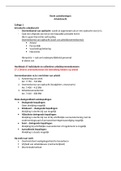
Summary Sustainability in Food
Chains
FPE-31806
Chapter 1 – Introduction
Traditional food production concept = 1 crop 1 Sustainability indicators
product = efficient industry, but not effective.
- Social = People
This has an effect on:
- Economic = Profit
- Land use - Environmental = Planet
- Land degradation
Ecological footprint = Human Development
- Biodiversity
Index must strive for a HDI>0.7 at a possible
Sustainability = Ability to maintain a process or footprint
state over a longer time development that
meets the needs of the present without
compromising the ability of future generations
to meet their own needs
Food miles = Distance that food travels from farm to plate
- Average 2200-4000 km for each product to consumer
- Increased with 25% between 1980-2007
o Globalization of trade over seas
o Focus of food supply bases into fewer, larger supplies
o Change in delivery pattern
o Increase in processing and packaging foods
o Fewer trips to the supermarket
- Food miles score = L diesel per ton of product
1
, Marly Verest
FPE-31806
Impacts through:
- (In)efficient use of feedstock
o Nature of feedstock
- Not all the feedstock can be easily converted into useful products
o Nature of the industry
- Industry is concentrated on 1 product, no channers for marketing of other
products
- Effectiveness was not commercially interesting; economic benefit of re-use and
recovery is low
o Trends
- Societal pressure and legislation
- High energy and feedstock prices
- Limits to wasting limits growth of the industry
- Waste generation (solids)
o 1/3 of food we buy ends up as waste
o 10 wt% is wasted in the supermarket
o The larger the diversity, the more waste
o What can we do?
- Make products less perishable
- Communicate what products can or should not be used anymore
- Education on how to prepare food
- Water use
o Water usage = waste water
- No knowledge on how to recover valuable components form waste streams
- Economic benefit of re-use and recovery is low
- No waste water exchange information media
- Absence of legislation and incentives
- Low costs, low fines for waste discharge
o Trends
- More attention to recovering ‘hidden value’
- Waste disposal as feed becomes more and more difficult
- Impossibility of expansion due to limits in disposal permits
- Energy use
o Conventionally not a concern
o Energy intensive
- >75%: heating and cooling
- ~12%: motors
- ~8%: facilities
What can/should we do?
- Avoid any unnecessary losses
- Develop technology to process concentrated streams
- Develop recycling
- Sustainable refining of feedstock into useful, valuable products
- Make products less perishable by the right (mild) processing
- Balance between food quality and shelf-life
Sources of unsustainability in food production: some cases on waste and energy
2
, Marly Verest
FPE-31806
Chapter 2 – Environmental impact evaluation of food
chains (energy & water)
Energy used in the food chain
- Primary production
o Examples:
- Energy to make fertilizers and pesticides
- Fuels for tractors and other equipment
- Fuels for heating and ventilation of farming buildings, livestock and poultry
facilities
- Electricity for irrigation, lighting, buildings
- Embodied energy in equipment and buildings
o Animal versus plant protein
- Inherently inefficient conversion of plant protein into animal protein 6kg of
plant protein for 1 kg of meat protein
- ~15% of protein and energy in these feed crops will ever reach human mouths
- Processing
o Unit operations
- Phase transition (evaporation, drying)
- Heat exchange processes (stabilization)
- Mixing processes
- Separation (membranes)
- Structuring (extrusion, emulsification, homogenization)
- Size reduction (milling)
o Overall process chain design
- Select efficient combination of operations (process synthesis)
- Scale of operation
- By-product (waste) generation causes indirect energy use
- Packaging
o Fossil fuel is used for production of conventional plastics (e.g. PE & PET)
o It serves as raw material and energy source
o It is useful to recycle plastics saves fossil fuels
o PHA, PHB, and PLA are biologically derived plastics (e.g. lactic acid)
o Additional environmental issues (e.g. plasticizers)
- Food preparation
o It is all about boiling water
How to allocated to multiple products form a single raw material?
- It is (mostly) allocated on:
o Economic value
o Nutritional value (Caloric)
o Solids content
- ! Be careful and consistent !
CO2 emission is for about 80% related to fuel combustion exception is a.o. primary production
Conclusions
- Quantification helps making energy-efficient choices
- Gains to be made can be found throughout the whole food chain system and are different for
each food
3
FPE-31806
Summary Sustainability in Food
Chains
FPE-31806
Chapter 1 – Introduction
Traditional food production concept = 1 crop 1 Sustainability indicators
product = efficient industry, but not effective.
- Social = People
This has an effect on:
- Economic = Profit
- Land use - Environmental = Planet
- Land degradation
Ecological footprint = Human Development
- Biodiversity
Index must strive for a HDI>0.7 at a possible
Sustainability = Ability to maintain a process or footprint
state over a longer time development that
meets the needs of the present without
compromising the ability of future generations
to meet their own needs
Food miles = Distance that food travels from farm to plate
- Average 2200-4000 km for each product to consumer
- Increased with 25% between 1980-2007
o Globalization of trade over seas
o Focus of food supply bases into fewer, larger supplies
o Change in delivery pattern
o Increase in processing and packaging foods
o Fewer trips to the supermarket
- Food miles score = L diesel per ton of product
1
, Marly Verest
FPE-31806
Impacts through:
- (In)efficient use of feedstock
o Nature of feedstock
- Not all the feedstock can be easily converted into useful products
o Nature of the industry
- Industry is concentrated on 1 product, no channers for marketing of other
products
- Effectiveness was not commercially interesting; economic benefit of re-use and
recovery is low
o Trends
- Societal pressure and legislation
- High energy and feedstock prices
- Limits to wasting limits growth of the industry
- Waste generation (solids)
o 1/3 of food we buy ends up as waste
o 10 wt% is wasted in the supermarket
o The larger the diversity, the more waste
o What can we do?
- Make products less perishable
- Communicate what products can or should not be used anymore
- Education on how to prepare food
- Water use
o Water usage = waste water
- No knowledge on how to recover valuable components form waste streams
- Economic benefit of re-use and recovery is low
- No waste water exchange information media
- Absence of legislation and incentives
- Low costs, low fines for waste discharge
o Trends
- More attention to recovering ‘hidden value’
- Waste disposal as feed becomes more and more difficult
- Impossibility of expansion due to limits in disposal permits
- Energy use
o Conventionally not a concern
o Energy intensive
- >75%: heating and cooling
- ~12%: motors
- ~8%: facilities
What can/should we do?
- Avoid any unnecessary losses
- Develop technology to process concentrated streams
- Develop recycling
- Sustainable refining of feedstock into useful, valuable products
- Make products less perishable by the right (mild) processing
- Balance between food quality and shelf-life
Sources of unsustainability in food production: some cases on waste and energy
2
, Marly Verest
FPE-31806
Chapter 2 – Environmental impact evaluation of food
chains (energy & water)
Energy used in the food chain
- Primary production
o Examples:
- Energy to make fertilizers and pesticides
- Fuels for tractors and other equipment
- Fuels for heating and ventilation of farming buildings, livestock and poultry
facilities
- Electricity for irrigation, lighting, buildings
- Embodied energy in equipment and buildings
o Animal versus plant protein
- Inherently inefficient conversion of plant protein into animal protein 6kg of
plant protein for 1 kg of meat protein
- ~15% of protein and energy in these feed crops will ever reach human mouths
- Processing
o Unit operations
- Phase transition (evaporation, drying)
- Heat exchange processes (stabilization)
- Mixing processes
- Separation (membranes)
- Structuring (extrusion, emulsification, homogenization)
- Size reduction (milling)
o Overall process chain design
- Select efficient combination of operations (process synthesis)
- Scale of operation
- By-product (waste) generation causes indirect energy use
- Packaging
o Fossil fuel is used for production of conventional plastics (e.g. PE & PET)
o It serves as raw material and energy source
o It is useful to recycle plastics saves fossil fuels
o PHA, PHB, and PLA are biologically derived plastics (e.g. lactic acid)
o Additional environmental issues (e.g. plasticizers)
- Food preparation
o It is all about boiling water
How to allocated to multiple products form a single raw material?
- It is (mostly) allocated on:
o Economic value
o Nutritional value (Caloric)
o Solids content
- ! Be careful and consistent !
CO2 emission is for about 80% related to fuel combustion exception is a.o. primary production
Conclusions
- Quantification helps making energy-efficient choices
- Gains to be made can be found throughout the whole food chain system and are different for
each food
3