PROPERTY OF HIGHYIELD HUB CO -DO NOT COPY
TOPIC
IMMUNO 3
AUTOIMMUNITY AND TRANSPLANTATION
THE MAKING AND BREAKING OF SELF-TOLERANCE
• Response to self antigens or antigens associated with commensal bacteria is called autoimmunity
• Response to non-self antigens on transplanted organs
• A critical function of the immune system is to discriminate self from non-self.
• When immune responses are directed against self antigens, they give rise to autoreactive effector cells
and antibodies (autoantibodies) against the self antigen.
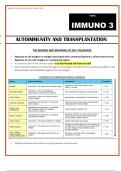
COMMON AUTOIMMUNE DISEASE SUMMARY
• Multiple tolerance mechanisms normally prevent autoimmunity.
,PROPERTY OF HIGHYIELD HUB CO -DO NOT COPY
• Immature lymphocytes recognize antigens and lead to negative signal causing lymphocyte death or
inactivation.
• This self tolerance happens when they are developing in thymus and bone marrow. This is called
central tolerance
• Tolerance induced to antigens after they have left primary lymphoid organ is called peripheral
tolerance
• Mechanisms to prevent autoimmunity goes through a succession of checkpoints.
• Together all these checkpoints ensure immune system still functions and there is no anti-self response
REQUIREMENTS FOR DEVELOPEMTN OF AUTOIMMUNE DISEASES
Autoimmunity results from a combination of different things
• Genetic susceptibility
• Breakdown of natural tolerance mechanism
• Environmental triggers such as infection
THE MAKING AND BREAKING OF SELF-TOLERANCE in T CELLS
• Central deletion or inactivation of newly formed lymphocytes is the first checkpoint of self-tolerance.
,PROPERTY OF HIGHYIELD HUB CO -DO NOT COPY
• Many tissue specific antigens are expressed in thymus by thymus epithelial cells or special dendritic
cells here
• A single transcription factor AIRE (autoimmune regulator) is thought to be responsible for turning on
and expression of many tissue specific proteins in thymic medullary cells
• Peptides are presented to the developing thymocytes as they undergo negative selection
ELIMINATION OF AUTOREACTIVE B-CELLS IN GERMINAL CENTERS
• During Somatic hypermutation
• In the Germinal center
• B-cells with autoreactive BCR arise
• Binding to the soluble autoantigen induces apoptosis of the autoreactive B-cell
, PROPERTY OF HIGHYIELD HUB CO -DO NOT COPY
SELF TOLERANCE CONTINUED
• Antigens in immunologically privileged sites do not induce immune attack but can serve as targets.
These sites are unique in 3 ways:
1. Communication between privileged site and body-extracellular fluid does not pass through
conventional lymphatics. Antigens can leave these areas
2. Sites are surrounded by tissue barriers that exclude naïve lymphocytes (blood brain
barrier)
3. Anti-inflammatory (TGF-b) produced in these areas. Antigens recognized along with TGF
induces Treg responses. Not Th17 or others.
4. Expression of Fas ligand in these sites, ensures that if Fas-bearing lymphocytes enter, they
will undergo apoptosis
TOPIC
IMMUNO 3
AUTOIMMUNITY AND TRANSPLANTATION
THE MAKING AND BREAKING OF SELF-TOLERANCE
• Response to self antigens or antigens associated with commensal bacteria is called autoimmunity
• Response to non-self antigens on transplanted organs
• A critical function of the immune system is to discriminate self from non-self.
• When immune responses are directed against self antigens, they give rise to autoreactive effector cells
and antibodies (autoantibodies) against the self antigen.
COMMON AUTOIMMUNE DISEASE SUMMARY
• Multiple tolerance mechanisms normally prevent autoimmunity.
,PROPERTY OF HIGHYIELD HUB CO -DO NOT COPY
• Immature lymphocytes recognize antigens and lead to negative signal causing lymphocyte death or
inactivation.
• This self tolerance happens when they are developing in thymus and bone marrow. This is called
central tolerance
• Tolerance induced to antigens after they have left primary lymphoid organ is called peripheral
tolerance
• Mechanisms to prevent autoimmunity goes through a succession of checkpoints.
• Together all these checkpoints ensure immune system still functions and there is no anti-self response
REQUIREMENTS FOR DEVELOPEMTN OF AUTOIMMUNE DISEASES
Autoimmunity results from a combination of different things
• Genetic susceptibility
• Breakdown of natural tolerance mechanism
• Environmental triggers such as infection
THE MAKING AND BREAKING OF SELF-TOLERANCE in T CELLS
• Central deletion or inactivation of newly formed lymphocytes is the first checkpoint of self-tolerance.
,PROPERTY OF HIGHYIELD HUB CO -DO NOT COPY
• Many tissue specific antigens are expressed in thymus by thymus epithelial cells or special dendritic
cells here
• A single transcription factor AIRE (autoimmune regulator) is thought to be responsible for turning on
and expression of many tissue specific proteins in thymic medullary cells
• Peptides are presented to the developing thymocytes as they undergo negative selection
ELIMINATION OF AUTOREACTIVE B-CELLS IN GERMINAL CENTERS
• During Somatic hypermutation
• In the Germinal center
• B-cells with autoreactive BCR arise
• Binding to the soluble autoantigen induces apoptosis of the autoreactive B-cell
, PROPERTY OF HIGHYIELD HUB CO -DO NOT COPY
SELF TOLERANCE CONTINUED
• Antigens in immunologically privileged sites do not induce immune attack but can serve as targets.
These sites are unique in 3 ways:
1. Communication between privileged site and body-extracellular fluid does not pass through
conventional lymphatics. Antigens can leave these areas
2. Sites are surrounded by tissue barriers that exclude naïve lymphocytes (blood brain
barrier)
3. Anti-inflammatory (TGF-b) produced in these areas. Antigens recognized along with TGF
induces Treg responses. Not Th17 or others.
4. Expression of Fas ligand in these sites, ensures that if Fas-bearing lymphocytes enter, they
will undergo apoptosis