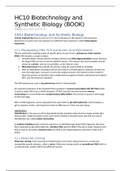
HC10 Biotechnology and
Synthetic Biology (BOOK)
Chapter 12.1-12.6, 12.9-12.11
CH12 Biotechnology and Synthetic Biology
Genetic engineering refers to the use of in vitro techniques to alter genes in the laboratory.
Expression of a gene from one organism in a different host organism is called heterologous
expression.
12.1 Manipulating DNA: PCR and Nucleic Acid Hybridization
The key method for isolating copies of specific genes in pure form is polymerase chain reaction
(PCR). PCR includes a couple of steps:
1. Template DNA is denaturated by heating and then two DNA oligonucleotide primers flanking
the target DNA on each strand are added in excess. This ensures that most template strands
anneal to a primer, and not to eachother, as the mixture cools.
2. DNA polymerase then extends the primers using the original DNA as template.
3. After an appropriate incubation period, the mixture is heated again to separate strands, but
now the target gene is present in twice the original amount. The mixture is then cooled to
allow the primers to hybridise with complementary regions of newly synthesised and original
DNA, and the process is repeated.
The DNA polymerase used is taq polymerase which is thermostable.
An important extension of the standard PCR procedure is reverse transcription PCR (RT-PCR) which
is used to make DNA from a mRNA template. RT-PCR uses the retroviral enzyme reverse
transcriptase to convert RNA into complementary DNA (cDNA). This process is shown in the image
on the next page.
DNA or RNA fragments can be separated from each other by gel electrophoresis, which employs a
gel to separate nucleic acid fragments based on differences in their size and charge.
Hybridisation
Hybridisation is the process of forming hybrid double stranded molecules from single strands after
denaturation. Single-stranded nucleic acids whose identity is already known and that are used in
hybridisation are called nucleic acid probes.
In southern blotting probes of known sequence are hybridised ago target DNA fragments that have
been separated by gel electrophoresis. Southern blot uses the DNA in the gel as target sequence and
RNA or DNA as the probe. Northern blot uses RNA as the target sequence and DNA or RNA as the
probe.
12.2 Molecular Cloning
Molecular cloning is the movement of desired genes from their original source to a small and
manipulable genetic element, called a vector. Molecular cloning results in recombinant DNA which is
a molecule that contains DNA from different sources.
, The major steps in gene cloning are:
1. Cut DNA with restriction enzyme
2. Ad vector cut with same restriction enzyme
3. Inserting DNA into a cloning vector
4. Add DNA ligase to form recombinant
molecules
5. Inserting the vector into a host
The recognition sequences are typically inverted
repeats and are called palindromes.
Cloning vectors
A vector with short segments of artificial DNA
containing cut sites for many different restriction
enzymes is called a multiple cloning site (MCS).
An important example of a cloning vector is pUC19:
For cloning genes into the yeast Saccharomyces
cerevisiae, yeast artificial chromoces (YACs) are often
used. These are linear vectors that replicate in yeast
like normal chromosomes but have sites where very
large fragments of DNA can be inserted.
Hosts
There are different suitable hosts, all with their
advantages and disadvantages:
Synthetic Biology (BOOK)
Chapter 12.1-12.6, 12.9-12.11
CH12 Biotechnology and Synthetic Biology
Genetic engineering refers to the use of in vitro techniques to alter genes in the laboratory.
Expression of a gene from one organism in a different host organism is called heterologous
expression.
12.1 Manipulating DNA: PCR and Nucleic Acid Hybridization
The key method for isolating copies of specific genes in pure form is polymerase chain reaction
(PCR). PCR includes a couple of steps:
1. Template DNA is denaturated by heating and then two DNA oligonucleotide primers flanking
the target DNA on each strand are added in excess. This ensures that most template strands
anneal to a primer, and not to eachother, as the mixture cools.
2. DNA polymerase then extends the primers using the original DNA as template.
3. After an appropriate incubation period, the mixture is heated again to separate strands, but
now the target gene is present in twice the original amount. The mixture is then cooled to
allow the primers to hybridise with complementary regions of newly synthesised and original
DNA, and the process is repeated.
The DNA polymerase used is taq polymerase which is thermostable.
An important extension of the standard PCR procedure is reverse transcription PCR (RT-PCR) which
is used to make DNA from a mRNA template. RT-PCR uses the retroviral enzyme reverse
transcriptase to convert RNA into complementary DNA (cDNA). This process is shown in the image
on the next page.
DNA or RNA fragments can be separated from each other by gel electrophoresis, which employs a
gel to separate nucleic acid fragments based on differences in their size and charge.
Hybridisation
Hybridisation is the process of forming hybrid double stranded molecules from single strands after
denaturation. Single-stranded nucleic acids whose identity is already known and that are used in
hybridisation are called nucleic acid probes.
In southern blotting probes of known sequence are hybridised ago target DNA fragments that have
been separated by gel electrophoresis. Southern blot uses the DNA in the gel as target sequence and
RNA or DNA as the probe. Northern blot uses RNA as the target sequence and DNA or RNA as the
probe.
12.2 Molecular Cloning
Molecular cloning is the movement of desired genes from their original source to a small and
manipulable genetic element, called a vector. Molecular cloning results in recombinant DNA which is
a molecule that contains DNA from different sources.
, The major steps in gene cloning are:
1. Cut DNA with restriction enzyme
2. Ad vector cut with same restriction enzyme
3. Inserting DNA into a cloning vector
4. Add DNA ligase to form recombinant
molecules
5. Inserting the vector into a host
The recognition sequences are typically inverted
repeats and are called palindromes.
Cloning vectors
A vector with short segments of artificial DNA
containing cut sites for many different restriction
enzymes is called a multiple cloning site (MCS).
An important example of a cloning vector is pUC19:
For cloning genes into the yeast Saccharomyces
cerevisiae, yeast artificial chromoces (YACs) are often
used. These are linear vectors that replicate in yeast
like normal chromosomes but have sites where very
large fragments of DNA can be inserted.
Hosts
There are different suitable hosts, all with their
advantages and disadvantages: