INTRODUCTION TO SOCIAL SCIENCE METHODS
WEEK 1
- Research;
- 2 forms (or strategies)
- Qualitative, or interpreting stuff
- Quantitative, or counting stuff
- Looking for and finding relevant information
- ...in a systematic way
- ...in answer to a question
- What? Who? How?
- Social research
- In relation to social reality
- Social science research
- Science = research + theory
- Methodology;
- The many considerations and choices that are at stake when obtaining
the information that is needed
- Balancing strengths and weaknesses;
- Often no ideal solution, but optimal solution
- Use your COMMON SENSE
- Theory
- A set of statements that are logically related,
- Explain observed regularities
- Often about relations between things
- Reduce complexity
- Apply to more situations than the ones studied (more or less
generalizable)
- Constructions
- Theories are not reality
- Theories are just ways to make sense of reality
- Work in progress
- Theories are only useful until they stop being useful
- Grand theories
- Explain a lot
- Massive complexity reduction
, - Very abstract
- Difficult to apply in research
- Middle range theories
- Explain a lot less
- Bound to specific contexts/situations
- Less abstract
- Easy to apply in research
- Relation theory-research
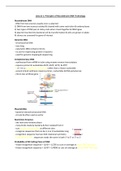
- Deduction;
- From theory to empirical data
- Expectation on the basis of theory (hypothesis)
- “People with a low brow are less intelligent”
- Collecting data (doing observations)
- Testing theory
- Observations in line with hypothesis
- Confirmation
- Observations contrast hypothesis
- Falsification
- Induction;
- From empirical data to theory
- Collecting data (doing observations)
- “Which people are more intelligent?”
- Interpreting findings
- Theory building by synthesis of findings
- Grounded theory
- But…
- Induction
- You need to know what/where to observe
- Some theory is prerequisite
- You might have some expectations about what you
will find
- Deduction
- Theory does not come out of the blue
- Based on prior research or (unsystematic)
observations
- In case of falsification, theory needs inductive
revision
- Empirical cycle:
- Inductive:
, - Question > Observation > Interpretation > Theory >
Question
- Deductive:
- Theory > Question > Hypothesis > Observation > Testing >
Evaluation > Theory
- The nature of scientific research
- Scientific research is about understanding (social) reality
- What is social reality > ontology
- How can we understand it > epistemology
- Ontology
- What is reality?
- Age-old philosophical debate
- How should we consider the being of things
- What is social reality?
- Is there such a thing as a social reality?
- Is this reality external t o us?
- 2 positions;
- Objectivism
- Social reality is REAL
- ‘Social fact’
- Objective
- External to us
- Groups are not just collections of individuals,
they are of a different order
- Social reality has an impact on our behaviour,
thinking, ...
- We cannot control social reality
- Gender roles, national identity, social class system,
...
- Affect the way we are, think and behave
- Constructivism
- Constructionism (constructivism)
- Social reality is CONSTRUCTED
- Only real in people’s minds (perceptions,
interpretations, ...)
- Intersubjective
- Constructed through interaction
- Groups depend on individuals,
no groups without individuals
, - Our behaviour, thinking, ... has an impact on
social reality
- We shape – and change – dynamic
social reality
- Gender roles, national identity, social class
system,...
- the outcome of how we think and
behave
- Or somewhere in between
- Once that social reality has been constructed, it does
become real
- “It is not important whether or not the
interpretation is correct – if men define situations
as real, they are real in their consequences.”
Theorem of W.I. Thomas (1928)
- Epistemology
- Given a conception of social reality, how can we gain an understanding
of it?
- What is the nature of knowledge?
- And when is this knowledge scientific? In other words, what is
the proper way to study things?
- Again, 2 positions;
- Positivism
- Social reality is like physical reality
- So, social sciences should operate like natural sciences
- Human behaviour is regular
- Research to capture and test regularities/patterns
- Universal laws ‘Social physics’ (Comte,
Quetelet)
- Explaining behaviour by finding its causes
- Studying facts by measuring/counting aspects of human
behaviour
- Interpretivism
- People are not just natural elements, because they make
sense of their surroundings
- So, social sciences are totally different from natural
sciences
- People make interpretations, scientist makes
interpretations of interpretations
WEEK 1
- Research;
- 2 forms (or strategies)
- Qualitative, or interpreting stuff
- Quantitative, or counting stuff
- Looking for and finding relevant information
- ...in a systematic way
- ...in answer to a question
- What? Who? How?
- Social research
- In relation to social reality
- Social science research
- Science = research + theory
- Methodology;
- The many considerations and choices that are at stake when obtaining
the information that is needed
- Balancing strengths and weaknesses;
- Often no ideal solution, but optimal solution
- Use your COMMON SENSE
- Theory
- A set of statements that are logically related,
- Explain observed regularities
- Often about relations between things
- Reduce complexity
- Apply to more situations than the ones studied (more or less
generalizable)
- Constructions
- Theories are not reality
- Theories are just ways to make sense of reality
- Work in progress
- Theories are only useful until they stop being useful
- Grand theories
- Explain a lot
- Massive complexity reduction
, - Very abstract
- Difficult to apply in research
- Middle range theories
- Explain a lot less
- Bound to specific contexts/situations
- Less abstract
- Easy to apply in research
- Relation theory-research
- Deduction;
- From theory to empirical data
- Expectation on the basis of theory (hypothesis)
- “People with a low brow are less intelligent”
- Collecting data (doing observations)
- Testing theory
- Observations in line with hypothesis
- Confirmation
- Observations contrast hypothesis
- Falsification
- Induction;
- From empirical data to theory
- Collecting data (doing observations)
- “Which people are more intelligent?”
- Interpreting findings
- Theory building by synthesis of findings
- Grounded theory
- But…
- Induction
- You need to know what/where to observe
- Some theory is prerequisite
- You might have some expectations about what you
will find
- Deduction
- Theory does not come out of the blue
- Based on prior research or (unsystematic)
observations
- In case of falsification, theory needs inductive
revision
- Empirical cycle:
- Inductive:
, - Question > Observation > Interpretation > Theory >
Question
- Deductive:
- Theory > Question > Hypothesis > Observation > Testing >
Evaluation > Theory
- The nature of scientific research
- Scientific research is about understanding (social) reality
- What is social reality > ontology
- How can we understand it > epistemology
- Ontology
- What is reality?
- Age-old philosophical debate
- How should we consider the being of things
- What is social reality?
- Is there such a thing as a social reality?
- Is this reality external t o us?
- 2 positions;
- Objectivism
- Social reality is REAL
- ‘Social fact’
- Objective
- External to us
- Groups are not just collections of individuals,
they are of a different order
- Social reality has an impact on our behaviour,
thinking, ...
- We cannot control social reality
- Gender roles, national identity, social class system,
...
- Affect the way we are, think and behave
- Constructivism
- Constructionism (constructivism)
- Social reality is CONSTRUCTED
- Only real in people’s minds (perceptions,
interpretations, ...)
- Intersubjective
- Constructed through interaction
- Groups depend on individuals,
no groups without individuals
, - Our behaviour, thinking, ... has an impact on
social reality
- We shape – and change – dynamic
social reality
- Gender roles, national identity, social class
system,...
- the outcome of how we think and
behave
- Or somewhere in between
- Once that social reality has been constructed, it does
become real
- “It is not important whether or not the
interpretation is correct – if men define situations
as real, they are real in their consequences.”
Theorem of W.I. Thomas (1928)
- Epistemology
- Given a conception of social reality, how can we gain an understanding
of it?
- What is the nature of knowledge?
- And when is this knowledge scientific? In other words, what is
the proper way to study things?
- Again, 2 positions;
- Positivism
- Social reality is like physical reality
- So, social sciences should operate like natural sciences
- Human behaviour is regular
- Research to capture and test regularities/patterns
- Universal laws ‘Social physics’ (Comte,
Quetelet)
- Explaining behaviour by finding its causes
- Studying facts by measuring/counting aspects of human
behaviour
- Interpretivism
- People are not just natural elements, because they make
sense of their surroundings
- So, social sciences are totally different from natural
sciences
- People make interpretations, scientist makes
interpretations of interpretations