Topic 1 How does political instability affect monetary and
fiscal policy
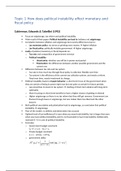
Cukierman, Edwards & Tabellini (1992)
Focus on seigniorage, tax reform and political instability
Main result of their paper: Political instability can lead to (reliance on) seigniorage
Correlation between inflation and seigniorage but country differences due to:
o Lax monetary policy: no stress on printing more money higher inflation
o Lax fiscal policy: politically instable government higher seigniorage
Laxity of policies (monetary or fiscal) depends on:
o Tax rate and composition of government revenue
o Political instability
Uncertainty: whether you will be in power next period
Polarization: the differences between another possible government and the
current one
Difference between tax rate and tax system
o Tax rate is how much tax through fiscal policy is collected. Flexible over time
o Tax system is the efficiency of the current tax collection system, and needs a reform.
Fixed over time, needs investment to change.
Political instability leads to myopic behavior: a short-term focus of the government when
they are certain of being in power right now but not quite as certain for future periods.
o Less incentives to invest in tax system clashing of short-term desires with long-term
optimality
o More focusing on short-term benefits to have a higher chance of getting re-elected
o Higher seigniorage so there is no tax reform but they still get revenue. Government can
finance through taxes or seigniorage, but one makes them less liked and the other
doesn’t.
Both political uncertainty and polarization lead to seigniorage, so conclusion that political
instability seigniorage
Flaw of the model: no deficits and debts taken into account
Optimal level of tax inefficiency θ is zero when you want total stability, but is larger than zero
when you have political instability and it is not favorable to have total stability. Deliberately
maintain θ > 0 in case of political instability
Formulas:
o Government budget constraint
Gt + Ft ≤ τt (1 – θt-1) + st
o Private budget constraint
C ≤ 1 – (1+δ)τt – (1+ϓ)st
o government utility
1
H L ( g , f )=
( α ( 1−α ) )
min [ αg , ( 1−α ) f ]
, Edwards & Tabellini
no optimal level of inflation
seigniorage is a residual source of revenue: it doesn’t go down when tax rate goes up, but it
does go up when the spending goes up or tax rate goes down.
Inflation is determined by political factors political instability
Budget deficits are also caused by political instability
Roubini
Budget deficit is caused by political factors, but also by seigniorage (unlike E&T’s findings)
The higher the seigniorage, the higher inflation and thus the higher nominal interest
payments. Therefore there is a positive correlation between deficit and seigniorage.
Teunisse (2014)
Without IMF involvement, there is no tradeoff between debt and seigniorage
When the IMF gets involved, there is negative correlation between debt and seigniorage.
Bohn, 2019a
Critique on C,E &T: higher political instability leads to more seigniorage but also more debt,
so is there maybe a relation between debt and seigniorage.
Main result of this paper: on its own, there is no monetary/fiscal policy tradeoff no
tradeoff between debt or seigniorage respectively. When the IMF gets involved however,
there is a trade-off.
Notices the contradictions between E&T and Roubini on the one hand (positive correlation
between seigniorage and deficit) and Teunisse on the other hand (negative correlation
between seigniorage and debt).
1 – ρβ(1+r) > 0 three different factors: discount rate, chance of being in power and
interest payments.
Political instability leads to lower levels of seigniorage and higher levels of IMF debt if
there is IMF conditionality. If not, political instability leads to higher levels of debt but not to
lower levels of seigniorage.
When debt conditionality is based on fiscal stability, S goes up. When debt conditionality is
based on monetary stability, S goes down so deficit can go up.
Debt conditionality on monetary stability is more effective under increased political stability,
because it makes deficit more attractive and you want to have even less seigniorage to get
more deficit.
Formulas:
o Government preferences in a two-period, three-period model
W = V1(C1) + H1(G1 , F1) + E{ ρ(V2 (C2) + H2(G2 , F2))}
fiscal policy
Cukierman, Edwards & Tabellini (1992)
Focus on seigniorage, tax reform and political instability
Main result of their paper: Political instability can lead to (reliance on) seigniorage
Correlation between inflation and seigniorage but country differences due to:
o Lax monetary policy: no stress on printing more money higher inflation
o Lax fiscal policy: politically instable government higher seigniorage
Laxity of policies (monetary or fiscal) depends on:
o Tax rate and composition of government revenue
o Political instability
Uncertainty: whether you will be in power next period
Polarization: the differences between another possible government and the
current one
Difference between tax rate and tax system
o Tax rate is how much tax through fiscal policy is collected. Flexible over time
o Tax system is the efficiency of the current tax collection system, and needs a reform.
Fixed over time, needs investment to change.
Political instability leads to myopic behavior: a short-term focus of the government when
they are certain of being in power right now but not quite as certain for future periods.
o Less incentives to invest in tax system clashing of short-term desires with long-term
optimality
o More focusing on short-term benefits to have a higher chance of getting re-elected
o Higher seigniorage so there is no tax reform but they still get revenue. Government can
finance through taxes or seigniorage, but one makes them less liked and the other
doesn’t.
Both political uncertainty and polarization lead to seigniorage, so conclusion that political
instability seigniorage
Flaw of the model: no deficits and debts taken into account
Optimal level of tax inefficiency θ is zero when you want total stability, but is larger than zero
when you have political instability and it is not favorable to have total stability. Deliberately
maintain θ > 0 in case of political instability
Formulas:
o Government budget constraint
Gt + Ft ≤ τt (1 – θt-1) + st
o Private budget constraint
C ≤ 1 – (1+δ)τt – (1+ϓ)st
o government utility
1
H L ( g , f )=
( α ( 1−α ) )
min [ αg , ( 1−α ) f ]
, Edwards & Tabellini
no optimal level of inflation
seigniorage is a residual source of revenue: it doesn’t go down when tax rate goes up, but it
does go up when the spending goes up or tax rate goes down.
Inflation is determined by political factors political instability
Budget deficits are also caused by political instability
Roubini
Budget deficit is caused by political factors, but also by seigniorage (unlike E&T’s findings)
The higher the seigniorage, the higher inflation and thus the higher nominal interest
payments. Therefore there is a positive correlation between deficit and seigniorage.
Teunisse (2014)
Without IMF involvement, there is no tradeoff between debt and seigniorage
When the IMF gets involved, there is negative correlation between debt and seigniorage.
Bohn, 2019a
Critique on C,E &T: higher political instability leads to more seigniorage but also more debt,
so is there maybe a relation between debt and seigniorage.
Main result of this paper: on its own, there is no monetary/fiscal policy tradeoff no
tradeoff between debt or seigniorage respectively. When the IMF gets involved however,
there is a trade-off.
Notices the contradictions between E&T and Roubini on the one hand (positive correlation
between seigniorage and deficit) and Teunisse on the other hand (negative correlation
between seigniorage and debt).
1 – ρβ(1+r) > 0 three different factors: discount rate, chance of being in power and
interest payments.
Political instability leads to lower levels of seigniorage and higher levels of IMF debt if
there is IMF conditionality. If not, political instability leads to higher levels of debt but not to
lower levels of seigniorage.
When debt conditionality is based on fiscal stability, S goes up. When debt conditionality is
based on monetary stability, S goes down so deficit can go up.
Debt conditionality on monetary stability is more effective under increased political stability,
because it makes deficit more attractive and you want to have even less seigniorage to get
more deficit.
Formulas:
o Government preferences in a two-period, three-period model
W = V1(C1) + H1(G1 , F1) + E{ ρ(V2 (C2) + H2(G2 , F2))}