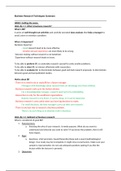
Business Research Techniques Summary
WEEK 1 Setting the scene.
Web clip 1.1. What is business research?
What is BR?
A series of well-thought-out activities and carefully executed data analyses that help a manager to
avoid, solve or minimize a problem.
Why is it important?
Decisions based on:
- Good research tend to be more effective
- Intuition or past experience are more likely to be wrong
*Decision making without research is not beneficial.
*Experience without research leads to losses.
To be able to perform BR, to undertake research yourself to solve smaller problems.
To be able to steer BR, to interact effectively with researchers.
To be able to evaluate BR, to discriminate between good and bad research proposals, to discriminate
between good and bad published studies.
Myths about BR
- There is no need to do or study BR for a future manager.
Managers with knowledge about research have an advantage over those without.
- Business research ends up in the bottom drawer.
For a knowledgeable manager, research need not to be intimidating.
- Researchers is only for the wealthiest organizations.
Busines research is very divers, it can be cheap, or it can be expensive.
- Business research is only useful when you have big decisions to make.
For small decisions, the best managers carry out their own research.
- There is one best way to research a business problem.
There is no such thing as an absolute truth in business.
Web clip 1.2. Hallmark of business research.
What is considered of good BR?
1. Purposiveness
a. Knowing the why of your research. It needs purpose. What do you want to
understand and what do you want to solve? If you know the problem, then it will
have impact.
2. Rigor
a. Exactness, strict precision. Sound theoretical base and a sound methodological
design. Your study may be incomplete. It might miss crucial factors. Make sure your
sample is representative. Do not ask unbiased questions (asking if you like the
lecture while the lecturer is present).
3. Objectivity
, a. Draw conclusions based on facts, not on subjective ideas or opinions. Leave out
details, numbers or facts to change the result to your liking or your idea.
4. Parsimony
a. Shaving away unnecessary details. Explain a lot with a little. Select as many as
possible or select a few. It will become overcomplicated and hard to manage. Be able
to pick out the most meaningful variables and most important factors.
5. Replicability
a. Finding the same results if the research is repeated in similar circumstances
(herhaalbaarheid). Carry out the same steps and arrive at the same results every
time. More evidence to test your theory. You should describe in great detail how you
did your research. You’ll allow others to replicate your study, so they get the same
results. Be transparent.
6. Generalizability
a. Being able to the research findings in a wide variety of different settings.
Make a distinction between two types of research:
i. Applied research:
1. To solve a current problem faced by a manager, applies to a specific
company, is done within firms or research agencies.
ii. Fundamental research:
1. To generate new knowledge about how problems that occur in
several firms can be solved, applies to several organizational settings,
is done mainly within universities and knowledge institutes.
Generalizability should hold for fundamental research (being able to use it for
different companies) but much less do for applied research.
Web clip 1.3. 7. step plan for inductive and deductive research.
How to structure your research?
1. Inductive research
- Starting with data
- Developing a theory from that data (building theory)
2. Deductive research
- Starting with theory
- You have data and observation to confirm a theory (testing a theory)
Inductive research: From the bottom up
1. You start with observations, data
2. You try to find a pattern
3. You formulate tentative hypothesis
4. You start to build a theory
Deductive research: From the top down
1. you start with a theory
2. You formulate tentative hypothesis (expectations
3. You gather your data, collect observations
4. Confirm the theory
,7 steps deductive research process:
Theory to Data
1. Define the business problem
2. Formulate the problem statement
3. Develop a theoretical framework
4. Choose a research design
5. Collect data
a. Collect data within that research design
6. Analyze data
7. Write-up
a. Conclusion of your study. The part where you confirm existing theory
7 steps inductive research process:
Data to theory
1. Define the business problem
2. Formulate the problem statement
3. Provide a conceptual background
4. Choose a research design
5. Collect data
6. Analyze data
7. Develop theory
WEEK 2 The research process.
Web clip 2.1. An introduction to business problems.
Deductive research process (quantitative)
Inductive research process (qualitative)
Step 1. Define the business problem.
A business problem: The gap between the actual state (current situation) and the desired state
(desired situation).
2 types of business problems:
1. The actual status is seriously wrong and needs to be solved asap
AH boycotts Unilever’s products
2. The current situation is not seriously wrong, but it can be made better
Pfizer may increase profits by having its sales reps approach doctors
differently.
2. What makes a good business problem?
Feasibility
o The business problem should not be impossible to research and should be doable.
The business problem is demarcated
Should be able to express the problem in variable
Should be able to gather the required data
Existing data (data the company owns/purchase)
, New data (experiments, surveys, interviews)
o Example of an infeasible problem:
ABN AMRO would like to know how to increase its profitability
Way too big, cannot be expressed in variables, no variables = no
data.
o Example of a feasible problem:
Pfizer would like to know whether soft-selling new drugs to doctors leads to
more descriptions than hard-selling.
Relevance
o It is worthwhile to solve. It should matter and be important.
It should be managerial relevant
Managers (brand, supply chain, accountants etc.) benefit from
having the problem solved
o Of one company
o Of one industry
o Of multiple industries
End users (consumers, investors, taxpayers etc.)
Public policy makers (government, EU etc.)
Should be academically relevant
Completely new topic.
o No research available at all, although the topic is important.
New context
o Prior research is available but not in the same context.
Integrate scattered research
Reconcile contradictory research
o Solve the contradictions through introducing one or more
moderators
Web clip 2.2. Formulating a problem statement and research questions.
Deductive research process (quantitative)
Inductive research process (qualitative)
Step 2. Formulate the problem statement.
1. What makes a good problem statement?
Manager-focused business problem Research-focused problem statement
You can do that with preliminary research
- Background information on the organization/context
- Background information on the topic that you’re focusing on (extant
literature)
Formulated in terms of:
o Variables, and
o Relations (increase, decrease, dependability)
Open-ended question
WEEK 1 Setting the scene.
Web clip 1.1. What is business research?
What is BR?
A series of well-thought-out activities and carefully executed data analyses that help a manager to
avoid, solve or minimize a problem.
Why is it important?
Decisions based on:
- Good research tend to be more effective
- Intuition or past experience are more likely to be wrong
*Decision making without research is not beneficial.
*Experience without research leads to losses.
To be able to perform BR, to undertake research yourself to solve smaller problems.
To be able to steer BR, to interact effectively with researchers.
To be able to evaluate BR, to discriminate between good and bad research proposals, to discriminate
between good and bad published studies.
Myths about BR
- There is no need to do or study BR for a future manager.
Managers with knowledge about research have an advantage over those without.
- Business research ends up in the bottom drawer.
For a knowledgeable manager, research need not to be intimidating.
- Researchers is only for the wealthiest organizations.
Busines research is very divers, it can be cheap, or it can be expensive.
- Business research is only useful when you have big decisions to make.
For small decisions, the best managers carry out their own research.
- There is one best way to research a business problem.
There is no such thing as an absolute truth in business.
Web clip 1.2. Hallmark of business research.
What is considered of good BR?
1. Purposiveness
a. Knowing the why of your research. It needs purpose. What do you want to
understand and what do you want to solve? If you know the problem, then it will
have impact.
2. Rigor
a. Exactness, strict precision. Sound theoretical base and a sound methodological
design. Your study may be incomplete. It might miss crucial factors. Make sure your
sample is representative. Do not ask unbiased questions (asking if you like the
lecture while the lecturer is present).
3. Objectivity
, a. Draw conclusions based on facts, not on subjective ideas or opinions. Leave out
details, numbers or facts to change the result to your liking or your idea.
4. Parsimony
a. Shaving away unnecessary details. Explain a lot with a little. Select as many as
possible or select a few. It will become overcomplicated and hard to manage. Be able
to pick out the most meaningful variables and most important factors.
5. Replicability
a. Finding the same results if the research is repeated in similar circumstances
(herhaalbaarheid). Carry out the same steps and arrive at the same results every
time. More evidence to test your theory. You should describe in great detail how you
did your research. You’ll allow others to replicate your study, so they get the same
results. Be transparent.
6. Generalizability
a. Being able to the research findings in a wide variety of different settings.
Make a distinction between two types of research:
i. Applied research:
1. To solve a current problem faced by a manager, applies to a specific
company, is done within firms or research agencies.
ii. Fundamental research:
1. To generate new knowledge about how problems that occur in
several firms can be solved, applies to several organizational settings,
is done mainly within universities and knowledge institutes.
Generalizability should hold for fundamental research (being able to use it for
different companies) but much less do for applied research.
Web clip 1.3. 7. step plan for inductive and deductive research.
How to structure your research?
1. Inductive research
- Starting with data
- Developing a theory from that data (building theory)
2. Deductive research
- Starting with theory
- You have data and observation to confirm a theory (testing a theory)
Inductive research: From the bottom up
1. You start with observations, data
2. You try to find a pattern
3. You formulate tentative hypothesis
4. You start to build a theory
Deductive research: From the top down
1. you start with a theory
2. You formulate tentative hypothesis (expectations
3. You gather your data, collect observations
4. Confirm the theory
,7 steps deductive research process:
Theory to Data
1. Define the business problem
2. Formulate the problem statement
3. Develop a theoretical framework
4. Choose a research design
5. Collect data
a. Collect data within that research design
6. Analyze data
7. Write-up
a. Conclusion of your study. The part where you confirm existing theory
7 steps inductive research process:
Data to theory
1. Define the business problem
2. Formulate the problem statement
3. Provide a conceptual background
4. Choose a research design
5. Collect data
6. Analyze data
7. Develop theory
WEEK 2 The research process.
Web clip 2.1. An introduction to business problems.
Deductive research process (quantitative)
Inductive research process (qualitative)
Step 1. Define the business problem.
A business problem: The gap between the actual state (current situation) and the desired state
(desired situation).
2 types of business problems:
1. The actual status is seriously wrong and needs to be solved asap
AH boycotts Unilever’s products
2. The current situation is not seriously wrong, but it can be made better
Pfizer may increase profits by having its sales reps approach doctors
differently.
2. What makes a good business problem?
Feasibility
o The business problem should not be impossible to research and should be doable.
The business problem is demarcated
Should be able to express the problem in variable
Should be able to gather the required data
Existing data (data the company owns/purchase)
, New data (experiments, surveys, interviews)
o Example of an infeasible problem:
ABN AMRO would like to know how to increase its profitability
Way too big, cannot be expressed in variables, no variables = no
data.
o Example of a feasible problem:
Pfizer would like to know whether soft-selling new drugs to doctors leads to
more descriptions than hard-selling.
Relevance
o It is worthwhile to solve. It should matter and be important.
It should be managerial relevant
Managers (brand, supply chain, accountants etc.) benefit from
having the problem solved
o Of one company
o Of one industry
o Of multiple industries
End users (consumers, investors, taxpayers etc.)
Public policy makers (government, EU etc.)
Should be academically relevant
Completely new topic.
o No research available at all, although the topic is important.
New context
o Prior research is available but not in the same context.
Integrate scattered research
Reconcile contradictory research
o Solve the contradictions through introducing one or more
moderators
Web clip 2.2. Formulating a problem statement and research questions.
Deductive research process (quantitative)
Inductive research process (qualitative)
Step 2. Formulate the problem statement.
1. What makes a good problem statement?
Manager-focused business problem Research-focused problem statement
You can do that with preliminary research
- Background information on the organization/context
- Background information on the topic that you’re focusing on (extant
literature)
Formulated in terms of:
o Variables, and
o Relations (increase, decrease, dependability)
Open-ended question