Please check the examination details below before entering your candidate information
Candidate surname Other names
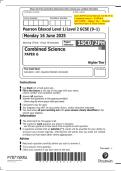
June 2025 Pearson Edexcel: GCSE (9–1)
Centre Number Candidate Number Combined Science – PAPER 6
(ISCO/2PH) – Higher Tier – Merged
Question Paper & Mark Scheme
Pearson Edexcel Level 1/Level 2 GCSE (9–1)
Monday 16 June 2025
Morning (Time: 1 hour 10 minutes) Paper
reference 1SC0/2PH
Combined Science 🟐 🟐
PAPER 6
Higher Tier
You must have: Total Marks
Calculator, ruler, Equation Booklet (enclosed)
Instructions
•• Use black ink or ball-point pen.
Fill in the boxes at the top of this page with your name,
centre number and candidate number.
•• Answer all questions.
Answer the questions in the spaces provided
– there may be more space than you need.
• Calculators
•• You must showmay
may be used.
Any diagrams NOT be accurately drawn, unless otherwise indicated.
all your working out with your answer clearly identified at the
end of your solution.
Information
•• The total mark for this paper is 60.
The marks for each question are shown in brackets
• Instructure
– use this as a guide as to how much time to spend on each question.
questions marked with an asterisk (*), marks will be awarded for your ability to
your answer logically, showing how the points that you make are related
or follow on from each other where appropriate.
Advice
• Read each question carefully before you start to answer it.
• Try
• Check your answers if you have time at the end.
to answer every question.
Turn over
P78715RRA
©2025 Pearson Education Ltd.
Y:1/1/1/1/1/1/1
, Answer ALL questions. Write your answers in the spaces provided.
Some questions must be answered with a cross in one of the four boxes . If you change your
DO NOT WRITE IN THIS AREA
mind about an answer, put a line through the box and then mark your new answer with
a cross .
1 (a) A student places a trolley at the top of a runway, as shown in Figure 1.
trolley
light gate
timer
runway 00:00:00
Figure 1
DO NOT WRITE IN THIS AREA
The student had to lift the trolley through a height of 26 cm to put it at the top of
the runway.
The gravitational potential energy, ΔGPE, of the trolley increases by 4.1 J when
lifted to the top of the runway.
The gravitational field strength, g, = 10 N / kg.
(i) Show that the mass of the trolley is about 1.6 kg.
Use the equation
ΔGPE
m
g Δh
(2)
DO NOT WRITE IN THIS AREA
2
■■■■
, (ii) The student releases the trolley and the trolley moves down the runway.
The student assumes that all the extra gravitational potential energy, ∆GPE,
DO NOT WRITE IN THIS AREA
stored at the top of the runway is transferred to kinetic energy at the end of
the runway.
Calculate the expected value of the velocity of the trolley at the end of
the runway.
Use the equation
2 GPE
v2
m
(3)
DO NOT WRITE IN THIS AREA
expected velocity =........................... m / s
(iii) The light gate, shown in Figure 1, is used to determine the actual velocity of
the trolley at the end of the runway.
The actual velocity at the end of the runway is less than the expected velocity
as calculated in (ii).
Suggest one way to reduce the difference between the actual velocity and
the expected velocity.
(1)
. . . .. . .. . .. . .. . .. . .. . .. . .. . .. . .. . .. . .. . .. . .. . .. . .. . . . . .. . .. . .. . .. . .. .. . . .. . .. . .. . .. . .. . .. . .. . .. . .. . .. . .. . .. . .. . .. . .. . .. . .. . .. . . .. . .. .. . . .. . .. . .. . .. . .. . .. . .. . .. . .. . .. . .. . .. . .. . .. . .. . .. . .. . .. . .. . .. . .. . .. .. . . .. . .. . .. . .. . .. . .. . .. . .. . .. . .. . .. . .. . .. . .. . .. . .. . . ......................
. . . .. . .. . .. . .. . .. . .. . .. . .. . .. . .. . .. . .. . .. . .. . .. . .. . .. . .. . .. . .. . .. . .. .. . . .. . .. . .. . .. . .. . .. . .. . .. . .. . .. . .. . .. . .. . .. . .. . .. . .. . .. . . .. . .. .. . . .. . .. . .. . .. . .. . .. . .. . .. . .. . .. . .. . .. . .. . .. . .. . .. . .. . .. . .. . .. . .. . .. .. . . .. . .. . .. . .. . .. . .. . .. . .. . .. . .. . .. . .. . .. . .. . . . . .. . . ......................
DO NOT WRITE IN THIS AREA
3
■■■■ Turn over
, (b) A different student finds out how much power can be generated by running up
some stairs in a measured amount of time.
DO NOT WRITE IN THIS AREA
The following quantities are measured:
mass of student = 48 kg
total height of stairs = 2.9 m
time to run up stairs = 3.4 s
Calculate the power the student generated.
Give the answer to 2 significant figures (2 s.f.).
Use the equation
weight of student height of stairs
power =
time to run up stairs
(3)
DO NOT WRITE IN THIS AREA
power =........................... W
(Total for Question 1 = 9 marks)
DO NOT WRITE IN THIS AREA
4
■■■■
Candidate surname Other names
June 2025 Pearson Edexcel: GCSE (9–1)
Centre Number Candidate Number Combined Science – PAPER 6
(ISCO/2PH) – Higher Tier – Merged
Question Paper & Mark Scheme
Pearson Edexcel Level 1/Level 2 GCSE (9–1)
Monday 16 June 2025
Morning (Time: 1 hour 10 minutes) Paper
reference 1SC0/2PH
Combined Science 🟐 🟐
PAPER 6
Higher Tier
You must have: Total Marks
Calculator, ruler, Equation Booklet (enclosed)
Instructions
•• Use black ink or ball-point pen.
Fill in the boxes at the top of this page with your name,
centre number and candidate number.
•• Answer all questions.
Answer the questions in the spaces provided
– there may be more space than you need.
• Calculators
•• You must showmay
may be used.
Any diagrams NOT be accurately drawn, unless otherwise indicated.
all your working out with your answer clearly identified at the
end of your solution.
Information
•• The total mark for this paper is 60.
The marks for each question are shown in brackets
• Instructure
– use this as a guide as to how much time to spend on each question.
questions marked with an asterisk (*), marks will be awarded for your ability to
your answer logically, showing how the points that you make are related
or follow on from each other where appropriate.
Advice
• Read each question carefully before you start to answer it.
• Try
• Check your answers if you have time at the end.
to answer every question.
Turn over
P78715RRA
©2025 Pearson Education Ltd.
Y:1/1/1/1/1/1/1
, Answer ALL questions. Write your answers in the spaces provided.
Some questions must be answered with a cross in one of the four boxes . If you change your
DO NOT WRITE IN THIS AREA
mind about an answer, put a line through the box and then mark your new answer with
a cross .
1 (a) A student places a trolley at the top of a runway, as shown in Figure 1.
trolley
light gate
timer
runway 00:00:00
Figure 1
DO NOT WRITE IN THIS AREA
The student had to lift the trolley through a height of 26 cm to put it at the top of
the runway.
The gravitational potential energy, ΔGPE, of the trolley increases by 4.1 J when
lifted to the top of the runway.
The gravitational field strength, g, = 10 N / kg.
(i) Show that the mass of the trolley is about 1.6 kg.
Use the equation
ΔGPE
m
g Δh
(2)
DO NOT WRITE IN THIS AREA
2
■■■■
, (ii) The student releases the trolley and the trolley moves down the runway.
The student assumes that all the extra gravitational potential energy, ∆GPE,
DO NOT WRITE IN THIS AREA
stored at the top of the runway is transferred to kinetic energy at the end of
the runway.
Calculate the expected value of the velocity of the trolley at the end of
the runway.
Use the equation
2 GPE
v2
m
(3)
DO NOT WRITE IN THIS AREA
expected velocity =........................... m / s
(iii) The light gate, shown in Figure 1, is used to determine the actual velocity of
the trolley at the end of the runway.
The actual velocity at the end of the runway is less than the expected velocity
as calculated in (ii).
Suggest one way to reduce the difference between the actual velocity and
the expected velocity.
(1)
. . . .. . .. . .. . .. . .. . .. . .. . .. . .. . .. . .. . .. . .. . .. . .. . .. . . . . .. . .. . .. . .. . .. .. . . .. . .. . .. . .. . .. . .. . .. . .. . .. . .. . .. . .. . .. . .. . .. . .. . .. . .. . . .. . .. .. . . .. . .. . .. . .. . .. . .. . .. . .. . .. . .. . .. . .. . .. . .. . .. . .. . .. . .. . .. . .. . .. . .. .. . . .. . .. . .. . .. . .. . .. . .. . .. . .. . .. . .. . .. . .. . .. . .. . .. . . ......................
. . . .. . .. . .. . .. . .. . .. . .. . .. . .. . .. . .. . .. . .. . .. . .. . .. . .. . .. . .. . .. . .. . .. .. . . .. . .. . .. . .. . .. . .. . .. . .. . .. . .. . .. . .. . .. . .. . .. . .. . .. . .. . . .. . .. .. . . .. . .. . .. . .. . .. . .. . .. . .. . .. . .. . .. . .. . .. . .. . .. . .. . .. . .. . .. . .. . .. . .. .. . . .. . .. . .. . .. . .. . .. . .. . .. . .. . .. . .. . .. . .. . .. . . . . .. . . ......................
DO NOT WRITE IN THIS AREA
3
■■■■ Turn over
, (b) A different student finds out how much power can be generated by running up
some stairs in a measured amount of time.
DO NOT WRITE IN THIS AREA
The following quantities are measured:
mass of student = 48 kg
total height of stairs = 2.9 m
time to run up stairs = 3.4 s
Calculate the power the student generated.
Give the answer to 2 significant figures (2 s.f.).
Use the equation
weight of student height of stairs
power =
time to run up stairs
(3)
DO NOT WRITE IN THIS AREA
power =........................... W
(Total for Question 1 = 9 marks)
DO NOT WRITE IN THIS AREA
4
■■■■