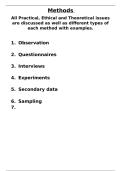
Methods
All Practical, Ethical and Theoretical issues
are discussed as well as different types of
each method with examples.
1. Observation
2. Questionnaires
3. Interviews
4. Experiments
5. Secondary data
6. Sampling
7.
, Observations
Observations are a qualitative data source that involves the
researcher watching (and sometimes participating in) the
behaviour of individuals or groups. Interpretivists often
favour observations for the rich, qualitative data they provide
that gives an insight into the experiences of those being
observed. In respect of the topic of…
Non-participant observation: The researcher observes
the group or event without participating. They may use a
two-way mirror for this.
Participant observation: the researcher takes part in an
event or the everyday life of the group while observing.
Overt observation, the researcher makes the identity and
purpose known to those being studied. They're open about
what they're doing.
Covert observation: studies carried out undercover call
mother researchers' identity and purpose are kept
concealed from the group being studied. The researcher
takes on a false identity and role, often posing as a real
member of the group.
Examples:
Covert Participant Observation – Macintyre and Chelsea
Headhunters
The study on the Chelsea Headhunters aimed to understand
football hooliganism.
- To gain access, he had to stalk the leader, move houses,
and get a tattoo to blend in and had to learn everything
about Chelsea to seem like a hooligan.
- The study was unethical as Macintyre deceived participants
by not gaining consent and covertly observing them. He
also provided evidence to the police, leading to the arrest of
the group leader, raising concerns about confidentiality and
potential harm.
,1. Structured Observation
Involves watching social behaviour using a pre-set list of
categories or coding schedule. The researcher systematically
records specific actions, often turning them into numerical data.
This method is preferred by positivist sociologists, who aim to
study society using objective, scientific approaches. They value
structured observation because it produces reliable,
replicable data that can be easily compared and statistically
analysed, helping to identify patterns and trends.
Practical Benefits:
Quick and cost-effective: Structured observation is often
faster to carry out and requires less
training/characteristics than unstructured. Researchers
simply follow a predefined schedule, which makes it easier
to manage resources and time effectively.
Ease of replication: The standardised categories in
structured observation allow for easy replication of the
study, making it possible for other researchers to replicate
and compare results.
Quantifiable data: Structured observation produces
numerical data, which is straightforward to analyse and
compare. This allows for clear patterns and trends to
emerge.
Practical Limitations:
Limited data capture: Structured observation relies on
predefined categories, it may overlook other significant
behaviours or actions not anticipated by the researcher,
limiting the richness of the data collected + failing to
capture the full range of social behaviours.
Lack of flexibility: Researchers are restricted by the
categories in the observation schedule and cannot adapt to
emerging or unforeseen events. This lack of adaptability can
lead to missed opportunities for deeper insight.
, Potential researcher bias: Predefined categories are
shaped by the researcher's assumptions and may
unintentionally focus on certain behaviours while neglecting
others, leading to biased data collection.
Ethical Benefits:
Informed consent: As structured observation is typically
overt, participants are usually aware that they are being
observed. This ensures informed consent is obtained,
respecting the autonomy of those being studied.
No deceit involved: Since participants are aware of the
observation, there is no risk of deceiving them or invading
their privacy, as would be the case with covert observation.
Ethical Limitations:
Privacy concerns: Even with overt observation,
participants may still feel uncomfortable being observed.
This discomfort may lead to behaviour alteration or
reluctance to fully express themselves.
Potential harm to participants: In certain settings,
especially with vulnerable populations, being observed
could cause distress or embarrassment, particularly if the
observation involves sensitive topics or environments.
Theoretical Benefits (Positivists):
Reliability and objectivity: The structured approach to
observation ensures that the data is reliable, standardized,
and objective, aligning with positivist principles that
emphasize scientific measurement and replication.
Easier generalization: With clear, structured data, it is
easier for researchers to generalize findings to larger
All Practical, Ethical and Theoretical issues
are discussed as well as different types of
each method with examples.
1. Observation
2. Questionnaires
3. Interviews
4. Experiments
5. Secondary data
6. Sampling
7.
, Observations
Observations are a qualitative data source that involves the
researcher watching (and sometimes participating in) the
behaviour of individuals or groups. Interpretivists often
favour observations for the rich, qualitative data they provide
that gives an insight into the experiences of those being
observed. In respect of the topic of…
Non-participant observation: The researcher observes
the group or event without participating. They may use a
two-way mirror for this.
Participant observation: the researcher takes part in an
event or the everyday life of the group while observing.
Overt observation, the researcher makes the identity and
purpose known to those being studied. They're open about
what they're doing.
Covert observation: studies carried out undercover call
mother researchers' identity and purpose are kept
concealed from the group being studied. The researcher
takes on a false identity and role, often posing as a real
member of the group.
Examples:
Covert Participant Observation – Macintyre and Chelsea
Headhunters
The study on the Chelsea Headhunters aimed to understand
football hooliganism.
- To gain access, he had to stalk the leader, move houses,
and get a tattoo to blend in and had to learn everything
about Chelsea to seem like a hooligan.
- The study was unethical as Macintyre deceived participants
by not gaining consent and covertly observing them. He
also provided evidence to the police, leading to the arrest of
the group leader, raising concerns about confidentiality and
potential harm.
,1. Structured Observation
Involves watching social behaviour using a pre-set list of
categories or coding schedule. The researcher systematically
records specific actions, often turning them into numerical data.
This method is preferred by positivist sociologists, who aim to
study society using objective, scientific approaches. They value
structured observation because it produces reliable,
replicable data that can be easily compared and statistically
analysed, helping to identify patterns and trends.
Practical Benefits:
Quick and cost-effective: Structured observation is often
faster to carry out and requires less
training/characteristics than unstructured. Researchers
simply follow a predefined schedule, which makes it easier
to manage resources and time effectively.
Ease of replication: The standardised categories in
structured observation allow for easy replication of the
study, making it possible for other researchers to replicate
and compare results.
Quantifiable data: Structured observation produces
numerical data, which is straightforward to analyse and
compare. This allows for clear patterns and trends to
emerge.
Practical Limitations:
Limited data capture: Structured observation relies on
predefined categories, it may overlook other significant
behaviours or actions not anticipated by the researcher,
limiting the richness of the data collected + failing to
capture the full range of social behaviours.
Lack of flexibility: Researchers are restricted by the
categories in the observation schedule and cannot adapt to
emerging or unforeseen events. This lack of adaptability can
lead to missed opportunities for deeper insight.
, Potential researcher bias: Predefined categories are
shaped by the researcher's assumptions and may
unintentionally focus on certain behaviours while neglecting
others, leading to biased data collection.
Ethical Benefits:
Informed consent: As structured observation is typically
overt, participants are usually aware that they are being
observed. This ensures informed consent is obtained,
respecting the autonomy of those being studied.
No deceit involved: Since participants are aware of the
observation, there is no risk of deceiving them or invading
their privacy, as would be the case with covert observation.
Ethical Limitations:
Privacy concerns: Even with overt observation,
participants may still feel uncomfortable being observed.
This discomfort may lead to behaviour alteration or
reluctance to fully express themselves.
Potential harm to participants: In certain settings,
especially with vulnerable populations, being observed
could cause distress or embarrassment, particularly if the
observation involves sensitive topics or environments.
Theoretical Benefits (Positivists):
Reliability and objectivity: The structured approach to
observation ensures that the data is reliable, standardized,
and objective, aligning with positivist principles that
emphasize scientific measurement and replication.
Easier generalization: With clear, structured data, it is
easier for researchers to generalize findings to larger