Education
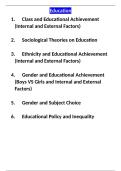
1. Class and Educational Achievement
(Internal and External Factors)
2. Sociological Theories on Education
3. Ethnicity and Educational Achievement
(Internal and External Factors)
4. Gender and Educational Achievement
(Boys VS Girls and Internal and External
Factors)
5. Gender and Subject Choice
6. Educational Policy and Inequality
, Class and Educational Achievement
o Social class and educational achievement (internal)
o Social class and educational achievement (external)
- Cultural deprivation
- Material deprivation
- Subcultures
- Cultural Capital (Marxist view)
Keywords:
Free School Meals (FSM) – An indicator used to identify low-income pupils.
Those on FSM are statistically more likely to underachieve in education due to
poverty, poor diet, or stigma.
Social Mobility – Refers to movement between social classes. Working-class
pupils are less likely to move up the social ladder through education due to
various barriers.
Social Disadvantage – Lacking economic, cultural, or social resources needed for
success in education. Leads to underachievement, particularly among the
working class.
Polarisation – The division between high and low achievers (often mirroring
class lines), showing how class inequalities manifest within schools.
Low-Class Subcultures – Working-class groups that develop values and norms in
opposition to school expectations, such as rejecting authority and academic
success.
Cultural Deprivation – The theory that working-class pupils fail because they
lack the right values, language, and behaviours needed to succeed in education.
Material Deprivation – Lack of physical necessities like housing, nutrition, or
educational resources, which negatively affect a pupil’s performance in school.
Fatalism – A belief that success is determined by fate, not effort. Common in
working-class culture and can lead to a lack of motivation in school.
Collectivism – Prioritising the needs of the group over the individual. Can lead to
working-class pupils rejecting individual academic success.
,Immediate Gratification – Seeking quick rewards rather than long-term goals.
This can reduce the drive to work hard in school for future qualifications.
Present Time Orientation – Focusing on the present rather than the future.
Leads to lower aspiration levels and planning, affecting educational
achievement.
Restricted Code – A form of speech with limited vocabulary and context-based
meaning, often used by working-class pupils. May hinder success in school
assessments.
Elaborated Code – A more formal, complex language structure used in middle-
class homes. Matches school language, giving middle-class pupils an advantage.
Cultural Capital – Knowledge, skills, and behaviours that the middle class
possess and schools value. Helps middle-class pupils succeed more easily.
Sure Start – A government programme aimed at helping children in deprived
areas with early education and parenting support. Cutbacks limited its long-term
impact.
EMA (Education Maintenance Allowance) – A grant given to low-income
students to stay in education post-16. Helped reduce dropout rates but was
scrapped.
Sociologists
Sugarman – Identified four key working-class values (fatalism, collectivism,
immediate gratification, and present time orientation) that hinder achievement.
Bernstein – Argued that working-class students use restricted code, while
middle-class students (and schools) use elaborated code, creating a language
barrier.
Bereiter & Engelmann – Claimed the language of some lower-class and ethnic
minority groups is inadequate for school success due to being ungrammatical or
disorganised.
Feinstein – Found that parental interest in education (more common among the
middle class) has a significant impact on achievement.
, Douglas – Showed that working-class parents place less value on education,
which leads to children having lower aspirations and leaving school earlier.
Willis – Studied 12 working-class boys who formed an anti-school subculture.
Their rejection of school values led them into working-class jobs, reproducing
inequality.
Bourdieu – Argued that middle-class pupils possess cultural capital (language,
values, knowledge) which schools reward, giving them an unfair advantage.
Sullivan – Found that students who read complex fiction or watched
documentaries had more cultural capital and achieved higher in exams.
1. Class and Educational Achievement
(Internal and External Factors)
2. Sociological Theories on Education
3. Ethnicity and Educational Achievement
(Internal and External Factors)
4. Gender and Educational Achievement
(Boys VS Girls and Internal and External
Factors)
5. Gender and Subject Choice
6. Educational Policy and Inequality
, Class and Educational Achievement
o Social class and educational achievement (internal)
o Social class and educational achievement (external)
- Cultural deprivation
- Material deprivation
- Subcultures
- Cultural Capital (Marxist view)
Keywords:
Free School Meals (FSM) – An indicator used to identify low-income pupils.
Those on FSM are statistically more likely to underachieve in education due to
poverty, poor diet, or stigma.
Social Mobility – Refers to movement between social classes. Working-class
pupils are less likely to move up the social ladder through education due to
various barriers.
Social Disadvantage – Lacking economic, cultural, or social resources needed for
success in education. Leads to underachievement, particularly among the
working class.
Polarisation – The division between high and low achievers (often mirroring
class lines), showing how class inequalities manifest within schools.
Low-Class Subcultures – Working-class groups that develop values and norms in
opposition to school expectations, such as rejecting authority and academic
success.
Cultural Deprivation – The theory that working-class pupils fail because they
lack the right values, language, and behaviours needed to succeed in education.
Material Deprivation – Lack of physical necessities like housing, nutrition, or
educational resources, which negatively affect a pupil’s performance in school.
Fatalism – A belief that success is determined by fate, not effort. Common in
working-class culture and can lead to a lack of motivation in school.
Collectivism – Prioritising the needs of the group over the individual. Can lead to
working-class pupils rejecting individual academic success.
,Immediate Gratification – Seeking quick rewards rather than long-term goals.
This can reduce the drive to work hard in school for future qualifications.
Present Time Orientation – Focusing on the present rather than the future.
Leads to lower aspiration levels and planning, affecting educational
achievement.
Restricted Code – A form of speech with limited vocabulary and context-based
meaning, often used by working-class pupils. May hinder success in school
assessments.
Elaborated Code – A more formal, complex language structure used in middle-
class homes. Matches school language, giving middle-class pupils an advantage.
Cultural Capital – Knowledge, skills, and behaviours that the middle class
possess and schools value. Helps middle-class pupils succeed more easily.
Sure Start – A government programme aimed at helping children in deprived
areas with early education and parenting support. Cutbacks limited its long-term
impact.
EMA (Education Maintenance Allowance) – A grant given to low-income
students to stay in education post-16. Helped reduce dropout rates but was
scrapped.
Sociologists
Sugarman – Identified four key working-class values (fatalism, collectivism,
immediate gratification, and present time orientation) that hinder achievement.
Bernstein – Argued that working-class students use restricted code, while
middle-class students (and schools) use elaborated code, creating a language
barrier.
Bereiter & Engelmann – Claimed the language of some lower-class and ethnic
minority groups is inadequate for school success due to being ungrammatical or
disorganised.
Feinstein – Found that parental interest in education (more common among the
middle class) has a significant impact on achievement.
, Douglas – Showed that working-class parents place less value on education,
which leads to children having lower aspirations and leaving school earlier.
Willis – Studied 12 working-class boys who formed an anti-school subculture.
Their rejection of school values led them into working-class jobs, reproducing
inequality.
Bourdieu – Argued that middle-class pupils possess cultural capital (language,
values, knowledge) which schools reward, giving them an unfair advantage.
Sullivan – Found that students who read complex fiction or watched
documentaries had more cultural capital and achieved higher in exams.